Gå direkte til indholdet

A growing product range can make packaging difficult to manage. Too many bag sizes, materials, and specifications can quickly increase purchasing and inventory work.
Packaging standardization does not mean using one identical bag for every product. It means standardizing the material, branding, construction language, and purchasing rules while allowing sizes and other details to change when products require it.
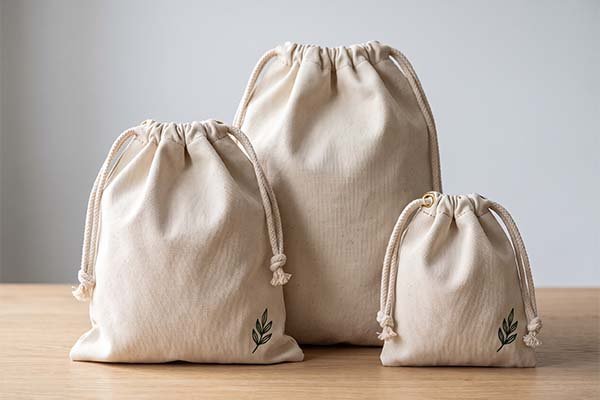
A practical packaging system should make different products look related without forcing every product into the same bag. The goal is to create a small group of approved packaging options that can support the product range today and new products later.
Why Is Packaging Standardization Important for Brands with Multiple Product Lines?
When a brand sells dried herbs, seeds, natural pantry products, small organic products, and seasonal bundles, each product may need a different amount of packaging space. If every product gets its own bag design, the packaging system can become harder to control than the products themselves.
A standardized packaging system helps different products look like they belong to the same brand while reducing unnecessary packaging specifications, purchasing work, and inventory complexity.
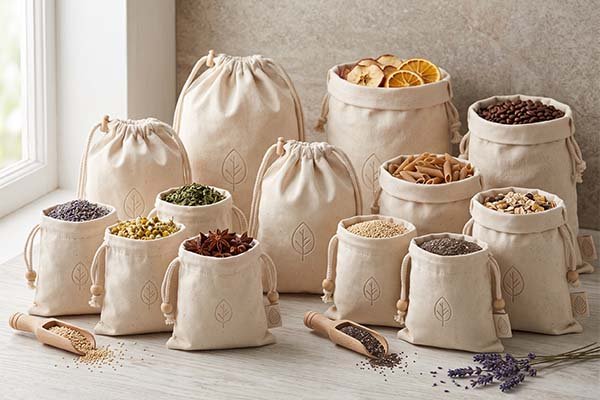
For an Organic & Natural Product Brand, a consistent Canvas material can start with a common Canvas material, a natural base color, one logo treatment, and a simple drawstring construction. A small bag can then be used for seeds, while a medium bag can hold dried herbs. A larger or gusseted bag can support seasonal bundles. The bags do not need identical dimensions to look like one product family.
This approach also avoids developing every bag from scratch. If a brand has separate bags for herbs, seeds, pantry products, and gift bundles, every new product may require another round of material selection, artwork setup, sampling, and specification confirmation. A standard system allows the brand to reuse approved specifications.
The same idea helps supplier communication. A buyer can create a common Brugerdefineret taske standard that defines the material, color, logo, printing style, drawstring, and stitching. The supplier then only needs to adjust product-related details such as size, capacity, or gusset when needed. The purchasing team does not need to rebuild the entire specification for every order.
Inventory is another reason to standardize. A company with 12 product SKUs does not necessarily need 12 bag SKUs. If four or five approved sizes can cover most of the range, the company can reduce slow-moving packaging stock and make replenishment easier.
Standardization also helps when the product range grows. When a new herbal product is launched, the first question can be simple: can an existing approved bag size handle it? If yes, the brand can use an existing packaging solution. A new bag specification only needs to be created when the current system cannot meet the product requirement.
The packaging system becomes a platform rather than a collection of individual bags. That difference matters because the same platform can support future products without forcing the brand to start over.
What Should You Standardize When Developing Custom Packaging Bags?
The easiest way to build a packaging system is to separate fixed brand elements from product-specific elements. The fixed elements create consistency. The variable elements give each product enough room to work properly.
Brands should usually standardize the material, base color, logo treatment, printing style, closure language, and basic packing method, while keeping size and selected structural details flexible according to the product.
Standardize the Material
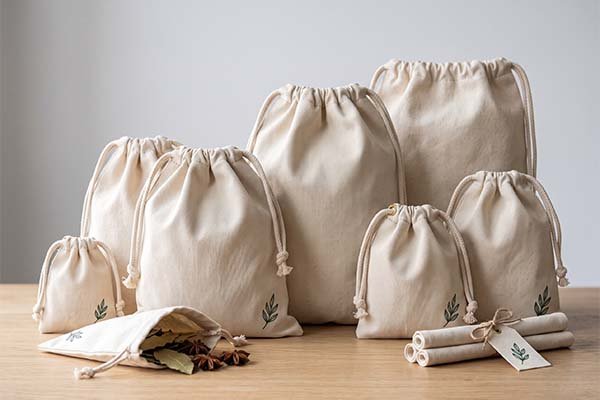
A common material can create a strong connection between different product lines. For an Organic & Natural Product Brand, Canvas can be a practical choice because it is durable, reusable, and suitable for a simple natural brand image.
The purpose is not to use Canvas because every product needs exactly the same material. The purpose is to avoid unnecessary material variation when one approved material can serve several applications.
Keep the Base Color Consistent
Natural Canvas is one simple option for a brand that wants a clean and natural appearance. A brand may also choose black or a custom-dyed color.
The main rule is consistency. If the brand uses natural Canvas for its standard packaging family, changing the base color for every product line can weaken the visual connection between products.
Standardize Logo and Printing
The logo artwork should remain the same across the packaging family. The brand can also define a basic rule for logo size, position, and color.
A one-color logo is a useful option for a simple Canvas bag system. It can work across several sizes without requiring a completely different printing approach for each bag.
The important point is to standardize the logo system rather than force one fixed logo measurement onto every bag.
Keep the Closure and Construction Language Consistent
If the main packaging format is a Canvas drawstring bag, the brand can standardize the drawstring construction, cord style, cord color, and general stitching appearance.
The exact structure can still change when the product needs it. A larger product may need a gusset. A heavier product may need stronger reinforcement. These changes do not have to break the visual identity.
Standardize the Packing Method
The outer packing process can also be included in the packaging standard. The brand can define folding requirements, individual packaging, carton packing, carton markings, and preferred quantities per carton.
This part may seem small, but it can save time when several bag sizes are purchased from the same supplier.
Keep Product-Specific Details Flexible
Size is usually the most useful variable.
A brand may use the same single-color Canvas drawstring design in four sizes. The small version can hold seeds or small dried products. The medium version can hold dried herbs or pantry products. The larger versions can support product combinations or seasonal bundles.
Gusset size, capacity, and some structural details can also change when the product requires them. The goal is not to remove customization. The goal is to prevent unnecessary customization.
Same Material, Same Design, Different Sizes: A Practical Custom Bag Strategy
A multi-product brand does not need a different visual identity for every bag. It can use one packaging language and create several sizes around that language.
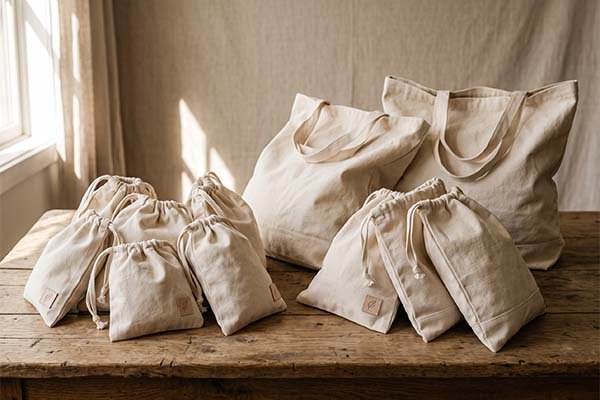
A practical Canvas bag system can use the same material, base color, logo, printing style, and drawstring construction across Small, Medium, Large, and larger gusseted formats, with the actual dimensions determined by the product.
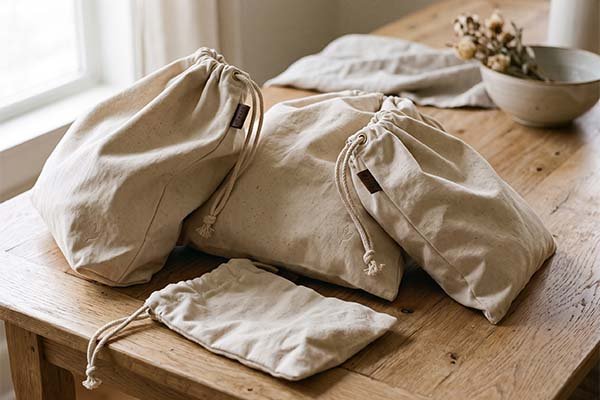
Consider an Organic & Natural Product Brand that sells dried herbs, seeds, natural pantry products, small product sets, and seasonal bundles.
The brand wants one consistent Canvas packaging system.
| Packaging Element | Standard |
|---|---|
| Materiale | Lærred |
| Base color | Natural |
| Udskrivning | One-color brand logo |
| Logo | Same approved artwork |
| Lukning | Snøre |
| Visual style | Simple and natural |
| Main variable | Størrelse på taske |
The brand could create four practical size categories.
| Taske størrelse | Possible Applications |
|---|---|
| Lille | Seeds, small dried products, small combinations |
| Medium | Dried herbs, pantry products, medium combinations |
| Stor | Larger product bundles and multiple-product purchases |
| Large/Gusseted | Seasonal collections and high-volume bundles |
These categories are examples, not fixed industry standards. The final size should come from the actual product dimensions, quantity, weight, volume, and packing method.
A product should not be forced into a Small bag simply because the product is classified as a “small product.” Two seed products can have very different fill weights and packaging requirements. The bag should fit the actual product.
Same Design Does Not Mean Same Dimensions
This is where many packaging systems become too rigid.
Suppose a brand uses a fixed 50 mm logo on every Canvas bag. The logo may look appropriate on a medium bag but too large on a small bag. It may also look too small on a much larger bag.
The better rule is to standardize the relationship between the logo and the bag.
| Branding Rule | Formål |
|---|---|
| Logo-to-bag ratio | Keeps the logo visually balanced |
| Minimum logo size | Protects readability |
| Print safe area | Prevents printing too close to seams |
| Edge distance | Keeps placement consistent |
| Center alignment | Creates a common visual structure |
This means the brand can use different bag dimensions while keeping the same visual logic.
The same idea can apply to other packaging formats. A flat pouch, stand-up pouch, gusseted bag, or shipping mailer does not have to share identical dimensions. The brand can still use a common visual system, approved materials, controlled print zones, and a consistent sizing convention.
The goal is simple: different formats, same packaging family.
How to Create a Standardized Size System for Different Products?
The hardest question is often not what material to use. It is how many sizes the brand really needs.
Start with actual product dimensions and group products with similar packaging requirements. Then create a limited number of approved size categories instead of designing one custom bag for every product SKU.
1. Start With Actual Product Dimensions
Before creating bag sizes, collect the basic product data:
- Length
- Width
- Height
- Product thickness
- Product weight
- Product quantity per bag
- Product volume
- Existing packing method
A bag that looks right on a specification sheet may not work well when the actual product is inserted.
2. Group Products by Packaging Requirements
Do not group products only by marketing category.
An Organic & Natural Product Brand could create groups such as:
- Group A — Small Products: seeds and small dried products
- Group B — Medium Products: dried herbs and pantry products
- Group C — Larger Combinations: multiple-product bundles
- Group D — High-Volume Bundles: seasonal collections
The purpose is not to assign one fixed bag to every product type. Products with similar packaging requirements can share the same bag size.
3. Create Standard Size Categories
The brand can start with categories such as:
Small → Medium → Large → Extra Large
The names are less important than the limits behind them. Each category should have an approved size range and clear usage conditions.
A brand may find that three sizes cover most products. Another brand may need five. The right number comes from the product portfolio.
4. Avoid Too Many Custom Sizes
Fifteen products do not automatically require fifteen bag sizes.
A better target could be:
15 products → 4–5 approved bag sizes
The brand can then assign each product to the closest suitable size.
This can reduce purchasing complexity without making the packaging system too restrictive.
5. Add a New Size Only When Needed
A new size makes sense when an existing bag creates a real problem.
The product may not fit properly. There may be too much empty space. The closure may not work well. The bag may look oversized at retail. A larger product may also require more capacity or a different gusset.
The new size should solve a clear packaging problem rather than simply provide another option.
Should Every Product Line Use the Same Custom Bag Style?
Not every product needs the same bag structure. A better goal is to create a packaging family with a common visual and material foundation.
Most product lines can share the same bag style when the product requirements are similar, but different structures can still belong to the same packaging family when they use the same core material and branding system.
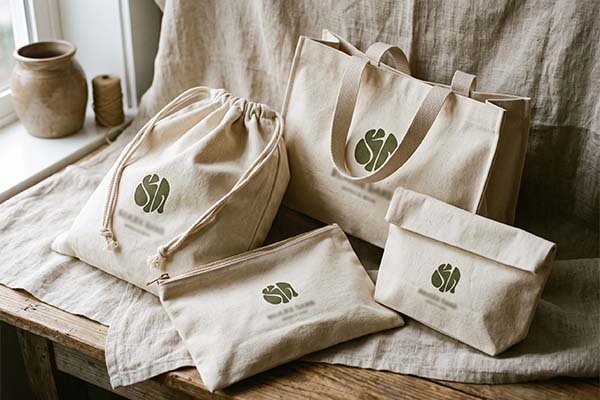
If most products can use Canvas drawstring bags, keeping that format across the range makes sense. It gives the brand consistent branding and makes sourcing and production easier.
But larger products may need more space. A flat Canvas drawstring bag may work for a small product, while a gusseted Canvas drawstring bag may work better for a larger seasonal bundle.
The visual system can remain unchanged:
- Same Canvas material
- Same base color
- Same logo
- Same printing approach
- Same cord style
- Same general stitching appearance
Only the structure changes because the product requires it.
A packaging family could include:
| Bag Family | Suitable Use |
|---|---|
| Small flat pouch | Small and lightweight products |
| Medium drawstring bag | Standard product packaging |
| Large drawstring bag | Larger product combinations |
| Gusseted bag | Higher-volume products and bundles |
This approach also leaves room for other packaging formats when necessary. A flexible packaging platform may include flat pouches, stand-up pouches, gusseted bags, and shipping mailers. Each family can have its own fixed construction rules while sharing the brand’s visual system.
There is also a simple strategy for brands with limited budgets.
If the order quantity for each product is small, changing only the bag size can be the most practical approach. Keep the material, color, logo, printing, and drawstring construction unchanged. Only adjust the dimensions.
This can avoid creating many new specifications and can make better use of the supplier’s existing production setup. It also gives the buyer a simple way to separate products without paying for a completely new packaging design every time.
For a small store or growing brand, this approach can reduce purchasing pressure while still making the product range look organized.
How Can Packaging Standardization Reduce Custom Bag Costs, MOQ and Inventory?
Standardization does not automatically mean that a supplier will offer a lower MOQ or lower unit price. Its main value is that it reduces unnecessary variation in the purchasing system.
A standardized packaging system can reduce material variety, packaging SKUs, one-off specifications, and inventory complexity, while making purchasing and reordering easier to plan.
Reduce Material Variety
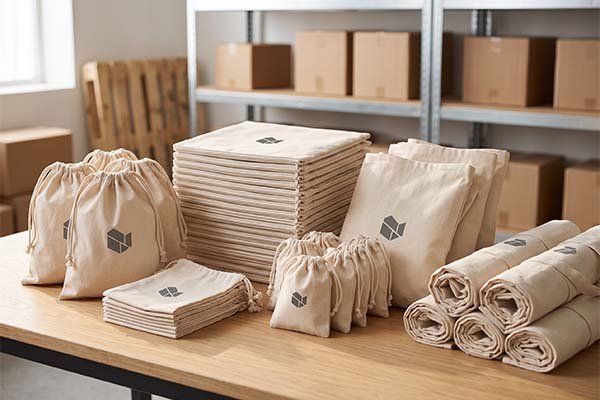
If several product lines can use one approved Canvas material, the buyer does not need to manage a separate material specification for every product.
This can simplify:
- Material sourcing
- Supplier communication
- Quality checks
- Specification management
- Reordering
The same principle can apply to other packaging systems. A brand may approve one or two material structures for a specific use case instead of creating a new material specification for every SKU.
Reduce Packaging SKU Complexity
A brand with 12 products may currently have 12 different bag specifications.
After reviewing the portfolio, it may be possible to move toward:
12 products → 4 standard bag sizes
That does not mean all 12 products use identical bags. It means the packaging system has fewer approved specifications.
Plan MOQ More Effectively
Standardization does not guarantee a lower MOQ. MOQ depends on material, printing, construction, order quantity, production setup, and supplier policy.
Still, standardization can help the buyer group similar requirements and plan purchasing by size.
Instead of treating every product as a separate packaging project, the buyer can plan:
- Small size quantity
- Medium size quantity
- Large size quantity
- Gusseted size quantity
This gives the purchasing team a clearer view of the total packaging demand.
Improve Inventory Management
Fewer packaging specifications can also reduce slow-moving stock and obsolete packaging.
This becomes especially useful when product labels, product names, or seasonal artwork change often. A brand that keeps the bag itself more standardized may have more flexibility when its product range changes.
This principle is also consistent with broader source reduction and reuse1 approaches, where reducing unnecessary material use and packaging is considered preferable to managing excess material later.
Simplify Reordering
Once the packaging system is approved, a repeat order can become much simpler.
The buyer can refer to the approved Small, Medium, Large, or Gusseted specification instead of reviewing every bag detail again.
Improve Production Planning
If several bag sizes share the same material, printing approach, and construction, production planning may also become easier for the supplier.
The exact production benefit depends on the supplier’s manufacturing setup and order quantities. Still, fewer unique specifications usually mean fewer details for both sides to manage.
How to Build a Consistent Custom Packaging Solution for Your Brand?
A packaging standard becomes useful only when it can be used in daily purchasing and production. The process should start with the full product portfolio, not with one attractive bag sample.
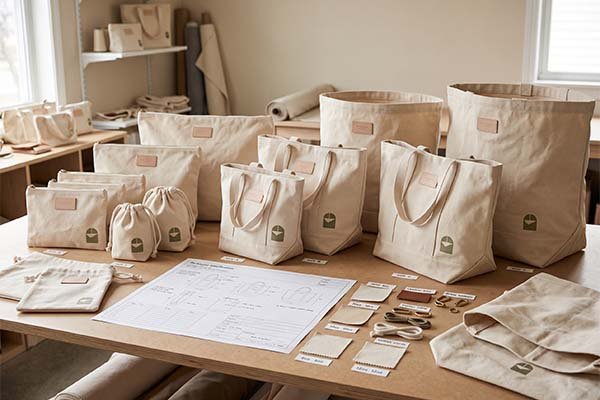
Build the system in stages: review the product range, group similar requirements, select common standards, create a few approved sizes, test representative samples, and record everything in one packaging specification sheet.
Step 1: Review Your Entire Product Portfolio
List every product and record:
- Product name
- Product dimensions
- Product weight
- Product quantity
- Current packaging
- Current packaging problems
- Expected future products
This gives the buyer a complete view of the packaging range.
Step 2: Group Products by Packaging Requirements
Group products according to their actual packaging needs.
You may end up with Small, Medium, Large, and High-Volume groups rather than separate groups for Product A, Product B, and Product C.
This shift makes the system easier to manage.
Step 3: Select the Common Packaging Material
For the Canvas example, define the approved Canvas material and its basic requirements.
The specification can include:
- Material weight
- Farve
- Tekstur
- Construction suitability
- Printing suitability
The goal is to create one clear reference that the supplier can follow.
Step 4: Define Your Brand Packaging Standards
Set the rules for:
- Materiale
- Base color
- Logo artwork
- Udskrivning
- Logo placement
- Lukning
- Cord
- Stitching
- General appearance
These should become the fixed parts of the packaging system.
Step 5: Create a Limited Number of Standard Sizes
Start with around three to five sizes when possible.
Do not create ten sizes simply because ten options seem useful. Each new size creates another specification to quote, approve, purchase, store, and reorder.
Step 6: Define What Can Be Customized
Keep flexibility where the product needs it.
Possible variable elements include:
- Størrelse
- Gusset
- Kapacitet
- Lukning
- Konstruktion
- Reinforcement
The brand should know which changes are allowed before a new product is developed.
Step 7: Test Representative Samples
There is no need to develop every possible size at the same time.
Start with representative Small, Medium, and Large samples when those categories cover the main product range.
Check:
- Product fit
- Appearance
- Holdbarhed
- Closure performance
- Udskrivning
- Ease of use
- Empty space
- Overall presentation
If the basic platform works, the remaining sizes can follow the same rules.
Step 8: Create a Packaging Specification Sheet
The final standard should be written down.
| Specification | Standard | Variabel |
|---|---|---|
| Materiale | Lærred | - |
| Farve | Brand standard | - |
| Logo | Standard artwork | - |
| Udskrivning | Standard | - |
| Lukning | Snøre | Application-dependent |
| Størrelse | - | Product-dependent |
| Gusset | - | Product-dependent |
| Konstruktion | Standard family | Product-dependent |
| Emballage | Standard | - |
This document becomes the reference for purchasing, sampling, production, and future product development.
The same principle can be applied beyond Canvas bags. A pouch system may standardize the film structure, zipper, seal width, print zones, and dieline while allowing height and product information to change. A shipping mailer system may standardize the material, adhesive strip, return seal, and branding while using several approved size tiers.
The goal is to make exceptions controlled rather than random. When a new product does not fit the existing system, the team can identify exactly which specification needs to change and why.
A useful rollout can follow a simple sequence:
- Audit the current packaging.
- Rationalize duplicate specifications.
- Prototype the proposed standard.
- Pilot the system with selected products.
- Convert gradually instead of changing every product at once.
- Maintain the approved specifications for future orders.
A good packaging system should make the next order easier than the last one.
Konklusion
The best packaging system does not make every bag identical. It standardizes the elements that matter and keeps enough flexibility for different products, sizes, and purchasing needs.
Frequenty Asked Questions
Q: Can custom packing bags be designed for products with different shapes?
A: Yes. A bag system can accommodate products with different shapes by adjusting the bag dimensions and construction while keeping the overall brand appearance consistent.
Q: How can a brand maintain consistent packaging when its products have different weights?
A: The brand should consider product weight when selecting the bag structure, fabric thickness, stitching, and reinforcement. Heavier products may require stronger construction.
Q: Can custom packing bags include product-specific labels?
A: Yes. Product-specific labels can be used to identify different SKUs while keeping the main bag design consistent across the product range.
Q: How should a company handle packaging changes for seasonal products?
A: Seasonal products can use the existing packaging platform whenever possible. Temporary labels, artwork, or product-specific inserts can provide differentiation without creating a completely new bag.
Q: Can packaging standards be updated after production has started?
A: Yes. A packaging standard can be reviewed and updated when product requirements, branding, regulations, or production conditions change. Version control helps prevent outdated specifications from being used.
Q: What information should a buyer provide when requesting a custom bag quotation?
A: The buyer should provide the intended use, product dimensions, estimated weight or volume, quantity, material preference, printing requirements, closure preference, and target delivery schedule.
Q: How can a buyer compare samples from different packaging suppliers?
A: Buyers should compare the material quality, dimensions, stitching, printing accuracy, closure performance, product fit, workmanship, and packing method rather than judging samples by appearance alone.
Q: Can the same custom bag specification be used for different suppliers?
A: Yes. A clear specification sheet can help different suppliers quote and produce against the same requirements, making supplier comparisons more consistent.
Q: What should a brand do when a supplier proposes a different material?
A: The buyer should compare the proposed material against the approved specification and test it against the intended product, appearance, durability, and cost requirements before making a change.
Q: How often should a custom packaging system be reviewed?
A: A brand should review its packaging system when it adds major product categories, changes its branding, experiences recurring packaging problems, or sees significant changes in purchasing volume.
-
The U.S. Environmental Protection Agency explains source reduction as reducing waste at the source and includes reducing packaging, redesigning products, reuse, and more efficient material use among relevant strategies.

 English
  Deutsch
  Español
  Português
  Русский
  العربية
  Français
  Italiano
  日本語
日本語  한국어
한국어  Dansk
Dansk