Gå direkte til indholdet

A buyer may request “custom cotton dust bags, 50 × 70 cm with a logo,” but this request still leaves several production decisions open.
A complete custom dust bag specification should define the material, size, construction, branding, packaging, and order requirements before production starts. This gives buyers a clear basis for quotations, samples, and bulk production.
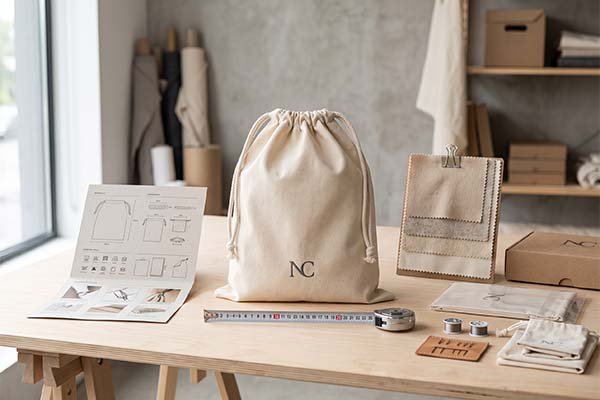
A dust bag may look like a simple packaging product, but small specification gaps can create real problems in a bulk order. The fabric may feel too thin, the finished size may not fit the product, or the logo may sit in the wrong position. A supplier may also quote different prices based on details that were never clearly defined. For B2B buyers, the goal is not just to describe what the dust bag should look like. The goal is to give the supplier enough information to produce the same result that the buyer expects.
What Material, Weight, and Size Specifications Should You Confirm?
Before discussing logo printing or other customization, you need to define the physical specifications of the custom dust bag. Material, GSM, size, and color all affect the final product and production cost.
You should confirm the material type, composition, fabric weight, finished dimensions, tolerance, and color reference before asking a supplier for a final production quotation.
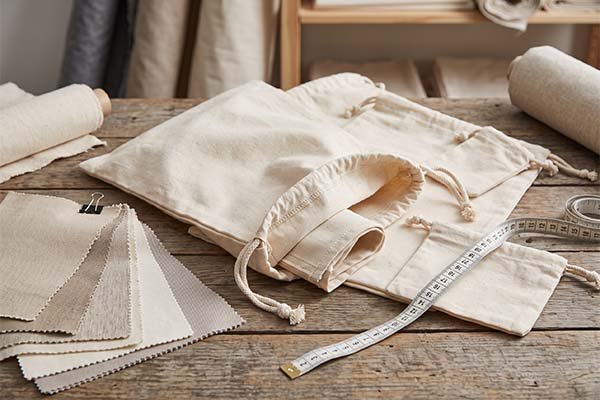
How Specific Should the Material Specification Be?
Writing only “cotton dust bag” is usually not enough for a bulk order. Cotton canvas, lightweight cotton, recycled cotton, and other cotton constructions can have very different hand feels, structures, and costs.
A better material specification tells the supplier what fabric you actually expect. It can state the material type, composition, recycled or virgin content, fabric construction, finish, and any special requirements. For instance, a buyer ordering dust bags for leather handbags may want a soft, breathable cotton fabric that will not scratch or transfer color to the product. A buyer packaging heavier shoes may prefer a stronger cotton canvas with a higher fabric weight.
The same principle applies to other popular dust bag materials. Cotton, canvas, microfiber, satin, polyester, non-woven PP, and recycled PET can all serve different applications. The right choice should come from the product being protected rather than from the material name alone.
For a supplier quotation, a specification such as “100% cotton, 180 GSM, natural color, soft hand feel” gives much more useful information than simply writing “cotton.” You can also review different custom cotton drawstring bag options to compare common material, weight, size, color, and branding specifications.
Why Should You Specify Fabric Weight or GSM?
Fabric weight is one of the specifications that directly affects the feel and performance of a custom dust bag. GSM, or grams per square meter, gives both the buyer and supplier a measurable reference. GSM is calculated as fabric weight divided by fabric area1, making it a useful objective specification for comparing materials.
A higher GSM fabric will often feel more substantial and provide more structure, while a lower GSM fabric can create a softer and lighter dust bag. GSM can also affect opacity, durability, packing volume, and production cost. Two fabrics can both be called cotton but still produce very different results because their fabric weights are different.
For this reason, a buyer should state a target GSM instead of using vague descriptions such as “thick cotton” or “heavy fabric.” If the order requires tight consistency, the specification can also include an acceptable tolerance and require a physical sample before bulk production.
A practical specification might read:
| Item | Example |
|---|---|
| Materiale | 100% cotton |
| Fabric weight | 180 GSM |
| Target tolerance | ±5% |
| Hand feel | Soft |
| Farve | Natural |
| Approval | Pre-production sample |
This makes the fabric requirement easier to quote, sample, inspect, and repeat.
What Size Information Does the Supplier Need?
A specification such as “50 × 70 cm” still needs more context. The supplier needs to know whether those numbers refer to the finished bag, cutting dimensions, internal dimensions, or external dimensions.
For a custom dust bag, the buyer should confirm the finished width, finished height, gusset, opening size, and acceptable size tolerance. A flat pouch and a gusseted bag can have the same stated width and height but hold very different products.
The product itself should also be measured in its fully packed condition. Handles, straps, hardware, tissue paper, and other parts can change the amount of space required. If the bag is too tight, the drawstring may not close properly or the product may look compressed. If it is too large, the dust bag may look loose and use more fabric than necessary.
The specification should therefore clearly state something such as “finished size, measured flat, ±5 mm tolerance” rather than leaving the measurement method open to interpretation. For reference, suppliers may also provide custom packaging bag solutions across different materials and structures.
How Should You Specify Color?
Color is another area where simple descriptions can cause inconsistency. “Beige,” “cream,” and “dark green” can mean different shades to different people.
For a one-time order, a physical color sample may be enough. For long-term wholesale or repeat orders, a Pantone reference or approved fabric sample gives the supplier a stronger reference. Buyers should also state whether the fabric should be natural, dyed, unbleached, or custom matched.
The logo color should be treated separately from the fabric color. A natural cotton dust bag with a black screen-printed logo has a different production requirement from a dyed dark-green bag with a white logo.
For repeat production, it is useful to keep one approved color reference together with the approved sample. This creates a fixed standard for future bulk dust bag orders.
What Construction Details Should You Specify for the Bag?
The material tells the supplier what the bag is made from. Construction tells the supplier how that material should become a finished product.
A complete construction specification should cover the closure, handle, seams, edge finishing, and reinforcement because these details affect both appearance and daily use.
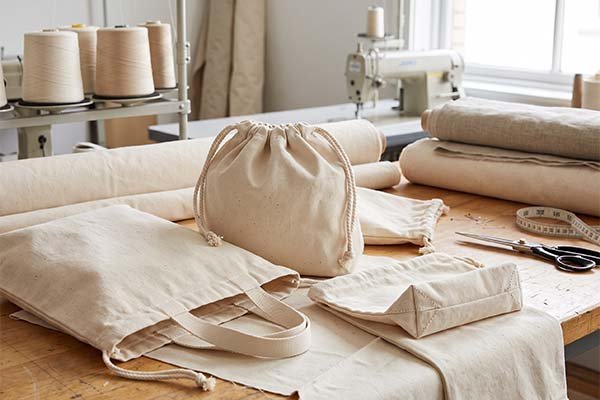
What Closure Details Should Be Confirmed?
A request for a “drawstring dust bag” still leaves several questions unanswered. The supplier needs to know whether the bag uses a single drawstring or double drawstring, and the cord itself also needs a specification.
For a custom dust bag, the buyer can define the cord material, diameter or width, length, color, and drawstring channel. A cord stopper can also be added if the design requires it. Ribbon, elastic, zipper, Velcro, and flap closures may also be suitable for specific products.
The closure affects both the appearance and the construction of the bag. A premium handbag dust bag may use a soft cotton cord and a clean folded channel. A basic storage bag may use a simpler drawstring construction to control cost. These are not just styling decisions because the closure changes fabric usage, sewing operations, and production time.
Does the Bag Need a Handle?
A handle should be specified according to how the dust bag will be used. If the bag stays inside a shipping carton or is mainly used to protect a product during storage, a handle may add cost without adding much value.
If the customer will carry the product inside the bag, the situation changes. A retail dust bag may need a single handle, double handles, or side handles. The handle length, width, material, position, and attachment method should then be defined.
For example, saying “add a 25 cm cotton handle” is more useful than simply saying “add a handle.” The buyer can go further and specify whether the handle is sewn into the top seam, attached separately, or reinforced with additional stitching.
Handle attachment deserves special attention because this area receives more pulling force than a normal side seam. A visually attractive handle can still create quality problems if the attachment is too weak for the packaged product.
What Stitching Details Should Be Included?
Stitching affects the strength, appearance, and consistency of a custom dust bag. It also creates different requirements for different areas of the product.
A side seam does not carry the same load as a handle attachment. A drawstring channel also needs to withstand repeated pulling. The bottom seam may need stronger stitching when the dust bag holds a heavier item.
The specification can therefore describe the seam type, seam allowance, stitch density, thread color, thread material, edge finishing, bottom construction, and reinforcement areas. The buyer does not always need to define every sewing parameter, especially when working with an experienced dust bag manufacturer, but the areas that affect product performance should be agreed during sampling.
A good pre-production sample gives both sides a physical reference. Once the sample is approved, the supplier can use it to control the stitching, proportions, and finishing during bulk production instead of relying only on written descriptions. This sample-first approach is also useful when customizing cotton canvas bags, where material, construction, size, and branding are usually confirmed before bulk manufacturing.
What Customization and Branding Specifications Should You Provide?
Sending a logo file does not mean the branding specification is complete. The supplier can receive the correct artwork and still produce the wrong logo size, position, color, or decoration method.
A complete branding requirement should specify the logo dimensions, position, decoration method, colors, artwork format, and final approval standard.

How Should You Specify Logo Size?
Logo size should be measured rather than described with words such as “small,” “large,” or “medium.” Those descriptions leave too much room for interpretation.
A buyer can specify a logo as 80 × 50 mm or state that the logo should be 100 mm wide while maintaining the original artwork proportion. The maximum print area can also be included when the bag has limited usable space.
The logo should be sized based on the finished dust bag rather than copied from another product without adjustment. A logo that looks balanced on a 30 × 40 cm bag may look too small on a 50 × 70 cm bag.
How Should You Define Logo Position?
“Centered logo” sounds simple, but the supplier still needs to know how the position will be measured.
A more precise specification can state that the logo is centered horizontally and positioned a fixed distance from the top edge. A drawing or approved artwork proof should show the same position.
This is especially useful for repeat orders. If the logo position is measured from a fixed seam or edge, the supplier can reproduce it more consistently. The written dimension and visual artwork should support each other instead of being used separately.
For instance, “centered on the front panel, 80 mm below the top finished edge” gives the production team a much clearer instruction than “logo at the top center.”
Which Printing or Decoration Method Should You Specify?
The decoration method should be confirmed during the quotation and sample stage because different methods can affect price, appearance, production time, and minimum order requirements.
Screen printing works well for many simple one-color or multi-color graphics. Heat transfer can suit certain detailed designs. Embroidery creates a raised and tactile appearance. Woven or printed labels can work well when the branding needs to be smaller or separated from the main fabric.
The buyer does not need to turn the dust bag specification into a printing manual. The order should simply state the selected method, logo size, position, number of colors, and color reference.
For instance, “one-color black screen print, 100 mm wide, centered on front panel, Pantone Black” gives a supplier enough information to prepare an accurate quotation and sample. For brands comparing different branding and packaging options, custom bag manufacturing and OEM services can also illustrate how logo methods and packaging details are incorporated into a broader customization process.
What Artwork Requirements Should Be Confirmed?
Production-ready artwork can prevent unnecessary revisions. Vector formats such as AI, EPS, SVG, and print-ready PDF are commonly useful when the logo needs to be scaled without losing quality.
The buyer should also confirm the final artwork version and convert fonts to outlines when required. If several logo files are being exchanged during development, the production team should receive one clearly approved version.
This matters more than it may seem. A buyer, designer, marketing team, and supplier may each have a different version of the artwork. If production starts from the wrong file, even a technically good print can become a rejected batch.
What Packaging and Order Details Should You Confirm?
The finished product is only one part of a B2B dust bag order. Packaging, carton configuration, quantity breakdown, labeling, and delivery requirements can also affect the final cost and shipping plan.
Buyers should confirm individual packaging, carton packing, quantity by color or size, labeling, production tolerance, and repeat-order requirements before bulk production begins.
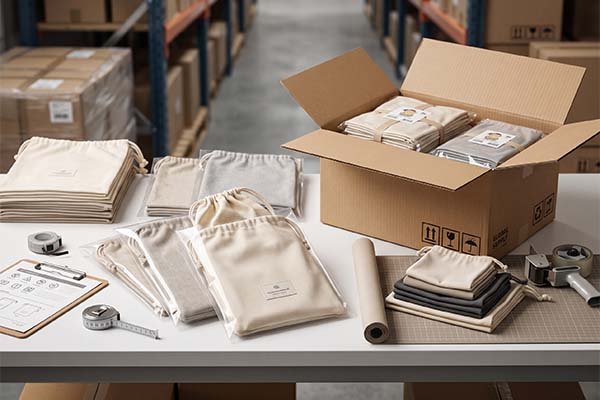
What Individual Packaging Do You Need?
The right packing method depends on how the dust bags will reach the final customer. A retail-ready dust bag may need individual polybagging or a paper band. A dust bag used only inside a warehouse or shipping carton may be better packed in bulk.
The specification can simply state whether each unit needs individual packaging, whether a paper band is required, or whether the products can be packed directly into cartons.
This detail should be confirmed before production because packaging adds materials and labor. It can also change the final carton quantity and shipping volume.
For brands that need packaging coordinated with the main product, a custom packaging solution can help align the bag material, size, branding, and final presentation.
How Should Carton Packing Be Specified?
Carton packing becomes especially relevant when the order is shipped internationally. The buyer should know how many dust bags will be packed into each carton and what the expected carton configuration will be.
The specification can include the number of units per carton, carton dimensions, gross weight, net weight, SKU labels, barcode requirements, and shipping marks. If different colors or sizes are mixed in one carton, that breakdown should also be stated.
For example, a supplier brief might specify 100 pieces per master carton, separate by color, with SKU labels on two carton sides. This is much easier for a warehouse team to receive than a general instruction such as “pack properly.”
Carton configuration can also affect freight calculations. If the packing method changes the carton size significantly, the shipping cost may change even when the product itself remains exactly the same. International packaging practices also consider performance and requirements across the supply chain, as reflected in ISO’s packaging standards framework2.
What Quantity Information Should Be Included?
“2,000 pcs” is useful, but it may not be enough for a mixed-color or mixed-size order.
A complete order quantity should show the total quantity and the exact breakdown. For example, a buyer may order 2,000 custom dust bags with 1,000 black, 600 beige, and 400 white. If there are multiple sizes, each size should also have its own quantity.
The specification should also state whether mixed-color production is allowed, whether mixed-size packing is required, and what production tolerance is acceptable.
This information matters when comparing supplier quotations. A quotation for 2,000 identical bags may not have the same production cost as a quotation for 2,000 bags divided across four colors and three sizes.
What Should You Record for Repeat Orders?
Repeat orders should be based on approved production references rather than memory or a short product name.
A buyer should keep the approved material, GSM, color reference, physical sample, artwork, size tolerance, construction details, and packaging specification. These records create a useful standard for the next purchase.
This becomes especially valuable for brands that reorder custom dust bags every few months. If the first order used 180 GSM natural cotton and the second order simply says “same as last time,” the supplier may still need to locate the correct historical specification. A saved specification sheet makes the process much faster and reduces the chance of changes between batches.
What Should a Complete Dust Bag Specification Sheet Include?
Once the material, construction, customization, packaging, and order details have been confirmed, you can turn them into one specification sheet for quotation and production.
A useful custom dust bag specification sheet should put the product requirements, production details, branding, packaging, quantity, and quality standards into one clear document.
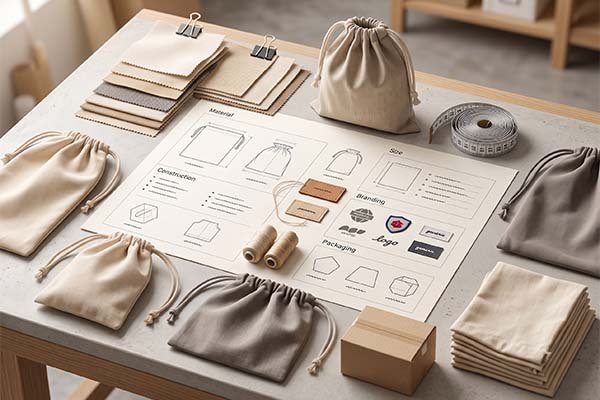
Core Specification Checklist
| Kategori | Specification to Confirm |
|---|---|
| Produkt | Product type, product dimensions, product weight, surface sensitivity, special protection needs |
| Materiale | Material type, composition, recycled or virgin content, fabric construction |
| Stof | GSM, hand feel, finish, color, color reference, material tolerance |
| Størrelse | Finished width, finished height, gusset, opening size, internal or external dimensions, size tolerance |
| Form | Flat pouch, bottom gusset, side gusset, shaped pattern, envelope style, garment-cover style |
| Lukning | Closure type, cord or ribbon material, thickness, length, color, cord lock |
| Konstruktion | Seam type, seam allowance, stitching, edge finishing, bottom construction, reinforcement |
| Håndtag | Handle type, length, width, position, material, attachment method |
| Branding | Logo size, logo position, decoration method, number of colors, Pantone reference |
| Artwork | Final artwork file, file format, approved version, font treatment |
| Emballage | Individual packaging, inner packing, master carton quantity, carton dimensions |
| Labeling | SKU, barcode, carton label, shipping marks |
| Order | Total quantity, color breakdown, size breakdown, MOQ, production tolerance |
| Kvalitet | Sample approval, inspection requirements, defect standard, color and size tolerance |
| Repeat Order | Approved sample, material, color, artwork, packaging, construction reference |
For the labeling section, buyers using barcodes can also refer to GS1’s guidance on logistic and carton labels3, particularly when cartons need machine-readable identification during receiving and distribution.
This sheet can then follow the order through the whole purchasing process. The same information can support the initial supplier quotation, sample development, approval, bulk production, inspection, and future repeat orders.
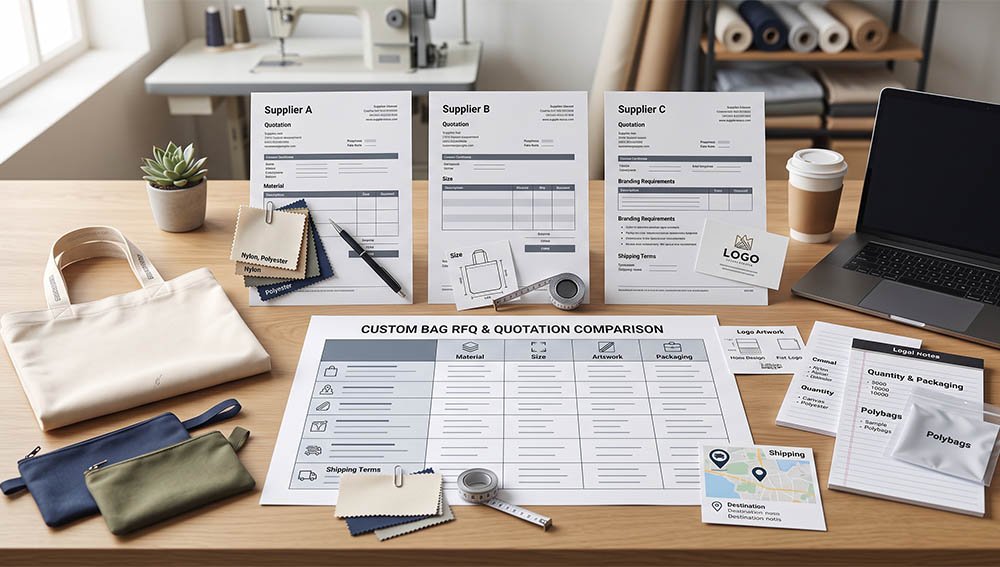
A strong specification sheet also makes supplier comparison easier. If Supplier A quotes a lower price than Supplier B, the buyer can check whether both suppliers are actually quoting the same GSM, size, printing method, packaging method, and quantity breakdown. Without these details, a lower quotation may simply reflect a different product specification.
For B2B buyers, this is where a custom dust bag specification becomes more than a product description. It becomes a production control document. It gives the buyer and supplier the same reference before money is spent on bulk production.
The more clearly you define your dust bag specifications before production, the less room there is for interpretation between buyer and supplier. A complete specification sheet helps you compare quotations accurately, approve samples faster, and reduce avoidable changes during bulk production. For buyers who want to formalize the inspection stage, ISO 2859-1 provides an acceptance-sampling framework for lot-by-lot inspection4.
Konklusion
A complete dust bag specification connects the product, quotation, sample approval, and bulk production into one clear standard that both buyer and supplier can follow.
Frequenty Asked Questions
Q: What types of products are commonly packaged in custom dust bags?
A: Custom dust bags are commonly used for handbags, shoes, watches, jewelry, clothing, bedding, electronics, cosmetics, and other products that need protection from dust, scratches, or surface contact.
Q: Can custom dust bags be made for unusually shaped products?
A: Yes. Suppliers can develop custom patterns for irregular products, including curved, tapered, oversized, or multi-part items. A product sample or detailed drawing can help the supplier develop the correct pattern.
Q: Can I order custom dust bags in different fabric materials?
A: Yes. Manufacturers can usually develop dust bags from different fabric families based on the required appearance, protection level, budget, and intended use.
Q: Are custom dust bags suitable for luxury product packaging?
A: Yes. A well-designed dust bag can become part of the product presentation. Premium fabric, refined finishing, custom branding, and suitable closure details can create a stronger unboxing experience.
Q: Can dust bags be made in environmentally friendly materials?
A: Yes. Buyers can request materials such as organic cotton, recycled cotton, recycled polyester, RPET, or other lower-impact material options depending on the product requirements and available certifications.
Q: Can a supplier develop a custom dust bag from a physical product sample?
A: Yes. A physical product can help the manufacturer understand the actual shape, dimensions, surface, and handling requirements. This is often useful when the product has unusual proportions or complex details.
Q: What is the usual development process for a custom dust bag?
A: A typical process includes requirement review, quotation, pattern development, sample production, sample evaluation, revisions if needed, final approval, and bulk production.
Q: Can custom dust bags be ordered in multiple colors for the same design?
A: Yes. One dust bag design can usually be produced in several fabric colors. Each color may have different minimum quantities depending on the material and manufacturing process.
Q: Can custom dust bags be designed to match existing brand packaging?
A: Yes. Buyers can coordinate the dust bag with existing boxes, tissue paper, shopping bags, ribbons, or other packaging elements to create a consistent brand presentation.
Q: How can buyers reduce the risk of receiving dust bags that do not match their expectations?
A: The best approach is to establish clear approval points before bulk production. Buyers should review the physical sample, confirm the final artwork, and approve the production standard before authorizing the full order.
-
Textile School explains GSM as the weight of fabric per square meter, providing a measurable basis for fabric weight specifications. ↩
-
ISO’s packaging committee provides information on terminology, characteristics, performance requirements, and testing related to packaging and supply chains. ↩
-
GS1 provides guidance on logistic labels, carton identification, and barcode-based information used across supply chains. ↩
-
ISO 2859-1 defines acceptance sampling plans for lot-by-lot inspection, providing a standardized reference for evaluating product quality through sampling. ↩

 English
  Deutsch
  Español
  Português
  Русский
  العربية
  Français
  Italiano
  日本語
日本語  한국어
한국어  Dansk
Dansk