Перейти к содержанию

Choosing a clear bag material can seem simple until PVC, TPU, and PE start looking almost the same on a product page. The wrong choice can affect cost, feel, structure, and how long the bag lasts.
PVC, TPU, and PE can all be used for clear bags, but they suit different needs. PVC is often a practical choice for structured and cost-controlled bags, TPU is better for flexible premium reusable bags, and PE is usually the most economical option for lightweight packaging.
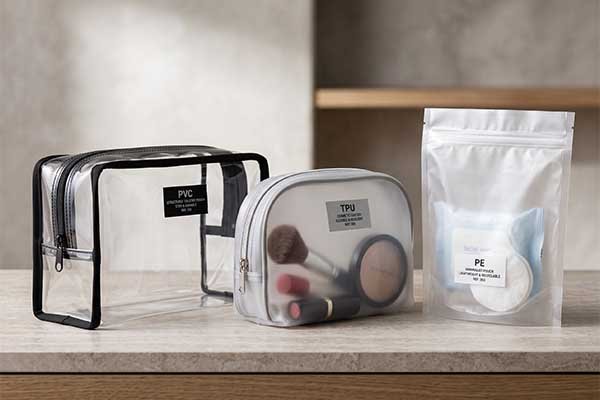
A transparent bag does not automatically look or perform the same just because the material is clear. The film thickness, surface finish, construction, and final shape can change the result significantly.
For a buyer, this difference matters. A clear cosmetic pouch for a beauty brand has different requirements from a garment protection bag used during export. One may need a soft premium feel, while the other mainly needs to protect the product at a low cost.
Which Clear Bag Material Fits Your Product?
PVC, TPU, and PE can all produce transparent bags, but the better choice depends on what the finished bag is expected to do. For a buyer, the useful question is not simply "Which material is best?" but "Which material gives me the performance and positioning I need at the target cost?"
PVC is often a practical starting point for structured clear bags, TPU makes more sense when flexibility and a premium reusable feel are important, and PE is usually the practical choice for lightweight protective packaging.
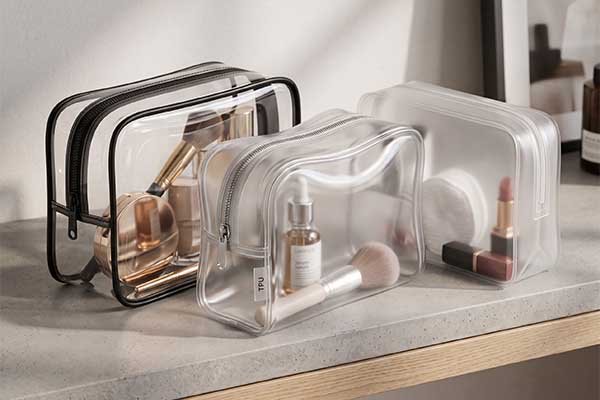
The word "clear" only describes the appearance. It does not tell you whether the bag will be soft or firm, whether it will keep its shape, or whether it is suitable for repeated use.
What Does the Material Need to Do?
For a clear bag manufacturer, the film has to do more than look transparent. It needs to work with the intended construction, closure, printing process, and level of use.
PVC, TPU, and PE can all be converted into clear bags, but they respond differently to thickness, folding, forming, printing, and repeated handling. That is why the material decision should be made together with the finished design.
Material selection affects:
- Transparency
- Гибкость
- Structure
- Долговечность
- Touch and feel
- Printing performance
- Вес
- Стоимость
- Overall appearance
This is why two transparent bags can have completely different market positions.
A thin PE bag may be used to protect a garment during shipping. A 0.50 mm PVC pouch may be designed for cosmetics or travel. A soft TPU pouch may be positioned as a premium reusable accessory.
The material should match the job instead of being selected only because it looks clear.
When Does PVC Make Sense for a Clear Bag?
PVC, or polyvinyl chloride, is widely used for clear bags because it can provide good transparency while offering a useful level of structure. This makes it particularly suitable for bags that should look neat and hold a defined shape.
A thicker PVC film can create a firm hand feel. It can also help a rectangular bag maintain its form after the customer puts products inside.
PVC works well with many common bag components. Manufacturers can combine it with zippers, binding, pockets, handles, D-rings, and straps.
PVC is especially common in products such as:
- Clear cosmetic bags
- Clear travel bags
- Quart size bags
- Toiletry bags
- Promotional pouches
- Retail packaging
- Reusable organizers
- Event bags
Thickness is important here. A thin PVC film can remain fairly flexible, while a thicker film can feel much more substantial.
PVC can also be attractive for B2B buyers because it often gives a good balance between appearance and cost. A brand can create a structured clear pouch without paying the higher material cost associated with TPU.
There are still factors to check before production. PVC formulations can differ in flexibility, odor, aging behavior, and chemical composition. Buyers should therefore ask for information about the actual film being used rather than relying on the word "PVC" alone.
When Is TPU Worth the Higher Material Cost?
TPU, or thermoplastic polyurethane, is known for its softness, elasticity, and flexibility. These properties make it useful when a clear bag needs to feel more like a reusable accessory than basic packaging.
A TPU bag can bend and flex easily. It can also provide a soft hand feel that some brands prefer for premium products.
TPU is a good option for:
- Premium cosmetic bags
- Skincare pouches
- Reusable travel bags
- Beauty kits
- Personal care kits
- Hotel amenity kits
- Promotional gift sets
- Outdoor or wet-use pouches
The main reason to choose TPU is not simply that it is "better." The real reason is that its properties can be useful in certain applications.
Consider a travel pouch that will be folded into a suitcase several times a month. It may also be exposed to cosmetics, water, sunscreen, and daily handling. In that case, flexibility and resistance to repeated movement become more valuable.
TPU usually costs more than PE and often more than PVC. The additional cost makes more sense when the bag itself has long-term value.
A premium beauty brand, hotel group, or outdoor brand may be willing to pay more because the customer is expected to keep using the bag.
When Is PE the More Practical Choice?
PE, or polyethylene, is widely used for flexible plastic packaging. For clear bags, suppliers commonly work with LDPE, LLDPE, or blends of these materials.
PE is lightweight, flexible, and economical. It is especially useful when the main purpose of the bag is product protection rather than premium presentation.
PE clear bags are commonly used for:
- Garment bags
- Textile protection
- Product sleeves
- Inner packaging
- Simple transparent pouches
- Promotional packaging
- Упаковка навалом
- Retail polybags
PE usually has less structure than thicker PVC. A thin PE bag may collapse when empty, but this is not necessarily a weakness. If the bag is used to protect a cotton bag during shipping, maintaining a rigid shape is not important.
LDPE and LLDPE also have slightly different roles. LDPE is generally softer and more flexible. LLDPE can improve strength and puncture resistance.
This makes PE a strong option for high-volume packaging projects where buyers need to control unit cost without giving up basic product visibility and protection.
PVC, TPU, and PE: A Practical Starting Point
| Buyer consideration | ПВХ | TPU | PE |
|---|---|---|---|
| Typical clarity | Высокий | Высокий | Good to High |
| Гибкость | Средний | Высокий | Высокий |
| Natural structure | Хорошо | Средний | Low–Medium |
| Hand feel | Средний | Мягкий | Light / flexible |
| Repeated-use potential | Хорошо | Good–High | Application dependent |
| Premium positioning | Хорошо | Высокий | Основные |
| Relative material cost | Средний | Выше | Economical |
| Common role | Structured cosmetic, travel, retail bags | Premium reusable products | Lightweight packaging and protection |
The table gives a useful starting point, but it should not be treated as a fixed ranking.
A thick PE film can feel more substantial than a very thin PVC film. A thin PVC pouch can be more flexible than a thick PVC pouch. A structured TPU bag can also feel firmer because of its construction.
The resin tells you what the film is made from. The finished specification tells you what the customer will actually experience.
What Actually Changes When You Choose a Different Clear Bag Material?
A buyer may first focus on transparency because that is the most obvious feature of a clear bag. In practice, material affects much more than visibility.
The material influences how the bag looks, how it feels, how well it holds its shape, how long it can be reused, how it can be printed, and how much the finished product costs.
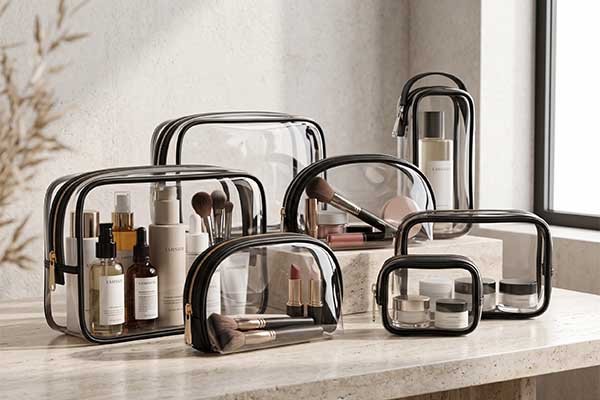
This becomes especially important when the clear bag is customer-facing. A branded cosmetic pouch or retail accessory needs to create the right impression from the first touch.
How Much Does Material Change the Look and Feel?
Transparency is not simply a yes-or-no feature.
A PVC bag can have a clear, glossy appearance. TPU can also provide high clarity while creating a softer visual and physical impression. PE can range from clear to translucent depending on the resin, thickness, and processing.
The surface finish also changes the appearance. A glossy film reflects more light and can make the product look brighter. A frosted or matte finish creates a softer visual effect.
Thickness matters too.
A very thin film can look light and flexible. A thicker film can create stronger edges and a more defined shape. This difference can affect how customers judge the product before they even touch it.
This is why premium clear bags often need more than good transparency. They need the right combination of clarity, shape, surface, and construction.
For a beauty brand, the difference can be significant. A soft TPU pouch with clean edges may feel like part of the beauty product. A thin PE pouch may feel like temporary packaging.
Neither result is wrong. They simply serve different purposes.
How Should Flexibility and Structure Be Specified?
Flexibility and structure are two of the most important factors in clear bag design.
A flexible clear bag is easier to fold and store. It works well for travel pouches and products that need to fit into another bag.
A structured clear bag keeps a more defined shape. It can look cleaner on a retail shelf and can make the products inside easier to display.
PVC is often a good starting point for structured bags. TPU works well for softer and more flexible designs. PE is highly suitable for lightweight packaging.
However, material is only one part of the structure.
Thickness can change the result significantly.
| Design requirement | Possible direction |
|---|---|
| Soft and foldable | TPU or PE |
| Structured rectangular bag | ПВХ |
| Lightweight packaging | PE |
| Soft premium pouch | TPU |
| Firm retail organizer | Thicker PVC or structured construction |
Bag size also matters. A large bag may need more thickness or reinforcement than a small pouch made from the same material.
Construction matters as well. Binding, gussets, reinforced corners, zipper placement, and internal support can all affect how the final bag holds its shape.
How Should Durability Be Matched to Actual Use?
A clear bag should be designed around its expected life.
A PE garment bag may only need to survive shipping. A reusable cosmetic pouch may be used every week for several years. These products should not be judged by the same durability standard.
Repeated use creates stress in several places. The film may be folded. The zipper may be opened hundreds of times. Corners may rub against other products. Handles and D-rings may pull on the material.
TPU can be a strong choice for this type of repeated movement because of its flexibility and resistance to flexing and abrasion.
PVC can also provide good durability, especially when structure is important. However, its long-term performance can depend on formulation, thickness, UV exposure, and temperature.
PE can perform very well as flexible packaging when the correct film grade and thickness are selected. It is especially useful when the goal is protection rather than a premium reusable experience.
The complete bag should always be tested. A strong film cannot compensate for a weak zipper or poorly reinforced attachment point.
What Should Buyers Know About Printing on Clear Film?
A clear bag can become an important part of a brand’s packaging.
The transparent surface gives brands space for logos, graphics, patterns, and product information without completely covering the product inside.
Common decoration options include:
- Screen printing
- UV printing
- Heat transfer
- Full-color printing
- Repeat printing
- All-over printing
- Logo labels
The printing method needs to match the film.
PE often needs surface treatment to improve ink adhesion. PVC and TPU also require printing systems that match the actual film formulation.
A sample should therefore be printed before mass production when the logo finish matters.
The test should not stop with the first print. The printed bag can be folded, rubbed, cleaned, and opened repeatedly. These actions can reveal problems that are not visible on a flat film sample.
For a B2B project, the goal is not just to make the logo visible. The goal is to keep the logo looking good throughout the intended life of the bag.
Why Should You Compare Finished Bag Cost Instead of Film Price?
The material price is only one part of the finished bag cost.
A quotation can also be affected by:
- Material thickness
- Bag dimensions
- Film consumption
- Bag structure
- Печать
- Zipper
- Binding
- Оборудование
- Pockets
- Handles
- Straps
- Инструментальная оснастка
- Packaging
- Order quantity
This is why it is not useful to compare PVC, TPU, and PE only by price per kilogram or price per meter.
A small TPU pouch with a simple zipper may have a lower finished cost than a large PVC bag with thick film, several pockets, custom hardware, and full-color printing.
The application also changes the value of the material.
If a bag is only used to protect a product during export, PE may provide everything the buyer needs. If the customer will use the bag for years, TPU may justify the higher material cost.
The better comparison is the total cost of the finished product against its expected use.
Compare the Materials by the Performance You Actually Need
The most useful comparison is the one that connects film properties to the customer’s actual use. A buyer choosing a clear bag should consider visibility, handling, expected life, and target cost together.
PVC is often the better fit when structure and clear presentation matter; TPU is attractive when repeated flexing and premium reusable positioning matter; PE is usually the practical option when low weight and economical protection are the priority.
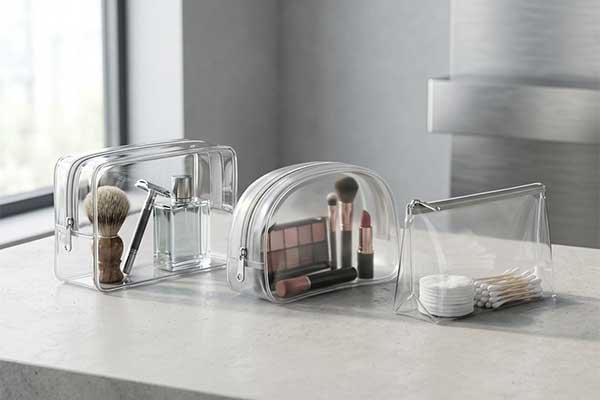
The important point is that no single material wins every category.
What Level of Clarity Should You Specify?
PVC can provide a very clear viewing area and is commonly used when the product inside needs to be easy to see.
TPU can also provide high transparency while maintaining a soft and flexible feel. This combination is useful for premium cosmetic and travel products.
PE can also be clear, but the result depends heavily on the specific grade and film thickness. Some PE films are highly transparent, while others have a softer or more translucent appearance.
Surface treatment can change the result too. Glossy films can look brighter, while matte or frosted films reduce reflection.
This is why a supplier’s statement such as "crystal clear" should not be treated as a complete specification.
The best approach is to approve a physical swatch or finished sample. Place the actual product inside the bag and check the result under normal lighting.
The finished bag is what the customer will see. The raw film specification is only the starting point.
How Much Flexibility Does the Finished Bag Need?
PVC generally provides more structure, especially at higher thicknesses. TPU is soft and elastic. PE is light and flexible.
A useful general order is:
More structured → PVC
Soft and elastic → TPU
Light and flexible → PE
Thickness changes this order.
A thin PVC film may be quite flexible. A thick TPU film can feel more substantial. A thicker PE film can also become stronger and less floppy.
This is why thickness should be included in the specification.
If a customer needs a foldable travel pouch, choosing a very thick film simply because it feels stronger may create a product that is difficult to fold.
If the customer wants a structured retail bag, using an extremely thin film may make the product look weak even if the material itself has good transparency.
The right flexibility is therefore linked to the way the bag will be stored, carried, displayed, and used.
What Should Durability Mean for Your Application?
Durability should be evaluated according to the environment.
Consider a clear pouch used at a hotel. It may be opened by guests, packed into luggage, exposed to cosmetics, and reused several times.
Now consider a PE garment bag. It may only need to protect a shirt from dust and moisture until the customer opens the package.
The performance requirements are completely different.
TPU is generally a strong choice for repeated folding, flexing, and abrasion. PVC can provide good durability and structure at a lower cost in many applications. PE can provide excellent practical performance for flexible packaging when the correct film grade is selected.
Temperature and UV exposure should also be considered.
A bag used outdoors will face different conditions from one stored inside a warehouse. A bag that sits in direct sunlight needs more attention to long-term aging than a bag used inside a bedroom closet.
The film, thickness, seam, zipper, hardware, and reinforcement all contribute to the final durability.
How Should Film Thickness Be Chosen?
Thickness is one of the easiest specifications to overlook and one of the most important to control.
A buyer may select TPU or PVC correctly but still receive a finished bag that feels wrong because the film thickness does not match the design.
Thinner film usually means:
- Lower weight
- More flexibility
- Easier folding
- Less material consumption
- Potentially lower cost
Thicker film usually means:
- More substantial feel
- Better shape retention
- More structure
- Higher material consumption
- Potentially higher cost
A structured cosmetic bag may benefit from thicker film. A foldable travel pouch may work better with a thinner and more flexible film.
The bag size also affects the decision. A large clear bag can need more support than a small pouch, even if both products use the same material.
Thickness should therefore be selected together with the bag dimensions, shape, closure, and intended use.
Match the Material to the Bag Application
Different clear bag applications place different demands on the material. A cosmetic pouch needs a different balance from a garment bag, while a premium gift set needs a different balance again.
For premium reusable products, TPU is often a strong starting point. PVC works well for structured clear bags with controlled costs, while PE is usually the better choice for simple and lightweight packaging.
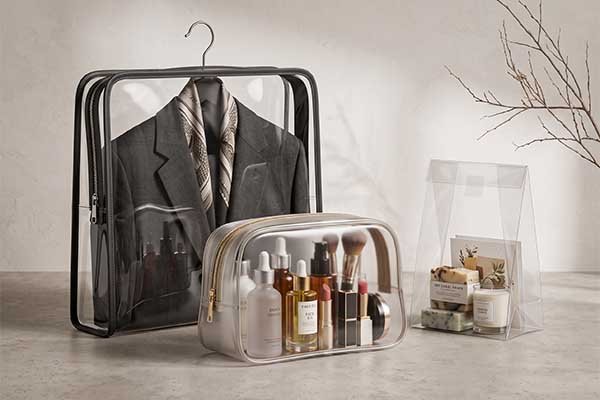
The final decision should still be based on the complete product design.
Which Material Works Best for Cosmetic Bags?
Clear cosmetic bags need good transparency because customers want to see the contents. They also need a surface that is easy to clean and a structure that works with the products inside.
PVC is a practical choice for structured cosmetic bags. It can create a defined rectangular shape and works well with gussets and zippers.
TPU is a strong option when the bag needs a softer and more premium feel. This is useful for skincare sets, beauty gift sets, and branded reusable pouches.
The product’s price also matters.
A promotional cosmetic bag for a $10 campaign does not necessarily need TPU. A premium skincare brand may see more value in TPU because the customer is likely to keep the bag.
Which Material Works Best for Travel Bags?
Travel bags need to handle repeated use, limited luggage space, and regular opening and closing.
A structured travel organizer can benefit from PVC because the material can help it maintain its shape.
A soft travel pouch can benefit from TPU because it can be folded and compressed more easily.
PE is more suitable when the bag mainly protects the contents and does not need to become a long-term travel accessory.
The zipper, gusset, and film thickness should be selected together. A travel bag with a large bottom gusset can require a different film specification from a small flat pouch.
Which Material Works Best for Reusable Quart Size Bags?
Reusable quart size bags need clear visibility and practical access to the contents. The zipper must work smoothly, and the bag needs enough structure to remain useful without becoming unnecessarily rigid.
PVC can work well for a structured quart size bag. It can create a clean rectangular shape and provide good product visibility.
TPU can be useful for a softer version that is easier to fold after travel.
PE can be used for simple and economical versions where the main goal is basic transparent packaging.
The flat or gusseted design also matters. A flat bag is compact and easy to store. A gusseted bag provides more usable depth but needs more material and may require more support.
Which Material Works Best for Retail Packaging?
Retail packaging has a different goal from shipping protection.
The package may sit on a shelf where customers can see it. The bag may also carry the brand logo and product information.
PE is usually suitable for simple product sleeves and inner packaging because it is lightweight and economical.
PVC can provide more structure and a stronger retail appearance.
TPU becomes more attractive when the packaging is intended to become a reusable accessory.
For a premium beauty kit, the clear pouch may continue to be used after the customer finishes the original products. In that case, the bag is no longer just packaging. It becomes part of the product value.
Which Material Works Best for Promotional and Gift Kits?
Promotional and gift kits often contain several small products. These can include cosmetics, skincare samples, wellness products, personal care items, or branded accessories.
A clear bag can display the contents while keeping the products together.
TPU is useful for premium promotional programs where reuse is part of the concept. PVC can provide a structured and cost-controlled alternative. PE can be used when the bag is mainly a protective or grouping layer.
For a hotel amenity kit, a reusable TPU pouch can continue to serve as a travel bag after the guest uses the products. That gives the packaging a longer useful life.
The best material therefore depends on what happens after the customer opens the package.
How Should You Develop a Custom Clear Bag?
By this point, the material differences are clearer. The next step is turning those differences into a practical purchasing decision.
Start with the finished product you want to create, then select the material, thickness, construction, and accessories that support that product. Do not choose the material first and try to force the design around it.
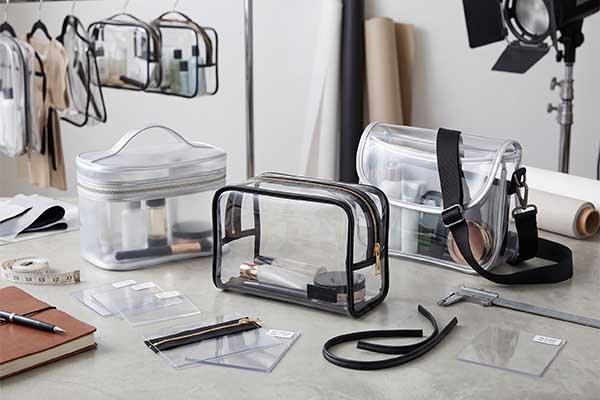
This approach usually gives better results because the same material can behave very differently in different bag constructions.
What Should You Define Before Asking for a Quote?
Before asking a supplier for a quotation, prepare a basic product checklist.
Product use
What will the bag contain? Cosmetics, clothing, toiletries, promotional products, or something else?
Expected life
Will it be used once, for a short campaign, or repeatedly for several years?
Structure
Should the bag stay flat, have a gusset, or maintain a strong rectangular shape?
Transparency
Does the product need to be fully visible, or is basic transparency enough?
Гибкость
Will the customer fold the bag or keep it in a fixed shape?
Размер
What are the finished width, height, and depth?
Thickness
What level of structure and hand feel does the product need?
Branding
Will the bag have a logo, full-color artwork, or an all-over pattern?
Закрытие
Will it use a zipper, snap, or another closure?
Functional details
Will it need pockets, D-rings, handles, straps, or reinforcement?
Quantity and target cost
How many pieces are needed, and what finished unit cost is acceptable?
These details give a supplier a much clearer starting point than simply saying, "We need clear bags."
A Simple Material Selection Rule for Buyers
A simple decision rule can help narrow the options.
Need a structured clear bag with good clarity and controlled cost?
→ Consider PVC.
Need a soft, flexible, premium reusable bag?
→ Consider TPU.
Need lightweight and economical protective packaging?
→ Consider PE.
This rule works well as a first filter.
The final choice should still be checked against the complete design.
A 30 cm structured bag with a heavy zipper may need a different film thickness from a 15 cm flat pouch. A bag used outdoors needs different aging requirements from one used inside a retail box.
For that reason, a supplier should review the complete specification before confirming the material.
Why Material, Thickness, and Construction Must Be Chosen Together
A material does not exist in isolation once it becomes a finished bag.
The final result comes from:
Material + Thickness + Size + Structure + Closure + Hardware + Printing
Changing any one of these factors can change the product.
A larger bag creates more stress on the film and seams. A gusset increases capacity but also changes how the film folds. A zipper creates stress along the opening. A D-ring or strap attachment creates a concentrated load in one area.
The construction can therefore make a major difference.
A 0.30 mm PVC bag may be suitable for a small pouch but may feel too soft for a large structured bag. A thicker TPU film may provide the desired feel for a premium organizer but may make a small pouch harder to fold.
This is why a sample is useful before mass production.
The buyer can physically check the shape, transparency, flexibility, zipper operation, printing, and overall feel. The supplier can then adjust the material thickness or construction before the production order is confirmed.
What Can You Customize Besides the Film?
Material is only one part of custom clear bag development.
The design can also include:
Size and shape
- Custom dimensions
- Flat construction
- Gusseted construction
- Structured construction
- Rectangular shapes
- Custom shapes
Closures
- Молнии
- Snaps
- Other closure solutions
Functional details
- Exterior pockets
- Interior pockets
- D-rings
- Handles
- Straps
Finishing
- Binding
- Edging
- Reinforcement
- Оборудование
- Woven labels
Branding
- Single-color logo
- Multi-color logo
- Full-color printing
- All-over printing
- Repeat patterns
These details can change the product’s appearance significantly.
A clear rectangular pouch with black edging, a black zipper, reinforced D-rings, and a detachable strap can look much more like a finished retail accessory than a basic transparent pouch.
For brands, this is useful because the clear bag can carry the visual identity even when most of the surface remains transparent.
What Should You Send a Manufacturer for an Accurate Quote?
A good inquiry should give the supplier enough information to understand the finished product.
Include:
- Bag type
- Finished dimensions
- Material preference
- Material thickness
- Quantity
- Intended application
- Logo or artwork
- Printing requirements
- Closure type
- Pocket requirements
- Hardware requirements
- Packaging requirements
You do not need to know every technical specification.
If you are not sure whether PVC, TPU, or PE is right, provide the application instead.
You can send a product photo, reference image, sketch, existing sample, or even a simple drawing with dimensions.
This gives the manufacturer something concrete to work from.
For OEM projects, this is often much more useful than choosing a material based only on an online comparison chart. The manufacturer can look at the size, structure, intended use, printing, and hardware and then recommend a suitable combination.
What Does the Right Material Choice Achieve?
The purpose of choosing between PVC, TPU, and PE is not to find one material that wins every category.
PE is a practical choice for lightweight and economical packaging. PVC works well when clarity, structure, and cost need to stay balanced. TPU is a strong option when flexibility, durability, repeated use, and premium feel are important.
The right decision also depends on thickness and construction.
For a premium hospitality or branded-product program, PE can be used for internal protective packaging while TPU is used for the customer-facing reusable pouch. PVC can remain a useful option for promotional clear bags where structure and price both matter.
The material should support the way the finished bag looks, feels, functions, and represents the brand.
That is the real goal of material selection.
Заключение
Choosing between PVC, TPU, and PE is ultimately a product-development decision rather than a material-only decision. Start with the bag’s application, dimensions, structure, expected life, branding, and target cost, then use the material and thickness to achieve that result.
The best clear bag is not the one with the most expensive film. It is the one whose material, construction, and finishing details are appropriate for the way the bag will actually be used.
Часто задаваемые вопросы
Q: Is a thicker clear film always better?
A: No. Thickness should match the bag size, structure, flexibility requirements, and expected use. Making a film thicker can improve stiffness and hand feel, but it can also increase weight, material consumption, and cost.
Q: Can the same clear bag design be made in PVC and TPU?
A: Often, yes, but the finished result may need adjustment. The different flexibility and forming characteristics can affect the film thickness, edge finishing, reinforcement, and overall shape.
Q: Does the zipper need to be selected together with the clear film?
A: Yes. The zipper affects the opening, seam construction, appearance, and stress around the top edge. For a reusable bag, zipper quality should be evaluated as part of the complete product rather than as an isolated component.
Q: Can a clear bag be made more rigid without simply using a much thicker film?
A: In some designs, yes. Gusset construction, binding, reinforced edges, internal support, panel design, and hardware placement can all influence how a bag holds its shape.
Q: Does a clear film’s surface finish affect the customer’s perception of quality?
A: Yes. Glossy, matte, frosted, and semi-transparent finishes create different visual impressions. The appropriate finish depends on the brand positioning and how much product visibility is required.
Q: Should buyers compare material prices by kilogram?
A: Material price per kilogram can be useful for internal costing, but it is not enough for comparing finished bags. Film thickness, dimensions, construction, printing, hardware, labor, packaging, and order quantity can all change the final unit cost.
Q: Can a clear bag be designed for repeated commercial use?
A: Yes. For repeated-use products, the film should be evaluated together with the zipper, seams, reinforcement, handles, straps, and attachment points. The finished sample should be tested under realistic handling conditions.
Q: What is the difference between a material sample and a finished bag sample?
A: A material swatch helps evaluate the film’s appearance, thickness, and hand feel. A finished bag sample also shows how the material behaves after cutting, joining, adding the closure, applying printing, and installing hardware.
Q: Should the buyer provide a reference bag when requesting an OEM project?
A: A reference bag, drawing, photo, or existing sample can make communication much easier. It helps the manufacturer understand the desired proportions, construction, details, and overall appearance before confirming the specification.
Q: What is the best way to approve a custom clear bag before bulk production?
A: Approve the finished sample rather than the material alone. Check the dimensions, clarity, film feel, shape, seams, zipper, printing, hardware, and intended use. If anything feels wrong, adjust the specification before mass production.

 English
  Deutsch
  Español
  Português
  Русский
  العربية
  Français
  Italiano
  日本語
日本語  한국어
한국어  Dansk
Dansk