Перейти к содержанию

You spend months planning your trade show booth, yet the bag you hand out is often an afterthought. A poorly chosen bag gets thrown away, wasting your budget and failing to display your brand.
To choose the best customized cotton bag, you must match the bag’s physical attributes—fabric density, handle length, and structural depth—to your specific exhibition goals. The right choice balances immediate utility for the attendee with long-term durability for your brand exposure.

Many companies default to the cheapest option without considering the user experience. This leads to bags that are uncomfortable or useless. To avoid this mistake, you need to analyze the specific functions the bag must perform.
WHAT cotton bag types fit exhibition use best?
Trade show attendees have different needs depending on how long they stay and what they collect. Giving the same generic bag to everyone ignores these distinct behaviors and lowers your engagement rates.
The best bag type depends on the "carry duration." Simple, open-top carriers work for quick brochure distribution, while structured bags with depth suit heavy catalog collectors. Selecting a shape that complements the visitor’s movement ensures they keep your bag as their primary carrier throughout the event.
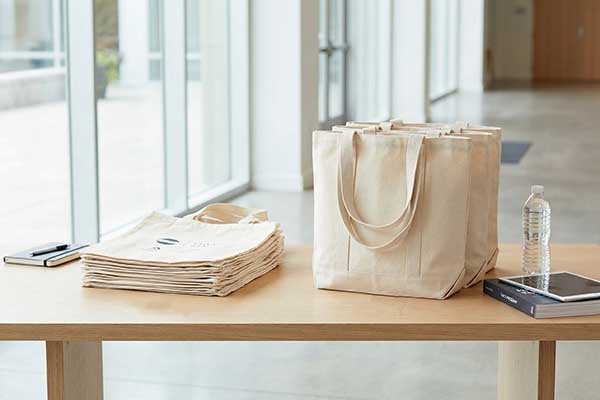
You should think about the mechanics of the trade show floor. Visitors are constantly moving, collecting, and organizing. The shape of your bag determines how helpful it is to them.
First, consider the Open-Access Carrier. This design has no zippers or flaps. It is designed for speed. When a visitor walks past your booth, you can hand this to them in one second. It is perfect for high-traffic zones where the interaction is brief. The goal here is volume distribution. The easier it is to open and fill, the more people will take it.
Second, consider the Secure-Storage Design. This might feature a closure mechanism or a deeper structure. This is ideal for visitors who stay for a presentation. They have personal items like phones, chargers, or notebooks. A bag that offers some security becomes a "safe haven" for their belongings. They will wear this bag all day because it protects their stuff.
Third, consider the Ergonomic Carrier. This focuses on how the bag sits against the body. A vertical shape hits the hip differently than a horizontal shape. If the exhibition hall is crowded, a vertical bag is better because it takes up less lateral space. It allows the visitor to navigate tight crowds without bumping into others. This subtle comfort factor means they are less likely to take the bag off and leave it somewhere.
HOW should size and capacity be selected?
A bag that is too small frustrates the user, while a bag that is too large looks empty and sad. Finding the right balance is crucial for a professional appearance.
Select a size that accommodates standard A4 documents with extra "slide-in" clearance to prevent creasing. You must also calculate the "usable volume" created by the bottom width, ensuring the bag can hold bulky items like samples without bulging or tearing.
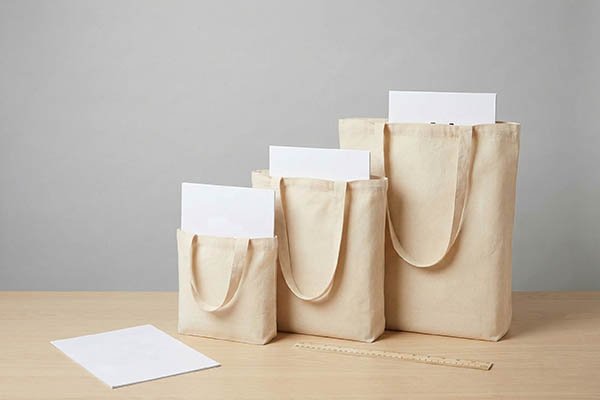
Capacity is not just about the height and width of the fabric. It is about the "living space" inside the bag. You need to calculate the dimensions based on the contents you want the visitor to carry.
The Document Safety Zone
Most industry literature is A4 size. A bag that is exactly the size of an A4 sheet is a failure. It requires precision to pack. Visitors do not have time for precision. You need a buffer zone. A bag width of at least 38cm allows a folder to drop in loosely. This ease of use is critical. If a visitor has to struggle to fit your brochure into the bag, they will likely just carry the brochure in their hand and toss the bag.
The Volume Multiplier
A flat bag has zero depth until it is filled, at which point it shrinks in width. This distorts your logo. If you plan to give away anything thicker than a magazine—like a water bottle, a sample box, or a t-shirt—you must choose a bag with a gusset (bottom depth). A 10cm gusset allows the bag to stand up on its own. This transforms the bag from a simple envelope into a portable container.
The "Winter Coat" Factor
You must also size the handles correctly. Capacity includes the human arm. If the trade show is in winter, attendees will wear thick jackets. A short handle will cut off circulation or slide off the shoulder. A handle drop of 30cm (approx. 60cm total length) ensures the bag fits over a bulky coat. This ensures the bag remains "hands-free," which is the most valuable asset you can offer a busy attendee.
WHY does fabric weight matter?
The thickness of the cotton communicates the quality of your brand instantly. A thin, flimsy bag signals cheapness, while a substantial fabric builds trust before the customer even sees your product.
Fabric weight, measured in ounces or grams, dictates both opacity and perceived value. Heavier fabrics prevent contents from showing through and resist wrinkling, providing a smooth, premium canvas for your logo that enhances brand credibility.

The tactile experience of cotton is a direct psychological trigger. When a potential client touches the fabric, they immediately judge the solvency and seriousness of your company.
The Opacity Test
Lightweight cottons are often semi-transparent. If a visitor puts a competitor’s bright orange flyer inside your white bag, and it shows through, your branding is compromised. The bag looks messy. Heavier fabrics (often referred to as canvas) are opaque. They mask the contents completely. This ensures that the only thing the world sees is your clean, sharp logo. It creates a solid background that acts like a walking poster.
The Longevity Curve
The weight of the fabric determines the bag’s lifespan. A light bag is a "single-event" item. It might survive the trip home, but it will likely degrade after a wash. A heavy, dense canvas bag is a "multi-year" item. It becomes a grocery bag, a gym bag, or a library bag. Every time that bag is reused in the real world, your cost per impression drops. You are paying for durability that extends your marketing reach far beyond the three days of the exhibition.
Wrinkle Resistance
Exhibitions are messy. Bags get stuffed into boxes and thrown under tables. Thin fabric holds wrinkles. When you hand it out, it looks crushed. Thicker fabric has a natural stiffness. It hangs flat. This keeps your logo legible. A wrinkled logo looks distorted and unprofessional. A smooth surface presents your brand as polished and prepared.
HOW does printing affect branding?
Even the highest quality bag will fail if the logo rubs off or is unreadable from a distance. The interaction between ink and fabric texture is critical for visual impact.
Your printing method must align with the fabric’s texture to ensure legibility. Bold, simple designs using screen printing work best on textured canvas, while high-contrast colors ensure your brand is visible from across the exhibition hall.

Печать on cotton is not like printing on paper. The surface is uneven. It absorbs ink. You must adapt your design strategy to the material to ensure your investment pays off.
The Contrast Rule
Trade show halls are visually chaotic. There are thousands of distractions. A subtle, low-contrast logo will disappear. You need high contrast. If the bag is natural beige, use black, navy, or deep red ink. Avoid yellow, pastel, or light gray. You want your brand to be readable from 10 meters away. If someone has to squint to read your company name, you have lost the opportunity.
The Texture Limitation
Cotton canvas has a weave structure. If your logo has very fine lines or tiny serif text, the weave will break up the ink. The text will look jagged or broken. You need to bold your fonts. You need to simplify your icons. A chunky, solid logo prints cleaner and looks more authoritative on a textile surface.
Ink Durability
You want the bag to be washed and reused. This means the ink must be heat-cured properly. Poorly printed bags crack and peel after one wash cycle. This reflects poorly on your brand. Water-based inks that soak into the fiber are often better than thick plastic-based inks that sit on top of the fiber, as they are less likely to crack over time. This also aligns with the eco-friendly nature of the cotton bag, maintaining a consistent sustainability message.
WHAT product mix is most cost-effective?
Spending your entire budget on premium bags is wasteful, but buying only cheap bags hurts your image. A strategic mix allows you to optimize costs while maximizing impact.
Adopt a tiered strategy by ordering a large volume of standard-utility bags for general visitors and a smaller quantity of premium-structure bags for VIPs. This approach controls average unit costs while ensuring key prospects receive a high-value item.
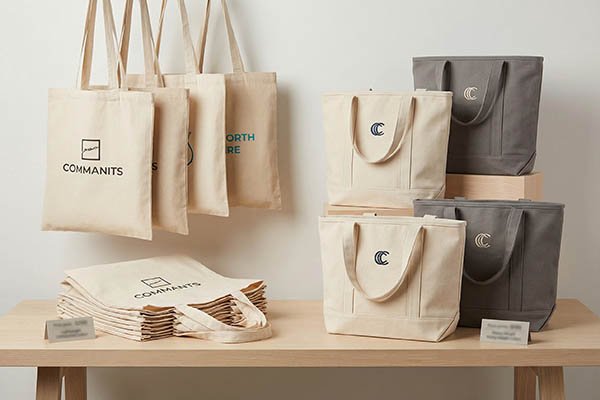
The most efficient way to manage your exhibition budget is to segment your audience. You do not treat every visitor the same way, so you should not give every visitor the same product.
The Pyramid of Value
Think of your inventory as a pyramid. The base of the pyramid is your "Volume Layer." These are cost-effective, lighter-weight bags. They are for the casual passerby, the students, and the brochure collectors. They do the job of brand visibility without draining your funds. You order these in the thousands.
The top of the pyramid is your "Prestige Layer." These are your heavy, structured, gusseted bags. You order these in the hundreds. You keep them behind the counter.
The Gifting Psychology
This mix creates a powerful psychological moment. When a visitor engages deeply with your team, you physically upgrade them. You reach for the special stock. You hand them the premium bag. This action validates their importance. It is a non-verbal way of saying, "We value this relationship."
Unified Visual Identity
Crucially, while the quality differs, the visuals must remain consistent. Use the same logo size and position on both bags. To the casual observer in the aisle, the sea of bags looks uniform. Your brand presence looks massive and consistent. Only the person holding the bag knows the difference in weight. This allows you to scale your visibility cheaply while cementing high-value relationships with quality.
Заключение
Choose bags by matching functional depth and fabric weight to visitor value. Prioritize A4 fit, handle comfort, and high-contrast printing. Contact Avecobaggie for guidance.
Frequently Asked Questions
Q: What is the typical production lead time for a custom exhibition bag order?
A: For standard cotton bags with screen printing, production usually takes 15 to 20 days after artwork approval. However, if you require specific dyeing of the fabric to match a corporate color or complex edge-to-edge printing, you should allow 25 to 30 days. Always factor in shipping time, which can vary depending on whether you choose air or sea freight.
Q: Does adding a zipper or inner pocket significantly increase the cost?
A: Yes, adding accessories like zippers, velcro, or inner pockets adds both material and labor costs, often increasing the unit price by 15-20%. For general exhibition giveaways, these are usually unnecessary. We recommend reserving these functional add-ons only for the high-end "VIP" tier bags to maximize your budget efficiency.
Q: Can I order bags in a specific pantone color instead of natural beige?
A: Yes, we can dye the cotton fabric to match your specific brand Pantone color. However, custom dyeing usually requires a higher Minimum Order Quantity (MOQ) compared to natural or white stock fabric, and it may add about a week to the production timeline.
Q: How much storage space will 500 cotton bags take up in my booth?
A: This depends heavily on the fabric weight and style. 500 units of flat, lightweight 5oz cotton bags can fit into just 2 standard export cartons, which can easily hide under a table. However, 500 units of structured 10oz canvas bags with bottom gussets are much bulkier and may require 5 to 6 cartons. You need to plan your booth storage accordingly.
Q: Will cotton bags shrink if the attendees wash them?
A: Natural cotton is untreated and not pre-shrunk, so it will shrink by approximately 5-10% after the first wash. We recommend advising users to wash them in cold water and hang them to dry. If size stability is critical for your design, we can discuss using pre-washed canvas, though this is a more premium option.
Q: Is it worth paying extra for double-sided printing?
A: For trade shows, absolutely. Attendees often swing bags around or wear them on different shoulders. If you only print on one side, your brand is invisible 50% of the time. Double-sided printing ensures 360-degree visibility in a crowded hall, which justifies the small additional printing cost.
Q: Can I get a physical sample before placing the full order?
A: Yes, we strongly encourage this. Digital mockups cannot show you the texture or the exact handle feel. We can send a pre-production sample with your logo so you can test the capacity and print clarity personally. This ensures there are no surprises on the day of the event.
Q: What is the difference between "Natural" and "Bleached White" cotton?
A: "Natural" cotton is unbleached and has a creamy, beige tone with tiny dark specks (seeds) visible in the fabric, emphasizing an eco-friendly image. "Bleached White" is chemically treated to be bright white. Natural is generally preferred for environmental exhibitions, while white works better for brands with logos that require a stark white background for contrast.
Q: If I have a very colorful, photographic logo, is screen printing still the best choice?
A: No. Screen printing is best for solid, separate colors. For photographic images or gradients, we recommend Heat Transfer or Digital Direct printing. While these methods might have a slightly different texture on the bag, they preserve the complex details and color shifts that screen printing cannot achieve.



 Русский
  English
  Deutsch
  Español
  Português
  العربية
  Français
  Italiano
  日本語
日本語  한국어
한국어  Dansk
Dansk