Перейти к содержанию

Many procurement managers struggle with custom orders because they do not fully understand how design choices affect production costs. This often leads to budget overruns or product specifications that are impossible to manufacture efficiently. You need a technical understanding of the product before you send an inquiry.
Defining your custom reusable bag needs requires a balance between design aesthetics and manufacturing realities. You must understand how material weight, cutting waste, sewing complexity, and print colors directly drive your unit cost. A clear specification sheet ensures accurate quoting and efficient production.

Understanding the cost structure of a bag is the first step to successful procurement. Let us analyze why this investment makes sense for your business operations.
Why choose custom reusable bags for your brand?
In B2B marketing, every dollar spent must show a return on investment (ROI). Custom bags are not just packaging; they are a high-frequency advertising asset with a lower Cost Per Impression (CPM) than most digital channels.
Custom reusable bags provide long-term brand exposure and tangible value to your clients. Unlike disposable packaging which is a sunk cost, a durable bag serves as a functional marketing tool that repeats your brand message thousands of times. This maximizes your marketing budget efficiency.

From a business perspective, custom bags solve two problems: packaging utility and brand visibility. When we analyze the cost benefits, we look at the lifespan of the product. A disposable plastic bag costs pennies but lasts twenty minutes. A custom cotton tote might cost a few dollars, but if your customer uses it twice a week for a year, your brand is seen over 100 times. The cost per view becomes negligible.
For retailers and brands, this also enhances the "perceived value" of the merchandise. B2B buyers know that packaging dictates the first impression. Delivering your samples or products in a high-quality, branded eco-bag signals to your clients that your company is stable, professional, and detail-oriented. It differentiates you from competitors who cut corners on packaging. Furthermore, in the current global trade environment, aligning with sustainability standards (ESG goals) is no longer optional; it is a requirement for entering many Western markets. Using certified eco-friendly bags ticks this compliance box for your supply chain.
How to pick the right material and style?
Material selection is the primary driver of your base cost. You must balance the physical weight (GSM) and texture with your budget constraints and the structural requirements of the bag.
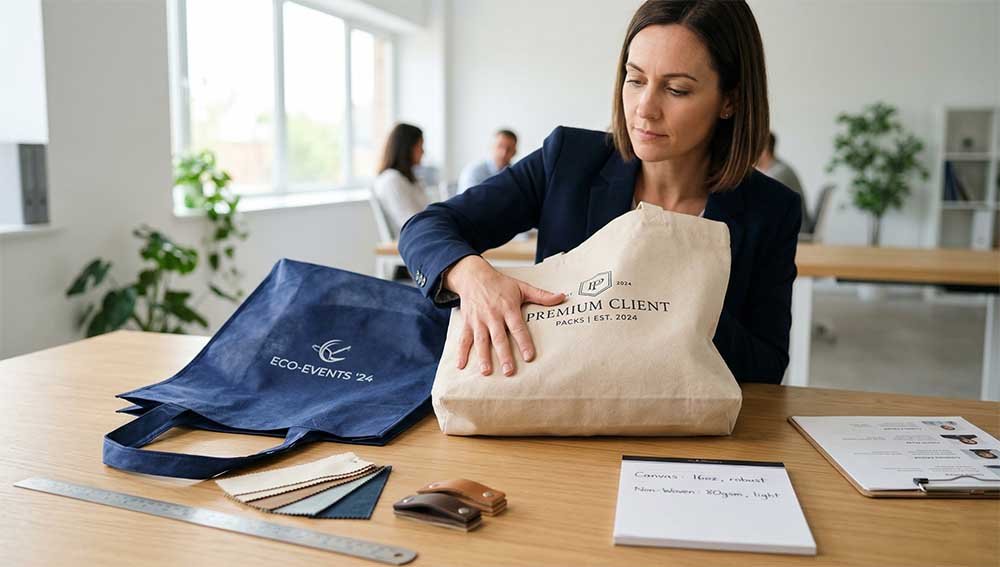
Select materials by analyzing the weight capacity required and your target unit price. Heavier fabrics like canvas increase durability but raise material and shipping costs, while non-woven fabrics offer the lowest entry price. The style complexity directly correlates with sewing labor hours.

When we calculate the quote for a client, the material cost usually accounts for 50% to 60% of the total price. This is determined by the material type and its thickness, usually measured in GSM (Grams per Square Meter).
- Cost Impact of Weight: A 12oz canvas bag is significantly more expensive than a 6oz cotton bag. Not only is the raw cotton more expensive, but the heavier weight also increases the shipping cost per unit when exporting from China to the US or Europe.
- Cost Impact of Style: The construction style dictates the "Sewing Labor Cost." A simple flat tote (two pieces of fabric sewn together) is the cheapest to produce. A bag with a "bottom gusset" adds complexity. A "full gusset" (sides and bottom) requires more stitching time. Adding features like zippers, inner pockets, or adjustable buckles will sharply increase the labor cost because they require skilled workers and slower production speeds.
- Material Efficiency: Standard materials like Non-woven or standard Polyester are cheaper because they are mass-produced. Specialized materials like Washable Paper or Tyvek have a higher raw material cost and often require higher Minimum Order Quantities (MOQ) from the fabric mill, which can tie up your cash flow.
| Материал | Cost Level | Долговечность | Best B2B Use Case |
|---|---|---|---|
| Нетканый материал | Низкий | Средний | Trade show giveaways, high volume events |
| Cotton (5-6oz) | Средний | Средний | Retail packaging, light gifts |
| Canvas (10oz+) | Высокий | Высокий | Premium merchandise, corporate gifts |
| RPET | Med-High | Высокий | Sustainable brand campaigns |
How to decide the size and capacity?
Size does not just determine capacity; it determines fabric utilization. Choosing a non-standard size can create significant fabric waste, which you pay for in the final price.
Determine bag dimensions by optimizing for fabric roll widths to minimize cutting waste. Standard sizes are more cost-effective than arbitrary custom dimensions. Capacity planning must account for the specific 3D volume of your products to avoid returns or usability issues.
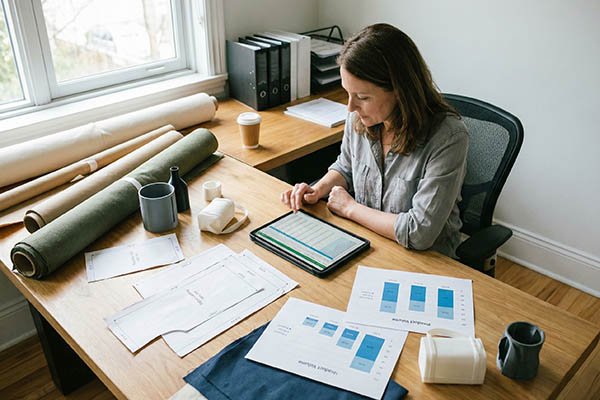
In bag manufacturing, we cut fabric from large rolls. These rolls come in standard widths (e.g., 1.5 meters or 1.6 meters).
- The "Waste" Cost: If your bag design fits perfectly across the width of the fabric roll, the efficiency is high, and the cost is low. If your bag size is just 2cm too wide, we might fit fewer bags across the roll, leaving a large strip of unused fabric. This is "offcut waste." You still pay for this wasted fabric. Therefore, using standard industry sizes or consulting your supplier for "optimal cutting sizes" can save you 10% to 15% on material costs.
- Structure vs. Labor: The shape also dictates the sewing process.
- Flat Bag: Simplest and cheapest. One continuous run of stitching.
- Box Bottom (3D): Requires folding and additional stitching at the corners. This takes more manual labor time.
- T-Bottom: A cheaper way to create volume compared to a full box structure.
- Shipping Volume: Do not forget logistics. A larger bag means fewer units per carton. This increases your freight cost per unit. If you are shipping via air cargo, a bulky bag layout can trigger "volumetric weight" pricing, which can be double the actual weight cost. We always recommend sizing your bag to fit efficiently into standard export cartons.
What affects printing and logo design?
The complexity of your artwork directly dictates the printing technology we must use, which in turn defines the setup fees and per-unit processing costs.
Printing costs are driven by the number of colors, print coverage area, and the chosen method. Screen printing requires separate films and plate fees for every color, making it costly for multi-color designs. Digital printing avoids plate fees but has a higher ink cost per unit.

In the B2B quoting process, "печать" is the most variable cost. We classify costs into "Fixed Setup Costs" and "Variable Running Costs."
- Screen Printing (Silkscreen): This is the industry standard for durability. However, every color in your logo requires a separate physical screen (a plate). If you have a 1-color logo, you pay 1 plate fee and 1 labor pass. If you have a 4-color logo, you pay 4 plate fees and the worker must print the bag 4 times. This quadruples the printing labor cost.
- Cost Tip: For tight budgets, reduce your logo to 1 single color. It creates a clean, minimalist look and saves significant money.
- Heat Transfer & Digital: For complex, colorful images (like a photo), we use heat transfer. This involves printing a film and pressing it onto the bag. The cost here depends on the area size of the print. A small logo is cheap; a full-coverage print is very expensive because of the film cost.
- Edge-to-Edge Printing: If you want artwork that goes all the way to the seam (full bleed), we must print the fabric до we sew the bag. This changes the production flow. We cannot use ready-made stock bags. This usually raises the MOQ and the lead time.
- Positioning: Printing a logo in the center is standard. Printing on the gusset (side) or close to the zipper is difficult and slows down production, leading to higher rejection rates and higher costs.
How to plan budget and MOQ effectively?
The unit price is heavily dependent on the order volume due to the amortization of fixed costs. You must analyze the "Price Break Points" to maximize your procurement budget.
Budget planning must include the Total Landed Cost: unit price, setup fees, packaging, and freight. Minimum Order Quantities (MOQ) exist to amortize machine setup and fabric sourcing costs. Ordering slightly above the MOQ often results in a significantly lower price per unit.

Every manufacturing run has "Start-up Costs." We have to purchase specific fabric, mix specific inks, and calibrate the cutting machines.
- The MOQ Logic: If you order 500 bags, these start-up costs are divided by 500. If you order 5,000 bags, they are divided by 5,000. This is why a small order might cost $3.00 per bag, while a large order drops to $1.50 per bag.
- Price Breaks: In bag manufacturing, typical price breaks happen at 500, 1000, 3000, and 10000 units. A smart procurement manager will ask, "What is the price difference if I increase from 500 to 1000?" Often, the total project cost increases only slightly, but you get double the inventory.
- Hidden Costs:
- Sample Fees: Custom samples cost money (usually $50-$150) to cover the technician’s time. This is usually refundable on bulk orders.
- Packing: Standard packing is bulk in a carton. If you need individual polybags or custom hangtags for retail display, this adds manual labor costs (approx $0.05 – $0.15 per unit).
- Payment Terms: Suppliers often require a 30% deposit to buy materials. Managing this cash flow is part of your budgeting.
How to find a reliable supplier?
A low unit price is meaningless if the defect rate is high or delivery is delayed. You need to audit suppliers based on their production control capabilities and supply chain stability.
Evaluate suppliers based on their production capacity, quality control (QC) systems, and export experience, not just price. A factory with robust QC reduces your risk of receiving defective goods. Reliable partners offer transparency in the supply chain and help optimize specifications to save costs.
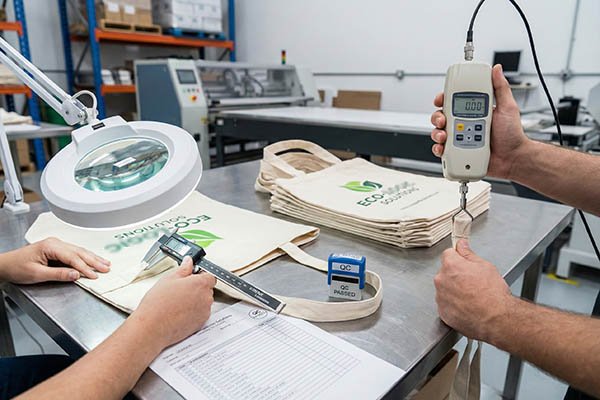
In international trade, the cheapest quote often carries the highest risk. If a supplier quotes 20% below market average, they are likely cutting costs in ways that will hurt you: using thinner fabric than promised, using cheap ink that fades, or skipping Quality Control checks.
- Factory vs. Trader: For complex custom bags, a factory with an internal design team (ODM service) is valuable. They can tell you immediately if a design is structurally unsound. However, for generic items, a trader might offer better logistics consolidation.
- The Cost of Quality: Ask about their QC process. Do they inspect the fabric before cutting? Do they trim loose threads? "Thread trimming" is a manual process. Cheap factories skip it, leaving your bags looking messy. We include this labor in our cost to ensure a "retail-ready" finish.
- Communication Efficiency: Time is money. A supplier who understands your spec sheet and replies within 24 hours saves your team weeks of back-and-forth emails. Look for suppliers who ask clarifying questions about load-bearing tests or print colors—this shows they are thinking about product safety and quality.
Заключение
To optimize your custom bag procurement, you must link design specs to cost drivers. Aligning your size with fabric width, simplifying print colors, and planning volume around price breaks will secure the best quality at the lowest effective cost.
Frequently Asked Questions
Q: What file formats do you need for the logo to ensure the print quality mentioned?
A: To avoid the "blurry" issues we discussed, we require Vector files (AI, EPS, or PDF) for screen printing. These files allow us to scale the logo without losing quality. For digital printing of photos, we need high-resolution Raster files (PSD, JPG, or PNG) at least 300 DPI to ensure clarity.
Q: How long does the manufacturing process actually take once I confirm the order?
A: While lead times vary by quantity, a typical B2B timeline involves 5–7 days for sample approval and 20–30 days for mass production after the deposit is received. If you have a specific event date, we recommend starting the inquiry process at least 60 days in advance to account for shipping.
Q: Can I request a pre-production sample (PPS) before you print all 5,000 bags?
A: Yes, and we highly recommend it. A PPS is a fully finished single unit made with your specified fabric and logo. Approving a physical PPS is the standard safeguard in B2B trade to ensure the "bulk production" matches your expectations 100% before we cut the rest of the fabric.
Q: Do you use Pantone (PMS) colors for matching my brand identity?
A: Yes. "Blue" is too vague for manufacturing. We use the Pantone Matching System (PMS) Solid Coated guide. You must provide the specific PMS code (e.g., Pantone 286 C) so our ink mixers can match your brand color exactly, regardless of the bag material.
Q: If I choose cotton bags, will they shrink after washing?
A: Natural cotton fibers are not pre-shrunk. You should expect about 5-10% shrinkage after the first wash. If precise sizing after washing is critical for your product, we can discuss using pre-washed canvas or adding a "wash cold/hang dry" care label to the inside of the bag.
Q: What are the standard payment terms for a B2B custom order?
A: The industry standard is a 30% deposit to initiate the order (used to purchase raw materials) and the remaining 70% balance paid before shipment or against the Bill of Lading (B/L), depending on our shipping agreement.
Q: Can you handle the logistics if I don’t have a freight forwarder?
A: Absolutely. While we discussed FOB (Free on Board) pricing, we can also quote DDP (Delivered Duty Paid). This means we handle the shipping, customs clearance, and taxes, delivering the bags directly to your warehouse door, which simplifies the process for many buyers.
Q: Does non-woven material have an expiration date?
A: Yes, this is an important storage consideration. Non-woven polypropylene is designed to be photodegradable. If stored in direct sunlight or high temperatures for over 12-18 months, the material may become brittle. We recommend storing these bags in a cool, dark warehouse.
Q: Can I add my own barcode or SKU sticker for retail scanning?
A: Yes. We can apply UPC barcodes or SKU stickers directly onto the hangtag or the outer polybag during the packing stage. This makes the goods "retail ready" immediately upon arrival, saving your warehouse team the labor of labeling them later.
Q: What is the acceptable defect rate (AQL) for a bulk order?
A: We follow the AQL 2.5 standard (Acceptable Quality Limit). This is the international standard for inspecting goods. It defines the maximum number of minor or major defects allowed in a batch. We perform internal inspections to ensure the batch stays well within these limits before shipping.

 Русский
  English
  Deutsch
  Español
  Português
  العربية
  Français
  Italiano
  日本語
日本語  한국어
한국어  Dansk
Dansk