Saltar al contenido

Premium products can lose part of their appeal when the packaging looks cheap, weak, or disposable. The right bag can protect the product and support the brand.
Tyvek packing bags can add value by combining lightweight protection, distinctive appearance, printability, durability, and potential reuse. For premium and sustainable brands, they can work as both packaging and a reusable product accessory.
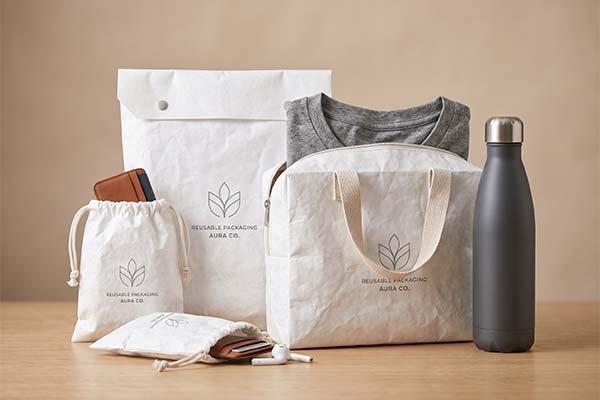
Packaging is not only about putting a product inside a bag. For premium accessories, designer goods, organic products, and specialty products, the packaging can affect product presentation, brand positioning, perceived value, and the customer experience.
This is where Tyvek becomes an interesting option. It can offer a different balance of protection, appearance, weight, and reuse compared with common paper, fabric, and plastic packaging.
Why Are Brands Looking Beyond Traditional Packaging Materials?
A packaging bag may look simple, but buyers often need it to handle much more than one transportation step. Premium products place higher demands on protection, appearance, and continued use.
Brands are looking beyond traditional packaging because packaging now needs to balance cost, protection, appearance, brand identity, customer experience, and possible reuse.
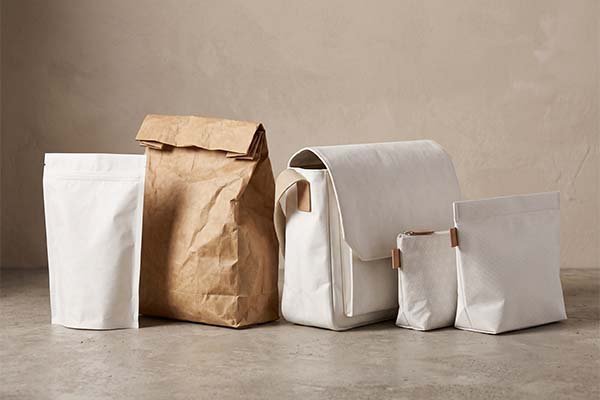
Paper packaging remains popular because it is easy to print, easy to customize, and familiar to consumers. It works well for many retail applications. However, repeated handling, moisture exposure, folding, and transportation can create limits for some products.
Fabric bags offer another option. Cotton and other textile bags work well for dust bags, reusable packaging, fashion products, and gift packaging, but their weight, thickness, sewing requirements, and production cost need to be considered.
Plastic film is lightweight, flexible, inexpensive, and water resistant, yet its appearance may not match a premium or design-led brand. This creates a gap between simple protection and a more complete packaging experience.
A buyer may want a bag that feels different from a disposable plastic bag but does not need the weight or appearance of a traditional fabric bag.
Packaging can also stay with the customer after purchase. A shoe bag, accessory pouch, or storage bag can continue to protect the product at home or during travel.
For this reason, packaging decisions are moving from Cost + Protection toward Cost + Protection + Appearance + Brand + Reuse.
Why Is Tyvek Considered for Premium and Sustainable Product Packaging?
Tyvek attracts attention because it combines characteristics that buyers usually associate with different materials. It can look paper-like, feel different from ordinary plastic, and provide the strength needed for repeated handling.
Tyvek is a nonwoven HDPE material that combines a paper-like appearance with lightweight construction, tear resistance, water resistance, breathability, durability, and strong printing potential.
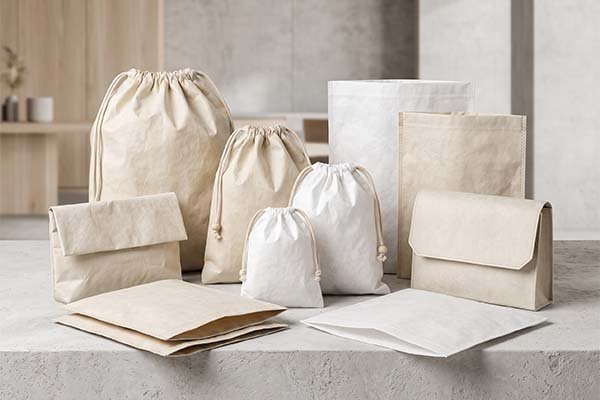
Tyvek is not ordinary paper, woven fabric, or plastic film. DuPont describes Tyvek as a material made from continuous high-density polyethylene fibers1. This structure gives it a distinctive combination of properties.
Its lightweight construction can help reduce packaging weight while still providing useful strength. Its continuous fiber structure also gives it resistance to tearing, puncture, and abrasion, which matters when bags are handled several times during production, transport, retail display, and storage.
Another useful characteristic is the balance between water resistance and breathability2. Tyvek can resist liquid water while allowing water vapor to pass through, so it should not simply be described as a fully waterproof material.
The surface also gives brands a different visual and tactile option. A simple logo on a clean Tyvek surface can create a modern packaging style without adding a large amount of decoration.
Printing is another strong point. Depending on the specific grade and production method, Tyvek can support processes such as offset, flexographic, screen, UV inkjet, thermal transfer, gravure, latex, and letterpress printing3. Buyers should confirm the suitable printing method with the supplier before production.
Tyvek also comes in different structures and grades. Hard structure versions have a more paper-like and firm feel, while soft structure versions are more flexible and fabric-like.
This means a buyer should not simply specify “Tyvek” and stop there. The structure and grade should match the intended application.
Which Products Can Benefit From Custom Tyvek Packing Bags?
The best applications are not defined only by industry. They are defined by the product’s need for protection, presentation, durability, and continued use.
Custom Tyvek packing bags can work well for premium accessories, fashion products, specialty goods, gifts, organic lifestyle products, and other items that need both product protection and branded presentation.
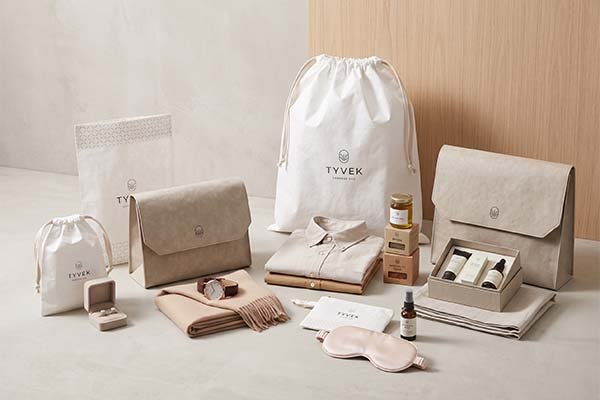
Premium footwear, handbags, belts, scarves, hats, jewelry, watches, and other accessories are strong candidates because their packaging often needs to support the product after purchase.
A Tyvek bag can work as a dust bag, storage bag, protective bag, or presentation bag. The same idea applies to specialty products such as art products, premium stationery, collectibles, design goods, small tools, and electronics accessories.
Organic and natural product brands can also consider Tyvek as part of a broader packaging strategy, but the sustainability claim needs to stay accurate. Tyvek is made from HDPE, so it should not be described as organic, biodegradable, or compostable.
Its potential sustainability value comes from properties such as durability, reuse, material efficiency, and possible recycling where suitable facilities exist. This distinction matters for B2B buyers because packaging claims need to match the actual material and local end-of-life system.
Reusability can be especially useful. A traditional disposable package may have a short life. A well-designed Tyvek bag can move from Open → Use → Store → Reuse.
A footwear brand, for instance, could use one branded Tyvek drawstring bag to protect a pair of shoes during delivery and then give the customer a useful storage bag for future travel.
The packaging then provides value beyond the point of sale.
How Can Tyvek Packing Bags Improve Perceived Product Value and Brand Experience?
A customer does not experience a product in isolation. The package is often the first physical layer between the customer and the product.
Tyvek packaging may improve perceived product value when its material, design, printing, and function match the product’s positioning and create a consistent customer experience.
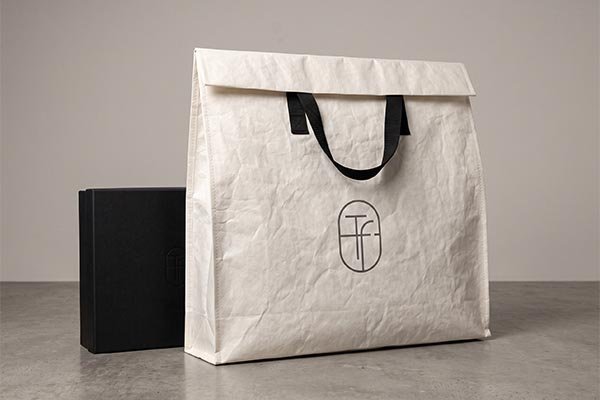
A premium product can feel less refined when the packaging is thin, generic, or difficult to reuse. The opposite can also happen. A carefully designed bag can make the product presentation feel more complete.
This does not mean that Tyvek automatically makes a product premium. The result depends on the relationship between the material and the product.
A minimalist fashion brand may use a clean Tyvek bag with a small black logo and simple closure. A lifestyle brand may use a printed pattern and a drawstring. A designer brand may use a custom shape with restrained graphics.
In each case, the material supports the design rather than replacing it. The unboxing sequence can also become more intentional.
A customer may open the outer carton, find a branded Tyvek bag, and then discover the product inside. After purchase, the bag can continue to protect the item in a wardrobe, suitcase, drawer, or storage area.
That creates another type of value. The customer is not only receiving packaging. They are receiving a useful accessory that carries the brand identity.
This is especially relevant for products such as shoes and handbags because storage protection is already part of the customer’s normal product use. A durable branded bag can therefore connect product presentation with post-purchase utility.
The actual product value does not change, but the customer’s perception of care, quality, and brand consistency can change.
How Can Brands Use Tyvek Bags as Part of Their Packaging Strategy?
Tyvek does not have to serve only one packaging function. Buyers can place it at different stages of the packaging system based on the product and logistics process.
Brands can use Tyvek bags as primary packaging, secondary packaging, protective packaging, reusable storage packaging, or branded presentation packaging.
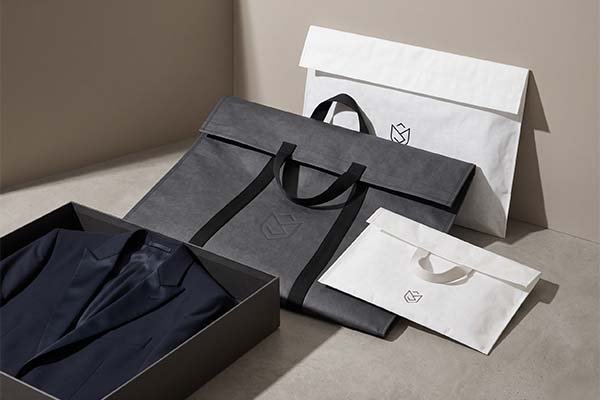
For primary packaging, the structure can be simple: Product → Tyvek Bag. This works when the bag itself needs to become part of the product presentation.
Accessories, small lifestyle products, specialty goods, and selected premium items can use this approach.
For secondary packaging, the structure may be Product → Inner Packaging → Tyvek Bag → Shipping Carton. Here, the Tyvek bag provides another protective and presentation layer around a product that already has a box or inner package.
This can make sense when the product needs additional protection during handling. Tyvek can also serve as a dedicated protective layer for dust, moisture, abrasion, or storage.
DuPont materials describe Tyvek applications that include industrial bags, parts protection, art packaging, and other protective uses.
Another useful structure is reusable packaging. The customer opens the package, removes the product, and keeps the bag for storage or travel.
This changes the role of packaging from a short-term container into something that can remain useful during the product’s life.
Brands can also build a stronger visual identity through logo printing, patterns, labels, closures, handles, drawstrings, gussets, and custom shapes.
The final product is then not just a generic packaging bag. It becomes a custom branded Tyvek packaging solution designed around the product.
What Should Buyers Consider When Developing Custom Tyvek Packaging Bags?
A good custom bag starts with clear specifications. The more production details are confirmed before quotation and sampling, the less room there is for avoidable changes later.
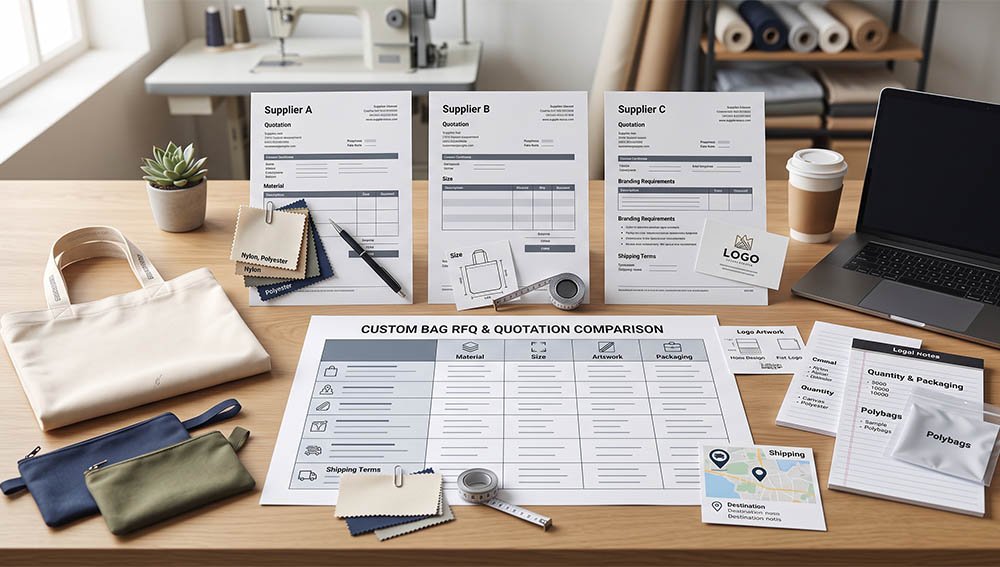
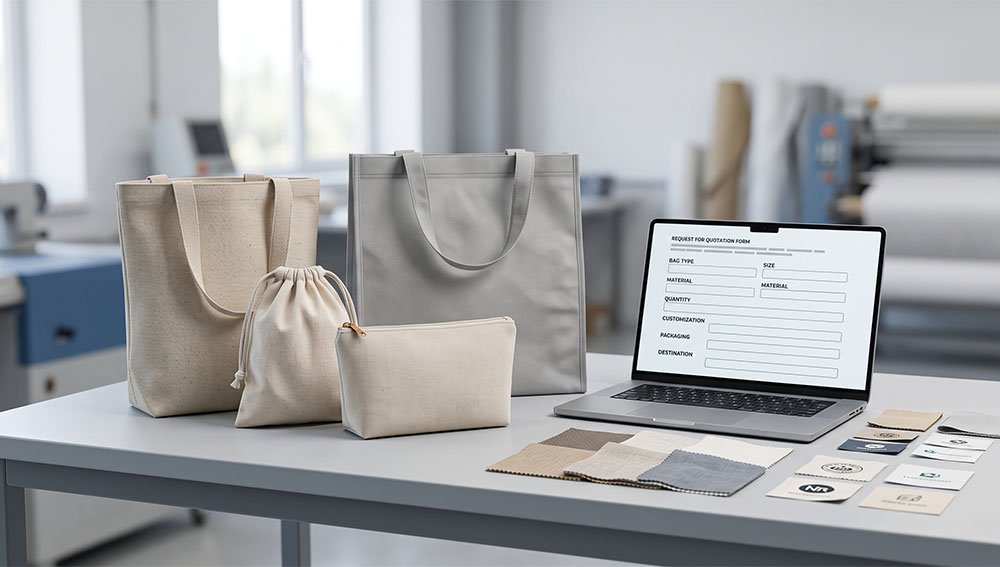
Buyers should define product dimensions, Tyvek structure and grade, bag construction, size tolerance, printing, accessories, MOQ, packing, and shipping requirements before bulk production.
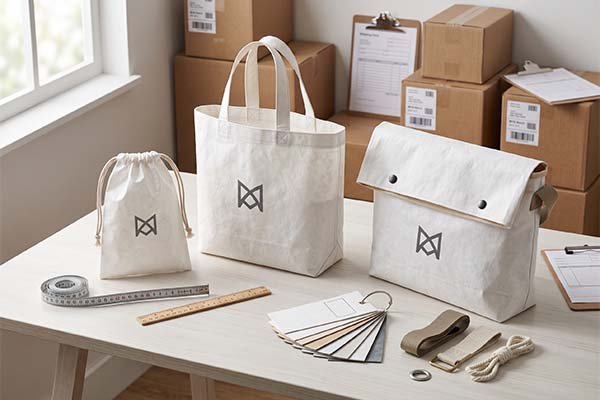
The first requirement is the product itself. Buyers should provide product length, width, height, weight, shape, and the required fit.
A request such as “30 × 40 cm bag” is not enough when the product has a specific opening or shape. The supplier also needs to know the required bag opening, gusset, closure position, and tolerance.
Material selection comes next. Different Tyvek structures and grades can provide different levels of firmness and flexibility, so the buyer should define the required appearance, durability, and handling characteristics.
Construction also affects the final result. A buyer may choose a flat bag, gusset bag, pouch, envelope, drawstring bag, or custom shape. Seams, reinforcement, and closures need to be specified as well.
Printing should include the artwork, printing side, area, position, color count, and file format. Accessories such as drawstrings, ribbons, zippers, labels, and hangtags can improve function, but each added component affects cost and production.
MOQ should be discussed together with expected annual demand rather than only the first order quantity.
Packing details also matter. Buyers should confirm inner packing, pieces per polybag when used, carton quantity, carton size, net weight, gross weight, and shipping marks.
For export orders, carton dimensions and CBM can affect freight cost and loading efficiency. A supplier should therefore evaluate the complete packaging specification instead of quoting only the bag itself.
How Does Custom Tyvek Packaging Affect Total Packaging Cost?
A low material price does not always produce the lowest packaging cost. Custom packaging needs to be evaluated as a complete production and logistics system.
Total Tyvek packaging cost can include material, bag construction, printing, accessories, MOQ effects, inner packing, cartons, and shipping, so buyers should compare the full delivered cost.
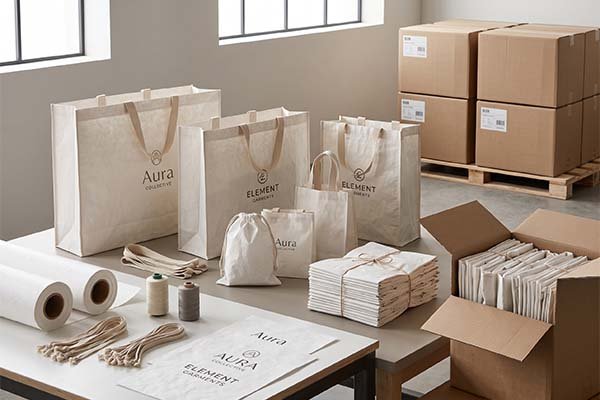
Material cost is usually influenced by the selected Tyvek grade, finished bag size, and material consumption. A larger bag naturally uses more material, but construction can also change consumption.
A gusset, reinforced seam, special shape, or complex closure may add production steps.
Printing creates another cost layer. The supplier may need to consider the printing area, number of colors, number of sides, artwork complexity, and setup requirements.
Accessories add cost too. A zipper, ribbon, drawstring, label, or hangtag may seem small when viewed individually, but the difference becomes meaningful across 10,000 or 50,000 bags.
MOQ also matters because small orders may not spread material purchasing, setup, and production costs as efficiently as larger orders.
Packing should be included in the calculation. Individual packing, inner bags, master cartons, carton labels, and shipping marks all affect the final cost.
Freight is another part of the picture. A lightweight material may reduce packaging weight, but bag dimensions and carton volume still affect CBM and loading efficiency.
This is why a buyer should ask for the total packaging cost, not only the unit price of the bag.
A supplier may offer a lower material price while creating higher costs through complex construction, oversized packing, inefficient cartons, or expensive accessories.
A right-sized bag with a simple structure, controlled printing, suitable MOQ, and efficient carton packing can sometimes provide a better overall result even when its material price is not the lowest.
When Does Tyvek Make Sense for Custom Packing Bags?
Tyvek is most useful when its specific properties solve a real packaging problem. Buyers should select it because the material fits the application, not simply because it sounds premium.
Tyvek makes sense when buyers need lightweight, durable, printable, water-resistant, reusable, or visually distinctive packaging for products with meaningful presentation and protection requirements.
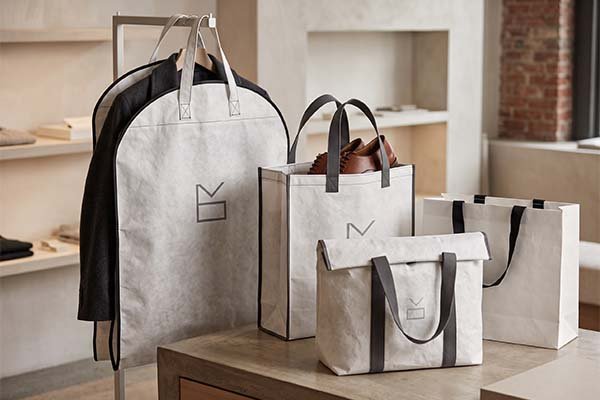
A premium product is one clear case. If the product has a higher price or a strong design identity, packaging needs to support that position.
Lightweight packaging is another reason. Export brands may ship thousands of bags, so reducing unnecessary packaging weight can help with handling and logistics.
Durability matters when bags face repeated transportation, storage, or customer use. Reusability makes the case stronger because the bag can provide value after the initial delivery.
Protective applications can also benefit from Tyvek’s combination of water resistance and tear resistance.
Branding is another practical reason. Buyers can use printing and bag construction to create a packaging piece that looks different from standard paper, plastic, or cotton bags.
The material can also fit brands that want a more modern or technical appearance.
Sustainable packaging strategy is a broader consideration. Buyers can assess material efficiency, durability, reuse, recyclability, and the local collection system together.
A simple mono-material Tyvek bag may be easier to assess than a package made from several bonded materials. Still, the buyer should evaluate the complete package rather than making a sustainability claim based on the material alone.
The strongest fit usually appears when several needs exist at the same time. A premium footwear brand may need protection, branding, low weight, and a reusable storage bag.
In that case, Tyvek can address several requirements with one packaging component.
When Might Tyvek Not Be the Best Packaging Material?
Tyvek is not the right answer for every packaging project. A good B2B recommendation should also show when another material may provide better value.
Tyvek may not be the best choice when the main requirement is the lowest possible unit cost for simple, disposable, high-volume packaging with limited branding and short-term use.
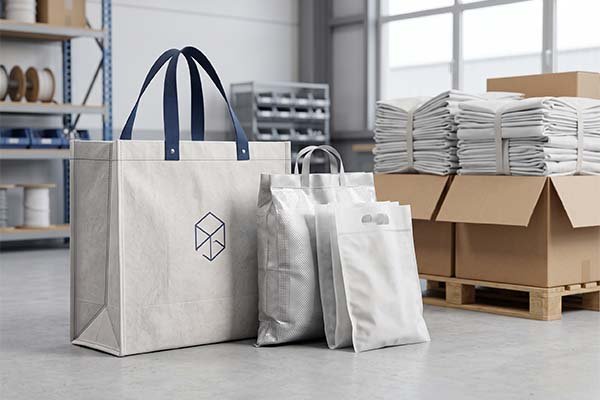
If a product needs a very basic disposable bag and the buyer orders hundreds of thousands of pieces with minimal printing, a lower-cost material may make more sense.
The same applies when the packaging has almost no handling after delivery and the customer has no reason to reuse it.
A buyer should also question whether the material’s performance is actually needed. Paying for higher tear resistance or a distinctive surface does not create value if the package only holds a lightweight product for a short period.
Construction can also make the difference. A highly customized Tyvek bag with several accessories may become unnecessarily expensive if a simple paper or textile bag can perform the same function.
Sustainability goals also need careful evaluation. Tyvek is HDPE-based, so it should not be presented as biodegradable or compostable.
Its recycling potential depends on the material format, complete package design, and local recycling infrastructure4.
A package with multiple bonded materials, coatings, or difficult-to-remove components may have a different end-of-life path from a simple Tyvek-only structure.
The right decision should therefore start with the actual packaging objective.
If the buyer needs durability, reuse, product protection, distinctive branding, and a lightweight structure, Tyvek may be a strong option.
If the buyer needs only a low-cost disposable container, another material may deliver better economic value. Tyvek should be selected when its properties match the job.
How to Develop Custom Tyvek Packing Bags From Concept to Production?
A custom Tyvek bag should move through a clear development process. This helps the buyer and supplier control material, appearance, cost, and production quality before bulk manufacturing.
A practical development process is Product Requirements → Material and Bag Design → Branding → Cost Evaluation → Sample → Approval → Production → Inspection → Shipment.
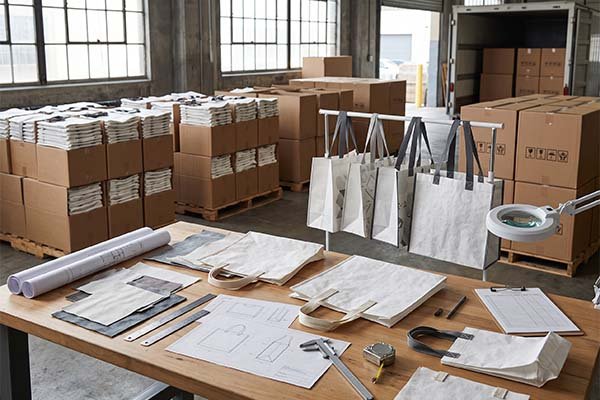
The first step is to define the product requirements. The buyer should provide the product type, dimensions, weight, application, target market, expected order quantity, and any special protection requirements.
The supplier can then recommend a suitable bag size and structure.
The second step is material and bag specification. This includes Tyvek structure, grade, finished size, shape, seam method, gusset, opening, and closure.
The third step covers branding. The buyer provides the logo, artwork, colors, printing position, and printing area.
At this stage, it is useful to review how the graphics work with the actual material surface instead of judging the design only on a computer screen.
The fourth step is cost evaluation. The supplier should calculate the effect of quantity, material, construction, printing, accessories, packing, and shipping.
A sample should then be developed. The prototype or pre-production sample gives the buyer a physical way to check size, material feel, construction, printing, closure, and overall appearance.
Sample approval should happen before bulk production.
Once the sample is approved, the factory can move into mass production using the approved specifications as the reference.
Quality inspection should cover material, dimensions, seams, printing, closure, appearance, quantity, and packing.
The final stage is packing and shipment. Carton quantity, carton dimensions, shipping marks, and export documents should match the agreed order details.
This process turns a general request for “Tyvek bags” into a controlled custom packaging project.
Conclusión
Tyvek packing bags can combine protection, branding, durability, and reuse in one packaging solution. For the right products, that can extend packaging value beyond the point of sale.
Frequenty Asked Questions
Q: Can Tyvek packing bags be made in custom colors?
A: Yes. Custom color options can be developed based on the selected Tyvek grade, printing method, and production requirements. Buyers should confirm the available color range with the supplier before sampling.
Q: Can Tyvek bags be made with transparent windows?
A: A transparent window can be added as part of some packaging designs, but it introduces another material into the bag. Buyers should consider how the added component affects appearance, construction, and end-of-life handling.
Q: Can Tyvek packing bags include a product label?
A: Yes. Labels can be attached to the bag as part of the branding design. The label can carry information such as the brand name, product code, care instructions, or other required details.
Q: Can Tyvek bags be folded for retail display?
A: Yes. Tyvek bags can generally be folded for storage, transportation, or retail presentation. The suitable folding method depends on the bag structure, thickness, construction, and final appearance requirements.
Q: Can Tyvek packing bags be used for food packaging?
A: Tyvek should not automatically be treated as suitable for direct food contact. Buyers should confirm the specific grade, intended application, regulatory requirements, and supplier documentation before using it for food-related packaging.
Q: Can Tyvek bags be made with custom handles?
A: Yes. Custom handles can be considered for applications that require easier carrying. Handle material, attachment method, size, and load requirements should be confirmed during the bag design stage.
Q: Can Tyvek bags be used for products with sharp edges?
A: They can be considered for some products with edges, but the bag design should match the product’s shape and handling conditions. Additional reinforcement or a different construction may be needed when the product creates higher puncture or abrasion risk.
Q: How should finished Tyvek bags be stored before use?
A: Finished bags should normally be kept in a clean and dry storage environment and protected from unnecessary compression, contamination, and prolonged exposure to unsuitable conditions. The supplier can provide storage guidance based on the specific material and construction.
Q: Can Tyvek packing bags be produced with different closure styles in the same order?
A: This can be possible for custom projects, but different closure styles may require separate production setups and can affect MOQ, sampling, and unit cost. Buyers should discuss mixed designs with the supplier before placing the order.
Q: Can Tyvek bags be used for international retail distribution?
A: Yes. Tyvek bags can be produced for international retail packaging, but buyers should check the packaging, labeling, recycling, and product-related requirements of each target market before mass production.
-
DuPont explains that Tyvek is a synthetic nonwoven material made from high-density polyethylene fibers and describes its lightweight, durable, breathable, and water-resistant properties. ↩
-
DuPont explains that Tyvek resists liquid water while allowing water vapor to pass through, giving the material its combination of water resistance and breathability. ↩
-
DuPont’s Tyvek printing guidance explains that Tyvek can be printed using a range of traditional and digital printing processes, depending on the specific material and application. ↩
-
The U.S. Environmental Protection Agency provides information on recycling infrastructure and emphasizes the importance of evaluating available local systems when considering end-of-life options for materials. ↩

 English
  Deutsch
  Español
  Português
  Русский
  العربية
  Français
  Italiano
  日本語
日本語  한국어
한국어  Dansk
Dansk