Skip to content

Sourcing customized bags for a major trade show or product launch is high-stakes. You face tight deadlines, strict budgets, and a market flooded with suppliers offering vastly different prices.
The market for customized non-woven bags is highly fragmented and fiercely competitive. While price wars are common at the low end, the B2B sector values supply chain stability and execution capability. For procurement professionals, the real competition is finding a balance between unit cost, print quality, and reliable delivery.
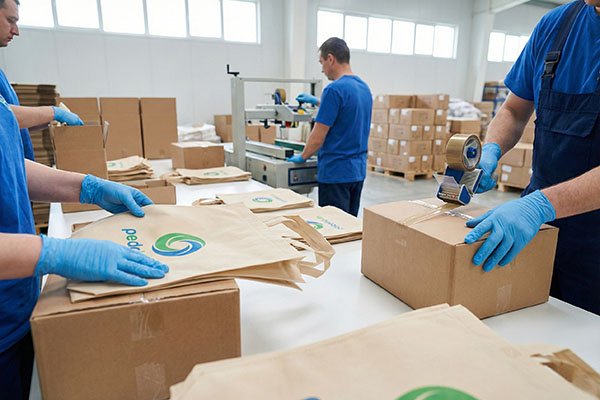
Comparing quotes is not enough. You must understand the manufacturing reality behind the price tag. This knowledge turns a commodity purchase into a strategic brand investment.
WHAT is the current market size and who are the buyers?
The global demand for non-woven bags is driven by corporate sustainability goals and the ban on single-use plastics. This is no longer just a retail trend; it is a B2B necessity.
Leading buyers include exhibition organizers, marketing agencies, and multinational corporations. In Europe and North America, the focus has shifted from "getting a bag" to "sourcing a compliant, high-quality branding tool." The market in Asia remains production-heavy, serving as the global factory floor.
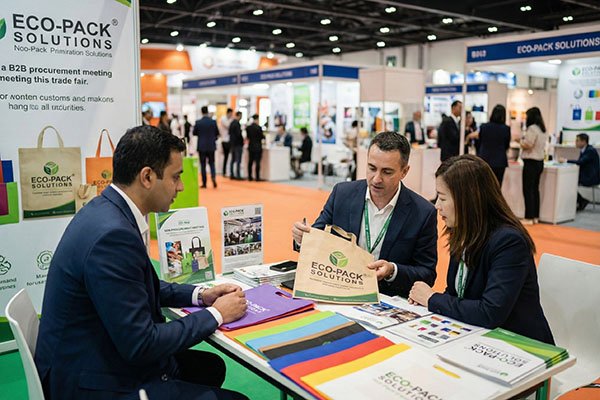
The customized bag market is segmented by buyer intent. A supermarket chain buying for utility has completely different requirements than a fashion brand buying for image. Understanding this segmentation helps you identify which suppliers are actually qualified to serve you.
Most B2B buyers fall into specific categories, each with distinct procurement priorities. If you approach a low-end factory with high-end requirements, you will fail.
| Buyer Category | Typical Profile | Primary KPI | Procurement Pain Point |
|---|---|---|---|
| Brand Owners | Marketing Directors | Brand Consistency | Color matching (Pantone) and print clarity. |
| Wholesalers | Importers/Distributors | Margin & Volume | Stability of raw material prices and container optimization. |
| Event Agencies | Project Managers | Hard Deadlines | Lead time reliability; a missed date means the product is useless. |
| Retail Chains | Procurement Officers | Unit Cost | Compliance (BSCI/Sedex) and massive scale production capacity. |
We see a clear trend: successful buyers treat their bag supplier as a strategic partner, not a spot vendor. This ensures priority during peak seasons.
WHY do prices and MOQs vary so much?
You receive two quotes: one for $0.35 and one for $0.55. On paper, the specs look identical. This price gap is usually due to invisible manufacturing costs.
Price variation is driven by raw material grades (virgin vs. recycled), machine amortization, and labor intensity. MOQs (Minimum Order Quantities) exist to cover the fixed setup costs of dyeing fabric and burning printing plates.
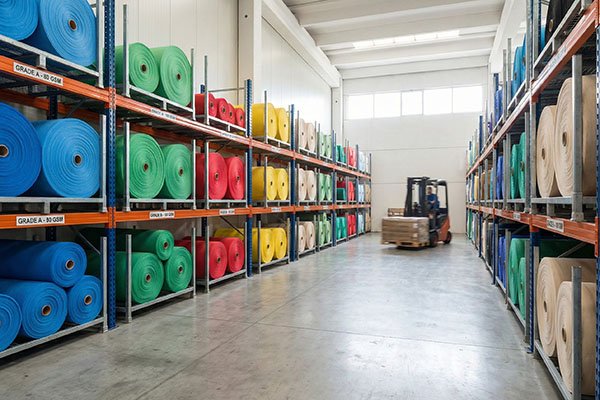
To understand the price, you must understand the cost structure of the factory.
Primo, Costo del materiale. This is the biggest variable. A bag made from 80gsm "New Material" (100% virgin PP) is strong and bright. A bag made from "Recycled Mix" might be cheaper, but the fabric is brittle and the color is dull. Unethical suppliers often use lighter fabric (e.g., 70gsm) while quoting 80gsm to undercut competitors.
Secondo, Production Method.
- Ultrasonic (Heat Sealed): This is an automated process. The machine cuts and bonds the fabric instantly. It has low labor costs but requires high MOQs (usually 5,000+) to justify the machine setup. The output is huge, but the perceived value is lower.
- Sewn (Stitched): This requires manual labor. Workers sew the bags on machines. It is slower and costs more per unit, but the load-bearing capacity is higher. It allows for lower MOQs because there is less machine changeover time.
Terzo, Printing Setup.
If you want a 4-color logo, we must make 4 separate screen plates or copper cylinders. This fixed cost is high. If you order 500 bags, that cost is huge per unit. If you order 10,000, it is pennies.
B2B Insight: A "too good to be true" price often means the supplier is using mixed scrap material or skipping the reinforcement stitching at the handles.
HOW does material and print affect competitiveness?
In B2B marketing, the bag is the first touchpoint with your client. A poor-quality bag reflects poorly on your company’s professionalism.
Competitiveness in this sector is defined by "Visual Value." High-end printing methods like Lamination (Rotogravure) create a waterproof, retail-grade finish. Simple Silk Screen is cost-effective but limited in detail.
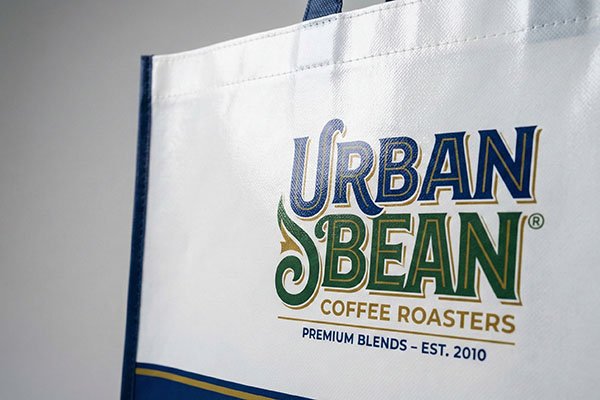
The material and print choice dictates the "shelf life" of your marketing message.
If you choose a cheap, heat-sealed bag with a single-layer screen print, the logo will scratch off after a few uses. The bag ends up in the trash, and your brand impression dies with it.
If you choose a laminated woven or non-woven bag, the print is protected under a film. The bag is waterproof and durable. Your client will use it for months for grocery shopping.
From a procurement perspective, you are buying "Cost Per Impression" (CPI), not just a bag.
- Silk Screen: Best for simple vector logos (1-3 colors). It is manual and slow. The ink layer is thick.
- Heat Transfer: Best for full-color images on small quantities. It is a digital sticker applied with heat.
- Lamination: Best for high-volume, full-coverage branding. It involves printing on a BOPP film and bonding it to the non-woven fabric. This is the gold standard for durability.
Technical Note: Always ask for the "handle cross-stitching." This "X" stitch increases the weight capacity from 5kg to 10kg. It costs a few cents more but prevents handle failure—a common embarrassment at trade shows.
WHAT impact does sustainability have on purchasing?
Sustainability is no longer a "nice-to-have"; it is a compliance requirement for entering markets like the EU and UK.
Eco-compliance is a major differentiator. Buyers now demand documentation like GRS (Global Recycled Standard) to prove the recycled content claims. This shift impacts pricing, as certified rPET material carries a premium over standard plastic.
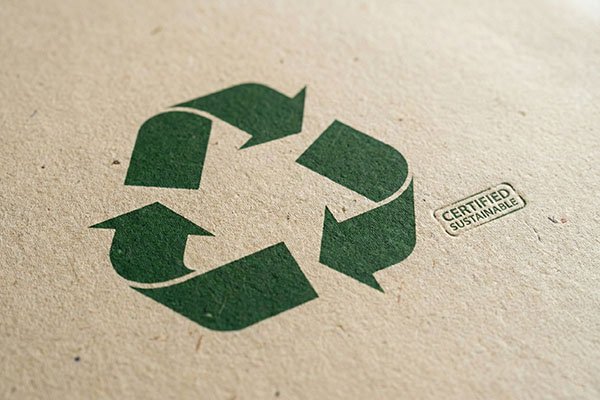
Many B2B buyers face internal pressure to procure "green" products. However, the market is full of greenwashing.
A standard non-woven bag is reusable, but it is still Polypropylene (plastic). To be truly competitive in the eco-sector, you need rPET (Recycled Polyethylene Terephthalate). This is made from plastic bottles.
The procurement challenge here is the cost-benefit analysis:
- Standard PP: Lowest cost. Reusable. Accepted in most markets.
- rPET (with GRS certificate): Higher cost (15-20% more). High marketing value. Essential for brands with strict CSR (Corporate Social Responsibility) policies.
- PLA (Cornstarch): Very high cost. Biodegradable. Short shelf life.
If your company has a strict sustainability mandate, you must verify the supplier’s certificates. A trading company might fake a certificate. A real manufacturer will have their name on the GRS audit document. This validation is part of your risk management.
HOW to spot a reliable manufacturer vs trading company?
Supply chain transparency is the only way to guarantee quality control and on-time delivery.
Distinguishing between a factory and a trader is critical. Traders often lack control over production schedules, leading to delays. Manufacturers offer direct communication, lower costs for large volumes, and accountability for quality issues.
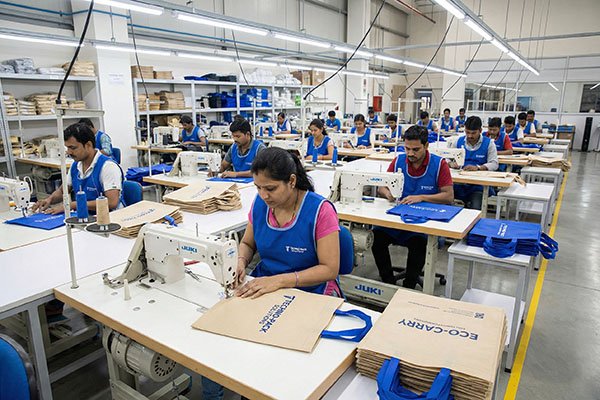
In international trade, the person who controls the production line controls the outcome.
Trading companies are useful for sourcing many different small items (pens, notebooks, bags) in one container. But for a dedicated bag order, they add a layer of cost and opacity.
Here is how you can vet a supplier during the RFQ (Request for Quotation) process:
- Technical Knowledge: Ask about the "gram weight tolerance" or "stitch length." A factory owner knows these answers immediately. A trader has to ask someone else.
- Customization Flexibility: Ask to change the handle length or add an inner pocket. A factory can say "yes" and adjust the pattern. A trader might say it is impossible because they are buying standard stock.
- Production Updates: Demand "WIP" (Work In Progress) photos. A real factory can send you a photo of your material being cut today.
- Location: Check the address. If they are in a downtown office building in a major financial city, they are likely a trader. If they are in an industrial zone in Wenzhou or Guangzhou, they are likely a factory.
For B2B buyers, the goal is Supply Chain Security. Working directly with a manufacturer like us means you have a dedicated line of communication. We understand that a late delivery for a trade show is not just an inconvenience; it is a business failure.
Conclusione
Success in the customized bag market depends on strategic sourcing, not just price comparison. By prioritizing material specs, print durability, and direct factory relationships, you secure a product that elevates your brand and delivers a strong ROI.
Frequently Asked Questions
Q: What is the specific HS Code I should use when importing non-woven bags to handle customs duties?
A: For most standard polypropylene (PP) non-woven shopping bags, the HS Code is typically 4202.92. However, if the bags are classified strictly as packing material rather than "shopping bags," some regions use 6305.33. Always verify with your local customs broker, as duties vary significantly between the US, EU, and Australia based on these codes.
Q: Can I dye the non-woven fabric to a specific Pantone (PMS) color for my brand?
A: Yes, but with conditions. Factories usually stock 30-40 standard fabric colors (black, white, navy, red, etc.). To dye the actual fabric to a specific custom Pantone color, the MOQ is much higher—typically starting at 1 ton of material (approx. 20,000+ bags) because the factory must mix a custom masterbatch for the extruder.
Q: What file format do you require for the artwork to ensure the best print quality?
A: For Silk Screen and Rotogravure printing, we strictly require Vector files (AI, EPS, or PDF) where fonts are outlined. Raster files (JPG, PNG) are only acceptable for Heat Transfer printing, but they must be at least 300 DPI at actual print size to avoid blurriness.
Q: How should I store non-woven bags if I order a year’s supply at once?
A: Non-woven polypropylene is photodegradable. You must store the cartons in a dry, cool, and dark warehouse. Prolonged exposure to direct sunlight or high UV sources will cause the material to become brittle and disintegrate within 6-12 months.
Q: What is the industry standard for "acceptable defect rate" in a bulk order?
A: In mass production of non-woven bags, a defect rate of under 2-3% is considered the industry standard. This accounts for minor stitching variances or slight ink smudges. We usually provide a few extra bags in the shipment to cover this potential margin.
Q: Is there a difference in packing methods between "Carton" and "Woven Bale"?
A: Yes. Cartons (cardboard boxes) protect the bags better and prevent creasing, which is essential for laminated bags or retail orders. Woven Bales (compressed sacks) are cheaper and allow you to fit 20-30% more bags into a shipping container, but the bags will arrive wrinkled and are harder to handle at the warehouse.
Q: Are sample fees refundable if I place a full order later?
A: Generally, yes. The fee for a physical custom sample (usually $50-$150 depending on printing plates) is typically deducted from the final invoice if the subsequent bulk order meets the Minimum Order Quantity (e.g., 3,000+ pieces).
Q: How do you test the weight capacity of the bags to ensure they won’t break?
A: We perform two types of tests: a Static Test (hanging a weight, e.g., 10kg, for 24 hours) and a Dynamic Test (lifting the weighted bag up and down 500 times). For B2B buyers, we recommend requesting a "Load Test Report" before shipment to ensure the handle stitching meets your specifications.
Q: Why do my printed bags have a strong chemical smell when I open the carton?
A: This often happens with heavy screen printing or lamination if the bags are packed immediately after production without "airing out." While the smell usually dissipates after 48 hours of ventilation, you can request an "odor-free" requirement in your contract, which forces the factory to let the bags cure longer before packing.
Q: What are the standard payment terms for an OEM international order?
A: The standard B2B term is 30% deposit (T/T) to purchase materials and start production, and 70% balance paid before shipment (or against the Bill of Lading for established clients). Letter of Credit (L/C) is typically only accepted for orders exceeding $30,000 due to high bank fees.

 Italiano
  English
  Deutsch
  Español
  Português
  Русский
  العربية
  Français
  日本語
日本語  한국어
한국어  Dansk
Dansk