컨텐츠로 건너뛰기

A vague RFQ can lead to repeated questions, unclear prices, and slow replies. A clear RFQ gives a manufacturer enough information to start working.
A good custom bag RFQ should explain the bag type, intended use, size, material, quantity, customization, packaging, destination, and required date. You do not need every detail to be final, but you should clearly show what is fixed and what can be discussed.
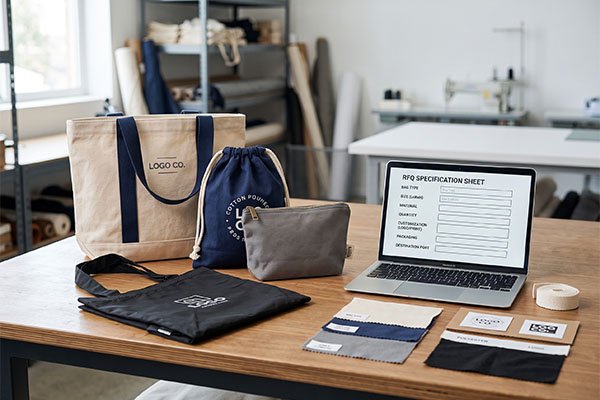
A first inquiry does not need to look like a complete technical document. In many cases, a manufacturer can start with a product photo, approximate dimensions, material preference, quantity, and logo.
The goal is simple. The manufacturer should be able to understand what you want to make, how you expect it to be used, how many pieces you need, and what needs to be customized. Once those basics are clear, the factory can ask more specific questions instead of starting the conversation from zero.
What Information Should You Include in a Custom Bag RFQ?
A useful RFQ gives the manufacturer enough information to understand both the product and the order. It should not force the buyer to provide technical details that have not been decided yet.
The basic information should cover the product, use, dimensions, material, quantity, color, branding, structure, packaging, destination, and timing. If a detail is still undecided, mark it as flexible or open to recommendation instead of leaving it unclear.
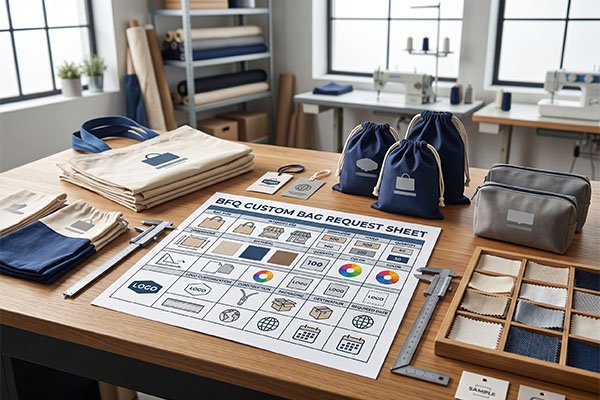
A simple checklist can help you prepare the first inquiry:
| RFQ Information | What to Provide |
|---|---|
| 가방 유형 | Tote, pouch, backpack, cosmetic bag, cooler bag, etc. |
| Intended Use | What the bag will carry and how it will be used |
| 크기 | Width × Height × Depth |
| 재료 | Cotton, canvas, rPET, PVC, polyester, etc. |
| 재료 무게 | GSM, oz, or thickness when applicable |
| Quantity | Total quantity and color or size breakdown |
| 색상 | Bag color or Pantone if available |
| Logo | Artwork, size, position, and preferred appearance |
| Structure | Pockets, gussets, compartments, closures |
| 액세서리 | Zippers, straps, buckles, labels, hardware |
| Packaging | Polybag, hangtag, barcode, carton requirements |
| Destination | Country and city |
| Required Date | Sample or bulk delivery date |
The product description should be specific enough to give the factory a starting point. “Custom canvas tote bag for retail packaging” tells a manufacturer much more than “custom bag.”
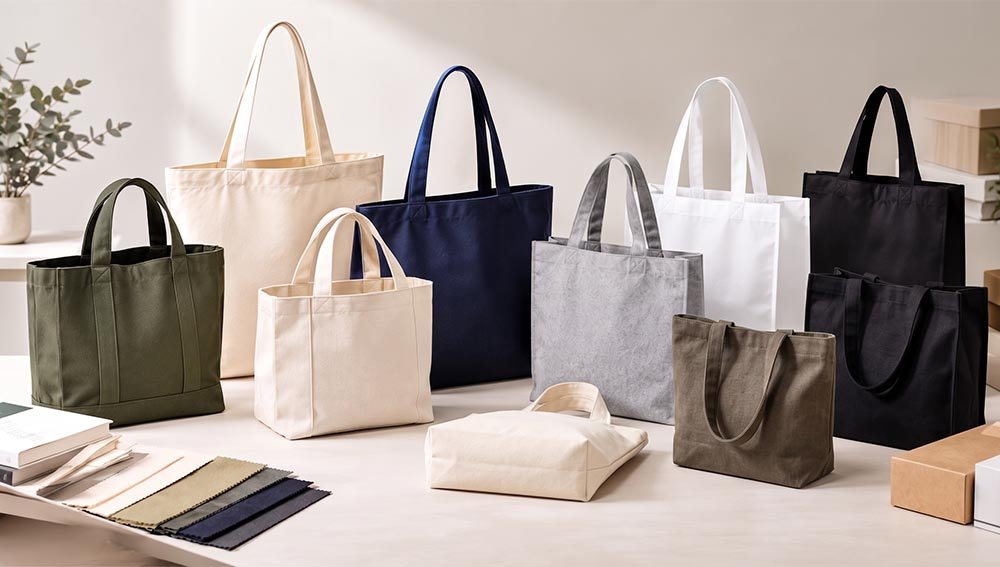
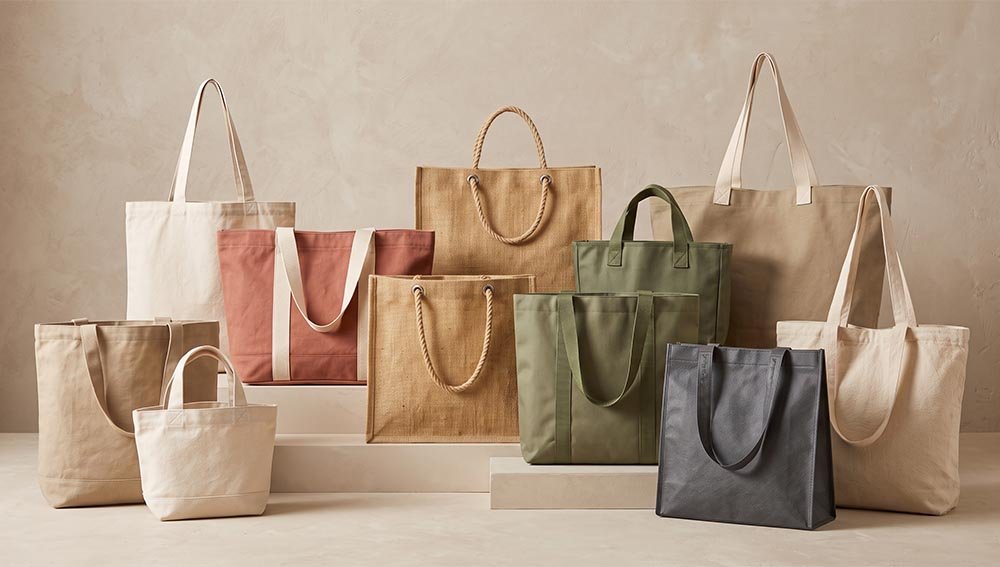
For example, you can review different cotton and canvas bag styles to identify the general product type before contacting a supplier.
The intended use also gives useful context. A retail packaging bag may need a different fabric and finish from a promotional giveaway. A hotel amenity bag may need easy-care material, while a travel organizer may need several compartments and a stronger zipper.
Quantity is another detail that should be clear from the beginning. If you need 1,000 pieces in two colors, write “1,000 pcs total, 500 black and 500 natural” instead of only saying “1,000 pcs.” This helps the factory check the production setup and custom bag MOQ.
Color and size breakdowns matter for the same reason. A manufacturer may calculate the order differently when 1,000 pieces are produced in one color compared with 1,000 pieces divided across four colors.
You can also include your target market or destination at this stage. A shipment going to the USA may require a different shipping calculation from one going to the UK or Australia.
How Should You Describe the Bag Size, Material and Structure?
The basic product idea is only the starting point. The manufacturer also needs to understand how the bag is built and what kind of material it should use.
Give the manufacturer the main dimensions, material preference, and structural details that can affect production. You do not need to measure every small part, but you should provide the measurements and specifications that affect capacity, appearance, construction, or cost.
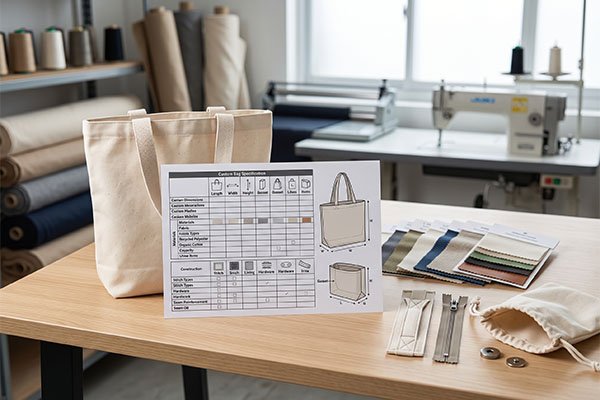
A three-dimensional bag is usually described by width × height × depth. A size such as 35 × 40 × 10 cm is much more useful than 35 × 40 cm when the bag has a bottom or side gusset.
The gusset matters because it changes the usable space and the way the bag is cut and sewn. A flat pouch, a tote with a bottom gusset, and a bag with side gussets may have similar front dimensions but require different construction.
You can also add measurements for parts that matter to the design, such as handle drop, shoulder strap length, pocket size, zipper opening, or compartment dimensions.
For instance, a specification can look like this:
| Part | 크기 |
|---|---|
| Main bag | 35 × 40 × 10 cm |
| Front pocket | 20 × 15 cm |
| Handle drop | 28 cm |
| Logo | 10 × 8 cm |
This gives the factory a much clearer picture than simply saying, “Please make it like this picture.”
Material specifications should follow the type of fabric or plastic you are using. For cotton and canvas, GSM or oz is often useful. For PVC and TPU, thickness is usually more relevant. For rPET, polyester, and Oxford fabric, you may provide fabric type, denier or GSM, finish, and recycled content if required.
For example, 12 oz cotton canvas gives a factory a useful starting point. So does 0.5 mm clear PVC when thickness is important to the product.
If you do not know the exact material specification, you can describe the material you prefer and explain the expected use. You can also ask the manufacturer to recommend the suitable weight or thickness.
For clear bags, you can refer to How to Choose the Right Thickness for Custom Clear Bags if you want to understand how thickness can affect different bag structures.
The same principle applies to structure. Mention features that affect the actual construction, such as pockets, compartments, dividers, gussets, zippers, drawstrings, handles, lining, and reinforcement.
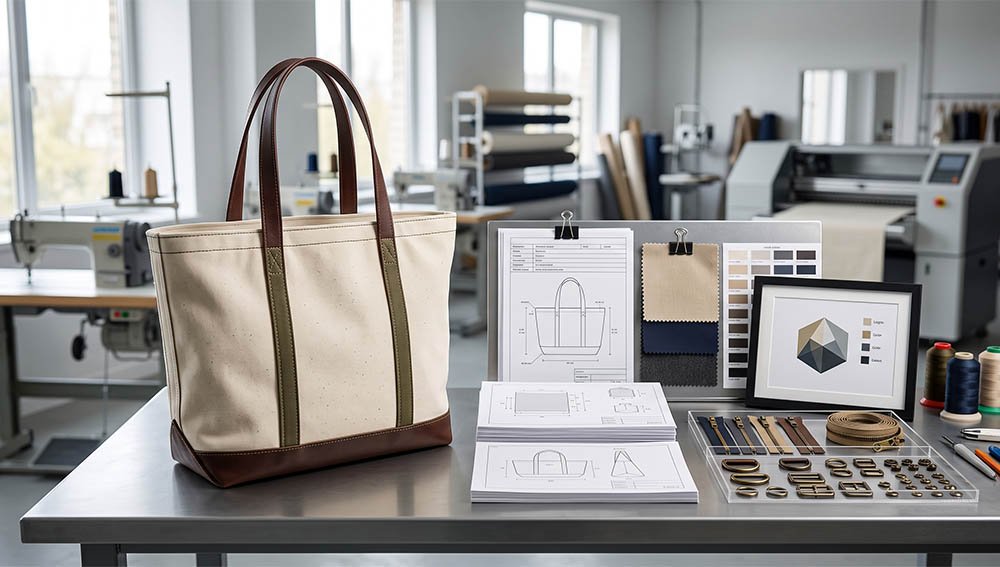
A reference photo can cover some of this information, but it helps to point out anything that needs to be changed. A short note such as “same shape as the reference, but with two front pockets and a longer shoulder strap” can remove a lot of uncertainty.
What Should You Tell a Manufacturer About Quantity, Logo and Packaging?
A manufacturer cannot prepare a useful commercial quotation from the product design alone. The customization and packaging can change the production cost quite a lot.
Your RFQ should explain the quantity breakdown, logo requirements, and packaging requirements. These details help the manufacturer quote the actual finished product instead of the price of a basic blank bag.
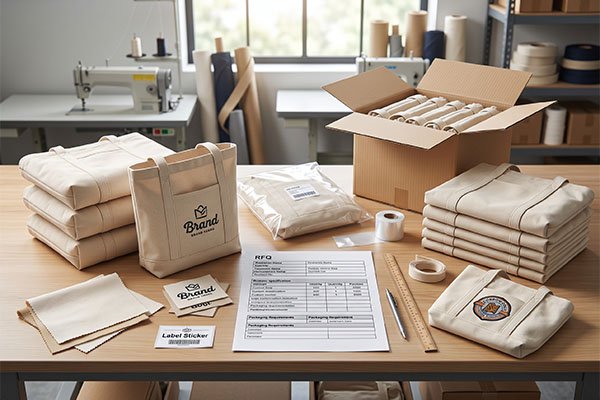
The quantity should include any important breakdown by color or size.
For example:
1,000 pcs total
500 black
300 natural
200 green
If the order includes several sizes, give the quantity for each size as well.
This is also the right time to ask whether the MOQ applies per design, color, size, or total order. The answer can affect how you organize the purchase.
Logo information should be just as practical. Send the logo artwork if you have it, preferably in a usable format such as AI, PDF, EPS, SVG, or a high-resolution PNG.
Then tell the manufacturer where the logo should go and roughly how large it should be. A simple instruction such as front center, approximately 10 × 8 cm is already useful.
You can also give the desired logo color. Black, white, Pantone colors, metallic effects, and multi-color artwork may require different production methods.
You do not always need to decide the printing method yourself.
If you want a white logo on black canvas, you can simply write that. The manufacturer can then recommend whether screen printing, heat transfer, embroidery, a woven label, or another method is suitable.
This is often better than choosing a method only because its name sounds familiar. The material, artwork, quantity, and desired appearance all affect the choice.
Packaging should also be mentioned before the final quotation. Individual polybags, recycled polybags, paper sleeves, hangtags, barcode stickers, insert cards, and retail packaging all add work or material costs.
A buyer selling the bags through a retail store may need each piece packed and labeled separately. A company ordering promotional bags for an event may only need bulk carton packing.
The earlier these requirements are known, the easier it is to get an accurate custom bag quotation.
What If You Do Not Know All the Specifications Yet?
This is where many first-time buyers make the RFQ harder than it needs to be. They think they must finish every technical detail before contacting a factory.
You can ask for a custom bag quote without a complete tech pack. A reference image, approximate size, preferred material, quantity, logo, and intended use can be enough to start the discussion.
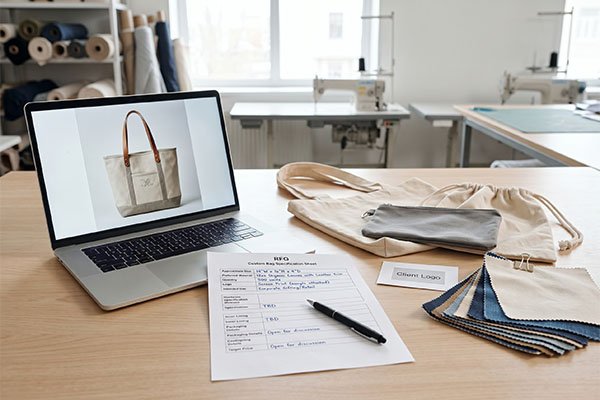
A complete technical pack is useful when a design is already finalized, especially for repeat production. It is not always necessary for the first inquiry.
Suppose you want to develop a cotton pouch for a subscription box. You know the approximate product size, want a natural fabric appearance, need 1,000 pieces, and have a logo. You may not know the exact GSM, zipper specification, or best printing method yet.
You can still send the RFQ.
The important thing is to tell the manufacturer what you know and what you do not know.
Instead of leaving the material blank, you could write:
Material: natural cotton canvas, open to recommendation on fabric weight.
Instead of guessing a printing method, you could write:
Logo: white, front center, please recommend a suitable printing method.
That gives the manufacturer permission to suggest an option without changing a requirement that you already consider fixed.
What Can You Send Instead of a Complete Tech Pack?
There are many ways to give a factory useful information without preparing a formal technical drawing.
| If You Don’t Have | You Can Send |
|---|---|
| Technical drawing | Reference photo or sketch |
| Exact dimensions | Approximate dimensions |
| Material specification | Preferred material or desired feel |
| Printing method | Logo artwork and desired appearance |
| Final structure | Reference bag or sketch |
| Physical specification | Existing sample |
| Final packaging plan | Basic packaging requirement |
An existing sample can be especially useful. A factory can review the sample, discuss the construction, and suggest changes based on your target price or intended use.
The same applies to reference images. You can send a product photo from another brand or a screenshot that shows the shape you want. Just make sure you explain which parts you want to copy as a general reference and which parts need to be changed.
A good RFQ does not hide uncertainty. It makes uncertainty clear.
How Can You Make the RFQ Easier for the Manufacturer to Review?
I recommend separating your requirements into three simple groups: fixed, flexible, and open to recommendation.
For example:
| Requirement | Status |
|---|---|
| Size: 35 × 40 × 10 cm | Fixed |
| Material: cotton canvas or rPET | Flexible |
| Printing method | Open to recommendation |
| Logo position: front center | Fixed |
| Packaging | Open to recommendation |
This small distinction can make the conversation much more efficient.
If the size is fixed, the factory knows not to change it without asking. If the material is flexible, the factory can suggest another fabric if it gives better cost or performance. If the printing method is open, the factory can recommend the process based on the actual material and artwork.
This approach also follows a broader procurement principle: clear product specifications help suppliers understand requirements and support fair offer comparisons1.
From my experience, this is much more useful than trying to make every part of the RFQ look finished when some decisions have not actually been made.
What Does a Good Custom Bag RFQ Look Like?
A good RFQ can be short enough to send by email or WhatsApp, but detailed enough for the manufacturer to understand the project.
A practical custom bag RFQ should combine the product information, customization details, order quantity, packaging, delivery destination, and the commercial information you want included in the quotation.
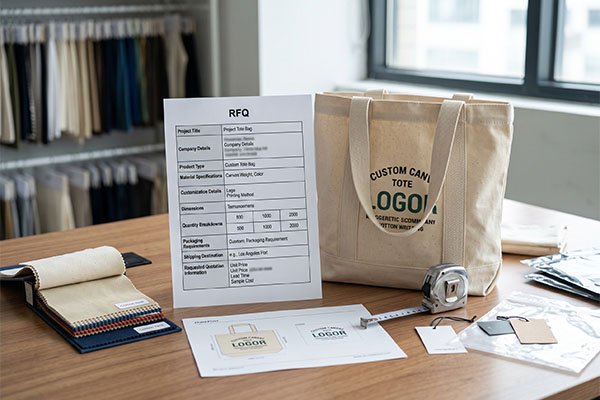
Here is a simple example that a buyer could use as a starting point.
What Should a Simple Custom Bag RFQ Include?
Product: Custom Canvas Tote Bag
Application: Retail packaging
크기: 35 × 40 × 10 cm
Material: 12 oz cotton canvas
색상: Natural
수량: 1,000 pcs
Logo: 1-color logo
Logo Position: Front center
Handle: 60 cm cotton handles
Packaging: 1 pc/polybag
Destination: USA
Required Date: June 15
Printing: Open to recommendation
This is already enough information for a manufacturer to understand the basic project.
You can then ask for the specific commercial details you need:
Please provide your unit price, MOQ, sample cost, sample lead time, bulk production lead time, and shipping options.
That last part is important because a quotation is more useful when the manufacturer knows what information you expect to receive.
What Should You Ask the Manufacturer to Include in the Quotation?
Do not ask only for the unit price.
Ask the supplier to state the unit price, MOQ, sample cost, sample lead time, bulk production lead time, packaging cost, printing cost, shipping cost, payment terms, Incoterm, and quotation validity.
You can also ask the supplier to identify any assumptions or exclusions.
This matters when you compare different suppliers.
One manufacturer may quote FOB with standard bulk packaging. Another may quote DDP with individual polybags. One may include printing in the unit price, while another may list it separately.
The numbers may look different even when the products appear similar.
That is why a clear quotation should explain what is included in the price.
How Should You Compare Custom Bag Quotations From Different Manufacturers?
Comparing three unit prices is easy. Comparing three actual offers requires more care.
Compare custom bag quotations only after checking that the material, construction, branding, packaging, quantity, shipping basis, and production requirements are based on the same specifications.
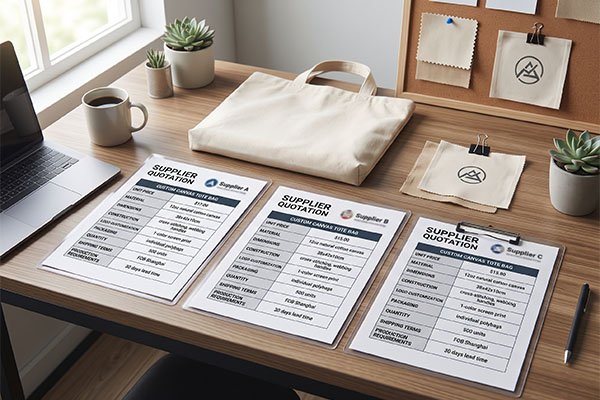
A simple comparison table can help:
| 카테고리 | What to Check |
|---|---|
| 재료 | Same material, GSM, thickness, and fabric quality? |
| Construction | Same gusset, pocket, zipper, lining, and reinforcement? |
| Branding | Same logo method, size, and number of colors? |
| Packaging | Same polybag, labels, hangtags, and carton packing? |
| Quantity | Same total quantity and color breakdown? |
| 배송 | Same EXW, FOB, CIF, or DDP basis? |
| Timing | Same sample and production schedule? |
Imagine one supplier quotes $1.20 per bag and another quotes $1.35.
The first supplier may be using standard bulk packaging and FOB terms. The second may include individual packaging and DDP shipping.
The $1.20 price is not automatically a better deal. The two quotations are simply based on different conditions.
The same issue can happen with materials. A 10 oz canvas bag and a 12 oz canvas bag may look almost identical in a product photo, but they are not the same specification.
The same applies to zippers, lining, pockets, printing, handles, hardware, and carton packing.
A useful custom bag quote should make these details clear enough that you can compare the actual project cost rather than only comparing one number.
For buyers working with several suppliers, this also makes the next step much easier. Once every supplier is quoting against the same basic specification, you can see where the price difference actually comes from.
For a practical example of available product options, you can also browse custom cotton canvas bags 또는 custom non-woven bag manufacturing solutions to compare materials and customization possibilities.
결론
A strong custom bag RFQ does not need to be complicated. Give the manufacturer the key facts, clearly mark uncertain details, and compare quotations using the same specifications.
자주 묻는 질문
Q: How early should I contact a custom bag manufacturer before I need the finished bags?
A: It is better to contact a manufacturer several weeks or months before your target delivery date, especially if the project involves custom materials, new molds, special hardware, or overseas shipping. This gives enough time for discussion, sampling, revisions, production, and logistics.
Q: Should I tell a manufacturer my target budget when requesting a custom bag quote?
A: You can share a target budget if you already have one. It can help the manufacturer suggest materials, construction methods, and finishing options that fit your cost range without changing the main purpose of the bag.
Q: Should I send the same RFQ to several bag manufacturers?
A: Yes. Sending the same basic requirements to several qualified manufacturers can make price and production comparisons easier. Keep the specifications unchanged when possible so that the quotations are based on similar conditions.
Q: Can a manufacturer help develop a bag design from an idea?
A: Many custom bag manufacturers can assist with product development, including construction suggestions, material selection, sampling, and design adjustments. The available support depends on the manufacturer’s development capabilities.
Q: How many custom bag samples should I request before placing a bulk order?
A: One sample may be enough for a simple project, while more complex bags may require several rounds. If the design has multiple compartments, special printing, custom hardware, or unusual construction, additional samples may be useful before production.
Q: What should I do if the manufacturer’s sample is different from my original design?
A: Compare the sample with the agreed specifications and identify the differences clearly. Ask the manufacturer to confirm whether each difference was intentional, caused by production limitations, or simply a mistake before approving the sample.
Q: Can custom bag manufacturers keep my design confidential?
A: You can ask the manufacturer about confidentiality before sharing sensitive designs. For projects involving original designs, private-label products, or unreleased products, some buyers also use a non-disclosure agreement.
Q: Should I ask for a pre-production sample before mass production?
A: A pre-production sample can be useful when the project has important visual or construction requirements. It gives the buyer another opportunity to confirm the finished details before the factory produces the full order.
Q: How can I reduce communication problems with an overseas bag supplier?
A: Keep the latest specifications, approved artwork, sample comments, and quotation in one clear record. When changes are made, confirm the updated version in writing so both sides are working from the same information.
-
The Oregon Procurement Manual explains how clear product specifications communicate requirements to suppliers and support product suitability, quality evaluation, and purchasing decisions. ↩
 English
  Deutsch
  Español
  Português
  Русский
  العربية
  Français
  Italiano
  日本語
日本語  한국어
한국어  Dansk
Dansk