الانتقال إلى المحتوى

Your exhibition bag is a tool. If the quality is bad, people throw it away fast. If the bag is good, people keep it and show your brand for months. You want to spend money on a marketing asset, not trash.
Choosing the right specifications means balancing function and cost. You must look at the size, the material thickness, and the printing method together. If you make the bag too fancy, you waste budget. If you make it too cheap, it breaks. The best bag fits the items inside it perfectly. It holds weight well. It makes your brand look professional.

You start with the purpose. You plan the size and material. Then you look at the details like handles and printing.
What size is ideal for exhibition giveaways?
Your visitors will carry many things at a trade show. A bag that is too small is useless. A bag that is too big is clumsy. You need to pick a size that fits standard documents and small gifts.
The standard size for most exhibitions is around 14 inches wide by 16 inches high. This size fits A4 catalogs, brochures, and flyers easily. If you give away small items like pens or keychains, a smaller 10×12 inch bag works well. If you have bulky gifts, you need a larger bag.
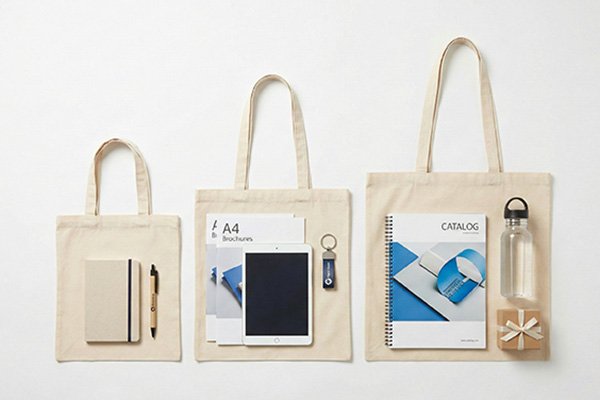
You need to think about what goes inside the bag. Most companies give out A4 papers. An A4 paper is roughly 8.3 x 11.7 inches. Your bag must be wider and taller than this. A flat bag (no sides) is cheaper. It works for flat documents. But if you have a thick book or a box, a flat bag will look bad. It will bulge.
For thick items, you need a gusset. A gusset is the extra fabric on the bottom or sides. It gives the bag depth. A 14×16 inch bag with a bottom gusset holds much more than a flat one. It also stands up better when you put it on a table.
We see many buyers make a mistake here. They pick a size based on price alone. Then the catalog sticks out of the top. This looks unprofessional. You must measure your largest item first. Then add at least 2 inches to the width and height of the bag. This ensures an easy fit.
| حجم الحقيبة | Dimension (Approx) | Best Use Case |
|---|---|---|
| صغيرة | 10" W x 12" H | Small trinkets, light flyers, jewelry |
| Standard | 14" W x 16" H | A4 catalogs, magazines, general swag |
| كبير | 18" W x 14" H x 4" D | Winter coats, big boxes, multiple kits |
How do I select the right canvas thickness (oz)?
Canvas thickness changes the price and the feel of the bag. A thin bag feels cheap and might tear. A thick bag feels expensive but costs more to make and ship. You must find the middle ground.
For a standard trade show, 8oz to 10oz canvas is the best choice. 8oz is light but not transparent. 10oz feels solid and hides the contents well. If you want a premium VIP gift, use 12oz or 16oz. 6oz is very cheap and only for single-day use.
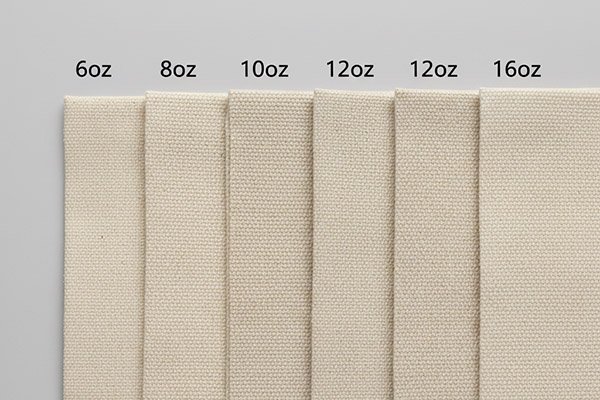
Fabric weight1 is measured in ounces (oz) or Grams per Square Meter (GSM). A lower number means thinner fabric. 6oz canvas2 is about 170-200 GSM. It is very flexible. You can fold it small. It is good if you need to ship thousands of bags cheaply. But it wrinkles easily. It does not hold a shape.
10oz canvas is about 280 GSM. This is the standard for a "good" tote bag. It has a tighter weave. It feels smooth. When you print on it, the ink sits better. The bag looks cleaner.
12oz canvas is about 340 GSM. This is heavy duty. It feels like a retail product. We recommend this for high-end brands. If your brand sells luxury goods, a 6oz bag will hurt your image. A 12oz bag shows quality.
You also need to think about shipping. Thicker bags weigh more. A box of 100 12oz bags costs much more to ship than a box of 100 6oz bags. If you ship by air, this difference is huge. You must calculate the total landed cost, not just the unit price.
What printing method works best for logos?
إن طريقة الطباعة affects your logo’s look and the bag’s price. Some methods are cheap for big orders. Some methods are better for colorful pictures. You need to match the method to your design.
Silk screen printing is best for simple logos and large quantities. It is durable and cheap. If your design has many colors or gradients, use heat transfer or digital printing. Embroidery looks very premium but costs the most.

Silk screen printing is the most common method we use. We make a screen (a stencil) for each color. We push ink through the screen onto the fabric. The color is thick and bright. It lasts a long time. It does not peel off. This is the most cost-effective way if you order 500 or more bags. But you pay a setup fee for each color. If your logo has 6 colors, it gets expensive.
Digital printing or heat transfer is different. It prints the image like a regular office printer. It can do photos, shadows, and gradients. There is no limit on colors. This is great for complex artwork. But sometimes the print feels like a plastic sticker on the bag. It might crack after many washes.
You also need to plan the print area. A standard print area is about 10×10 inches on a standard bag. We must keep the logo away from the seams. We need at least 1 inch of space from the edge. If you print too close to the handle or the bottom, the ink might smudge during production. Simple designs in the center of the bag usually look the best and cost the least.
How does bag structure affect on-site use?
The structure determines how easy the bag is to use. A bad structure makes the bag hurt the user’s shoulder. A good structure handles weight well. You want the user to be comfortable.
You should choose shoulder-length handles for exhibitions. People walk all day. They want to hang the bag on their shoulder. Hand-carry handles are tiring. Also, adding a bottom gusset helps the bag stand up when people pack their items.

Handles are very important. Standard shoulder handles are about 24 to 28 inches long. This length fits over a winter coat. It lets the bag hang at the hip. This is comfortable. If you make the handles short (14 inches), people must carry it in their hands. After one hour, their hands will get tired. They might throw the bag away.
You must also look at how we attach the handles. For heavy loads, we use "X-box" stitching. This is a square with an X inside it sewn at the connection point. It is very strong. Without this reinforcement, the handle might rip off if the bag is heavy.
The bottom structure matters too. A bag with a bottom gusset (width at the bottom) is easier to pack. At a busy booth, speed is important. You want to open the bag and drop items in quickly. A flat bag takes more time to open. These small structural choices change the user experience. They also change the production time. Simple bags are faster to sew. Complex bags with pockets and zippers take longer.
Why does load capacity matter after the exhibition?
The exhibition is just the start. You want the customer to use the bag for grocery shopping later. This is free advertising for you. If the bag breaks, the advertising stops.
A strong bag creates a feeling of quality. If the bag holds 10kg of groceries, the user trusts your brand. If the bag rips with a few books, the user thinks your products are weak. Load capacity turns a gift into a brand asset.
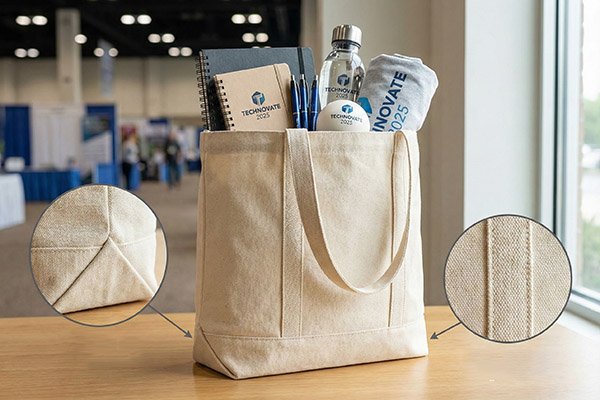
We see a big difference between "event bags" and "life bags". An event bag lasts two days. A life bag lasts two years. You want to make a life bag. This depends on load capacity.
Load capacity comes from the canvas weight and the stitching. A 10oz bag with reinforced handles can hold heavy items easily. It becomes a grocery bag, a gym bag, or a library bag. Every time your customer goes to the supermarket, 50 people see your logo. This is a very high return on investment.
If you choose a cheap 6oz bag with weak stitching, it will tear. The customer will throw it in the trash at the hotel. You save 10 cents on the unit price, but you lose 2 years of marketing.
You should test the samples. Put heavy books in the sample bag. Shake it. See if the handles stretch. See if the fabric looks stressed. A bag that survives this test is a bag that builds your brand reputation. Quality is a message.
الخاتمة
Focus on usage, budget, and brand goals. Define the purpose first to pick the right size and material. Work with an experienced supplier to avoid costly mistakes.
Frequently Asked Questions
Q: What is the standard lead time for manufacturing 1,000 custom canvas bags?
A: Generally, production takes 15–20 days after you approve the sample. If your design requires complex stitching or special dyeing, it might take 25 days. Shipping time is extra and depends on whether you choose air or sea freight.
Q: Can I dye the canvas fabric to match my brand’s specific PMS color?
A: Yes, we can dye the fabric to a specific Pantone (PMS) color. However, custom dyeing requires a higher minimum order quantity (typically 2,000–3,000 pieces) to make the industrial fabric dyeing process cost-effective compared to using stock colors.
Q: Are these canvas bags machine washable?
A: The printing we use is high quality and will not fade or peel easily. However, natural cotton canvas fabric tends to shrink if washed in hot water or machine dried. To maintain the flat shape and original size of the bag, we recommend hand washing in cold water.
Q: Do you offer organic or recycled canvas options?
A: Yes, we offer GOTS-certified organic cotton and GRS-certified recycled cotton (rPET or pre-consumer cotton). These materials cost slightly more but are excellent for brands focusing on sustainability.
Q: Can I add pockets or zippers to the standard tote bag?
A: Absolutely. You can add an inner pocket for phones or a zipper closure for security. Keep in mind that every accessory adds labor time, which increases the unit cost by $0.10–$0.30 depending on the detail.
Q: How do you pack the bags to prevent deep wrinkles during shipping?
A: We usually pack bags in bundles of 10 or 20 inside a waterproof polybag, then place them in a sturdy export carton. If you are worried about wrinkles, we can pack them flat, but this increases the carton volume and shipping cost.
Q: What happens if I need the bags faster than the standard schedule?
A: We can sometimes offer "rush order" services by prioritizing your production line. However, rush orders may incur a surcharge, and you will likely need to pay for expensive air freight to ensure they arrive on time.
Q: Can I mix materials, such as canvas body with leather handles?
A: Yes, mixed materials create a very premium look. PU leather or genuine leather handles make the bag stronger and more stylish. This is a great option for VIP gifts rather than general mass giveaways.
Q: Do you charge for the pre-production sample?
A: We usually charge a small sample fee to cover machine setup and labor. However, if you proceed with the bulk order (e.g., over 500 pieces), we often deduct the sample fee from your final invoice.
Q: How should I store the bags if they arrive months before the exhibition?
A: Store the cartons in a cool, dry place away from direct sunlight. High humidity can cause mold on natural cotton, and sunlight can yellow the fabric over long periods.
 English
  Deutsch
  Español
  Português
  Русский
  العربية
  Français
  Italiano
  日本語
日本語  한국어
한국어  Dansk
Dansk