الانتقال إلى المحتوى

Global eco-awareness is rising, but demand is not uniform across borders. A strategy that works in one region may lead to dead stock in another.
Distinct motivations drive the procurement of eco-friendly reusable bags: branding in the US, compliance in Europe, and utility in Asia. For B2B buyers, understanding these differences is critical. Selecting the wrong material or style for a specific market can result in inventory risks and failed quotes.
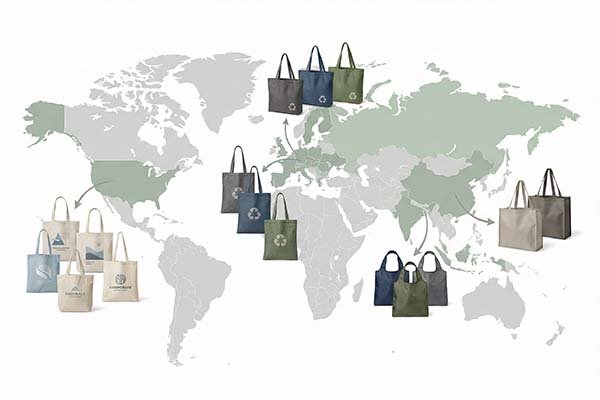
Suppliers often mistake "eco-friendly" for a universal standard. This assumption is costly. The following analysis breaks down the real procurement drivers in key global markets to help brands make precise product decisions.
Why Does the U.S. Remain the Largest Market for Reusable Bags?
American buyers view eco-bags as marketing investments rather than mere functional items. Why does this market prioritize visibility over strict minimalism?
In the US, reusable bags function as mobile advertising assets for retailers and event organizers. Procurement focuses heavily on logo customization and the visual impact of the brand. Buyers accept a reasonable price premium for high-quality printing on canvas, cotton, or rPET materials that ensure long-term brand exposure.

The core logic of the US market is that environmental protection1 must align with brand assets. Retail brands, whether offline or Direct-to-Consumer (DTC), drive the bulk of this demand. For these buyers, a bag is not just a vessel; it is a recurring touchpoint with the consumer. Consequently, procurement managers in this region are highly sensitive to print quality and material texture. A defect in a logo is often treated as a critical failure.
B2B transactions here are characterized by small, frequent batches. Brands prefer to hold less inventory and rely on rapid replenishment, which places pressure on suppliers to offer stable lead times and flexible Minimum Order Quantities (MOQs). While price sensitivity exists, US buyers are willing to pay more for "walking billboards"—bags that consumers will want to carry publicly. Common requests include heavy-duty canvas tote bags and certified rPET bags, where the material story supports the brand’s marketing narrative. Success in this market requires a supply chain that balances customization speed with consistent visual quality.
How Do European Policies Shape Demand for Eco-Friendly Bags?
European procurement is a response to strict regulations rather than voluntary marketing. Is the documentation sufficient to clear customs in Germany or the Netherlands?
Demand in Europe, particularly in Germany and Scandinavia, is driven by the need to minimize compliance costs. Buyers prioritize clear material lineage, recyclability, and adherence to environmental laws. The focus is on documentation and durability rather than complex designs or vibrant aesthetics.

In European markets, the purchasing decision is fundamentally legalistic. Regulations determine market entry, making the "reusable" nature of the bag a compliance requirement rather than a feature. Procurement managers in this region spend significant time verifying the source of materials. Certificates for organic cotton or المعيار العالمي لإعادة التدوير (GRS)2 verified rPET are not optional add-ons; they are essential for clearing customs and avoiding fines.
Unlike the US market, where visual appeal drives sales, European buyers prioritize "Simple and Durable." A bag must be robust enough to pass strict reusability tests. This results in longer decision cycles as technical specifications are scrutinized. B2B buyers here are less sensitive to the unit price if the product guarantees safety and legality. They avoid flashy designs that might complicate recycling. For suppliers, the key to this market is transparency. Providing a detailed bill of materials and valid certifications is more effective than offering lower prices or trendy styles. The aesthetic is often neutral, focusing on the raw, natural look of jute or unbleached cotton.
What Is Driving Reusable Bag Demand Across Asian Markets?
Asian demand is fragmented by specific usage scenarios rather than broad trends. Why do Japan and Korea require such precise manufacturing standards?
Markets in Asia show distinct preferences: Japan and Korea demand high-precision organizers, Southeast Asia seeks affordable brand upgrades, and the Middle East focuses on functional bags for hospitality. Success requires adapting to these specific, high-standard scenarios.
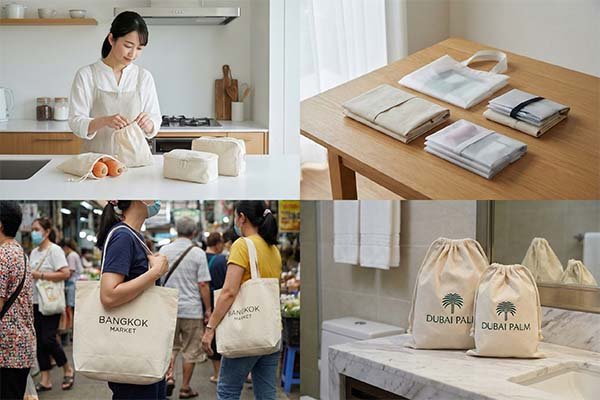
The Asian market cannot be treated as a monolith. In Japan and South Korea, the demand is for "fine usage" rather than high volume. Buyers here inspect stitching details and dimensional accuracy with extreme rigor. The preferred application is often organization—laundry bags, shoe bags, or sorting pouches—rather than general shopping totes. Consequently, logos are kept small and discreet, often just a wash label or a tiny tag. The most popular styles include drawstring bags and small zipper pouches, where workmanship dictates value.
In contrast, Southeast Asia is experiencing a shift driven by local brands expanding internationally. These buyers are moving from disposable packaging to reusable options like non-woven or simple cotton bags. They remain price-sensitive but are beginning to value the "reusable" concept for brand elevation. Meanwhile, the Middle East presents a functional demand driven by the hospitality and event sectors. Hotels require laundry and amenity bags that are clean, durable, and functional. They do not require complex customization but demand consistency and utility.For B2B suppliers, this means product lines must be highly adaptable to specific regional functions rather than offering a standard "Asian style" bag.
Why Are Australia and New Zealand Adopting Reusable Bags Faster?
Strict plastic bans combined with consumer consensus have accelerated market maturity. Is the product lifecycle long enough to satisfy this demand?
Government policy and public opinion have aligned to eliminate single-use plastics in this region. Buyers favor natural, durable materials like canvas and jute, rejecting disposable options entirely. The market rewards simple designs that emphasize long-term utility and legitimate eco-credentials.
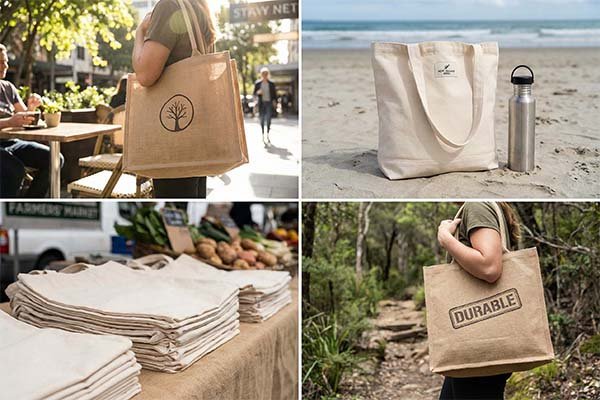
Australia and New Zealand represent a market driven by a unified rejection of plastic. The driving force is a combination of aggressive legislative bans and a high level of consumer willingness to switch. For procurement managers, the primary criterion is durability. A bag must be perceived as a permanent replacement for plastic, not just a temporary alternative. This preference steers demand toward heavy-weight natural fibers like jute and canvas, which convey strength and sustainability visually.
The design philosophy here is "less is more." Buyers do not look for complex features or excessive printing. They value the raw texture of the material and the practicality of the shape. B2B transactions often involve steady replacement orders for supermarkets and retail chains that have completely phased out plastic. Suppliers must focus on the "long-term use value" of the product. Any product that feels flimsy or disposable will be rejected by both the buyer and the end consumer.The winning strategy involves offering robust, minimalist bags that align with the outdoor, eco-conscious lifestyle prevalent in the region.
How Are Emerging Markets Shaping the Future of Reusable Bags?
Emerging regions are adopting reusable solutions rapidly, starting with the B2B sector. How can suppliers scale production for these high-growth areas?
While starting later, emerging markets are growing quickly, with demand initially driven by business events and promotions. Suppliers can capture this growth by offering standardized styles that allow for scalable production, while retaining the flexibility to customize for local B2B clients.

In emerging markets, including parts of Latin America and Africa, the trajectory of reusable bag adoption is unique. The demand does not start in retail but rather in the B2B sector. Companies and organizations drive the initial volume through promotional events, trade shows, and corporate gifting. This creates a specific need for cost-effective solutions that can be produced in large quantities. Non-woven bags are particularly strong here due to their balance of durability and low cost.
For suppliers, the challenge is scalability. These markets are price-sensitive and often require large volumes on short notice. Standardized bag models are the most effective way to meet this need, as they allow for rapid production and easy replication. However, local brands are increasingly seeking differentiation. A supplier that can offer a standard base product with flexible options for logo customization will have a competitive advantage.The trend suggests that as these markets mature, demand will eventually shift toward the retail behaviors seen in developed nations, but for now, the focus remains on functional, scalable B2B solutions.
الخاتمة
Global demand is not homogenous. The US prioritizes brand assets, Europe demands compliance, and Asia focuses on specific utility.Aligning product offerings with these distinct regional motivations is the key to securing long-term B2B partnerships.
Frequently Asked Questions
Q: What specific file formats should procurement managers provide to ensure high-quality logo printing for US orders?
A: To meet the high standards for brand visibility in the US market, vector files (AI, PDF, or EPS) are essential. Unlike raster images (JPG, PNG), vector files allow for scaling without pixelation, ensuring sharp lines and accurate color matching (Pantone/PMS) for "walking billboard" tote bags.
Q: Apart from material certificates, what factory audits are commonly required by major European retailers?
A: While the article mentions material compliance, European retailers often require social compliance audits for the factory itself. The most common standards include BSCI (Business Social Compliance Initiative) and Sedex (SMETA), which verify ethical labor practices and workplace safety before a supply chain relationship is established.
Q: How does fabric weight (GSM) influence the "durability" perception in the Australian market?
A: Since Australian buyers reject flimsy alternatives to plastic, the weight of the fabric is a key indicator of quality. For canvas or cotton bags, a density of at least 10oz (approx. 280 GSM) is recommended to ensure the bag feels substantial and capable of carrying heavy grocery loads repeatedly.
Q: What is the difference between "Biodegradable" and "Compostable" when sourcing for strict markets?
A: This distinction is technical but crucial. "Biodegradable" simply means it breaks down eventually, which can still leave microplastics. "Compostable" (specifically industrial compostable, e.g., EN 13432) means it breaks down into non-toxic elements under specific conditions within a set timeframe. Markets with strict greenwashing laws often prefer "Compostable" certification over vague "Biodegradable" claims.
Q: Which printing technique is best suited for the intricate, small-scale labels preferred in Japan?
A: For the high-precision requirements of the Japanese market, woven labels or high-definition heat transfer prints are superior to standard screen printing. These methods allow for legible text and crisp details even on very small surface areas, such as the corner of a drawstring pouch.
Q: How do Incoterms affect the responsibility for custom clearance in restrictive regions?
A: In regions with complex import regulations, buying on DDP (Delivered Duty Paid) terms shifts the risk of customs clearance and duties to the supplier. However, most experienced B2B buyers prefer FOB (Free on Board) to maintain control over their own logistics partners and import taxes, especially when consolidating shipments from multiple vendors.
Q: Can rPET bags be dyed to match any brand color, or are there limitations?
A: rPET (Recycled Polyethylene Terephthalate) fabric absorbs dye slightly differently than virgin polyester. While Pantone matching is possible, there can be a 5-10% color variance between batches due to impurities in the recycled plastic source. Buyers prioritizing strict brand color consistency should request physical "lab dips" for approval before mass production.
Q: What is the typical shelf life of a non-woven bag in a hot, humid climate like Southeast Asia?
A: Non-woven polypropylene is photodegradable. If stored in direct sunlight or extreme heat, it can become brittle and disintegrate within 6-12 months. For inventory management in tropical climates, it is crucial to store these bags in cool, dark warehouses to maintain their structural integrity before distribution.
Q: Do distinct markets require different testing standards for heavy metal content in inks?
A: Yes. While the US follows Prop 65 (California) and CPSIA standards for lead and phthalates, the EU follows REACH regulations, which cover a broader range of SVHCs (Substances of Very High Concern). An ink formula compliant in the US may not automatically be compliant in Europe, so region-specific testing is necessary.
Q: How much does the "washability" factor impact the cost of paper-based bags (washable kraft paper)?
A: Washable kraft paper is significantly more expensive than standard paper or basic cotton because it is treated with latex to be water-resistant and durable. It is often positioned as a premium "vegan leather" alternative. Buyers should expect a higher unit cost, making it suitable for high-end retail packaging rather than mass giveaways.

 English
  Deutsch
  Español
  Português
  Русский
  العربية
  Français
  Italiano
  日本語
日本語  한국어
한국어  Dansk
Dansk