الانتقال إلى المحتوى

Choosing the wrong thickness can make a clear bag feel weak, too stiff, or unnecessarily expensive. Buyers need more than a number before placing a bulk order.
The right custom clear bag thickness depends on bag size, structure, product weight, use frequency, and required flexibility. Common reference points include 0.3mm, 0.5mm, 0.8mm, and 1.0mm, but the finished bag should always be tested before bulk production.
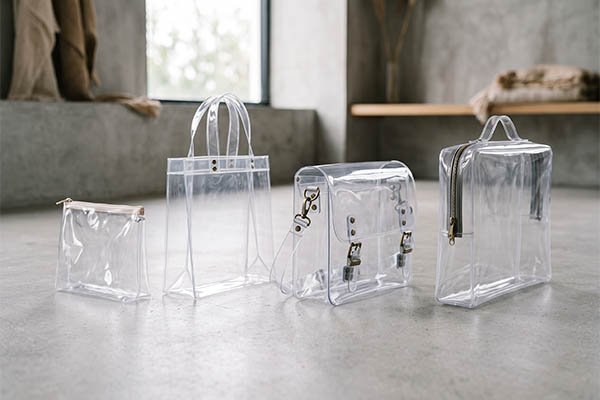
A thickness number looks simple on a supplier quotation, but the number does not tell you how the finished bag will feel or perform. A small cosmetic pouch and a large reusable bag can use the same clear material thickness and still behave very differently. Thickness should be selected as part of the full bag specification, not as an isolated material choice.
Why Does Clear Bag Thickness Matter for Custom Clear Bags?
A clear bag can look almost identical in a product photo even when the material thickness is different. The difference becomes much easier to feel when you fold it, open the zipper, load products, or carry it.
How Does Material Thickness Affect the Performance of a Clear Bag?
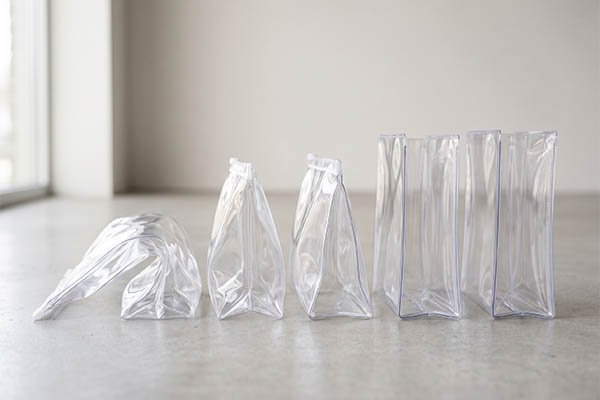
Material thickness affects durability, flexibility, structure, weight, handling, and cost. A thicker material usually gives the finished bag more body and support, while a thinner material normally feels softer and folds more easily.
For a B2B buyer, this difference matters because the bag needs to work in a real sales or packaging situation. A cosmetic pouch that sits inside a retail package has different requirements from a clear bag that customers will carry every week.
Durability is one of the first factors to consider. A thicker material can provide more resistance when the bag is handled repeatedly. This does not mean that a thicker bag cannot be damaged. Sharp corners, strong pulling forces, poor seams, and unsuitable construction can still cause problems.
Flexibility usually moves in the opposite direction. A 0.3mm clear material can feel much softer than a 0.8mm material. This makes a thinner bag easier to fold and pack.
Structure also changes with thickness. A thicker material can help a pouch keep its shape instead of collapsing when it is empty.
Weight and cost matter in B2B purchasing as well. More material generally means more material weight, and material usage can affect the final unit price. If a buyer selects a much thicker material without a clear reason, the extra cost may not create a useful improvement for the end customer.
For buyers who want to understand how plastic film thickness is measured, ASTM International provides a standard guide for determining plastic film thickness1.
What Is the Relationship Between Thickness and Bag Structure?
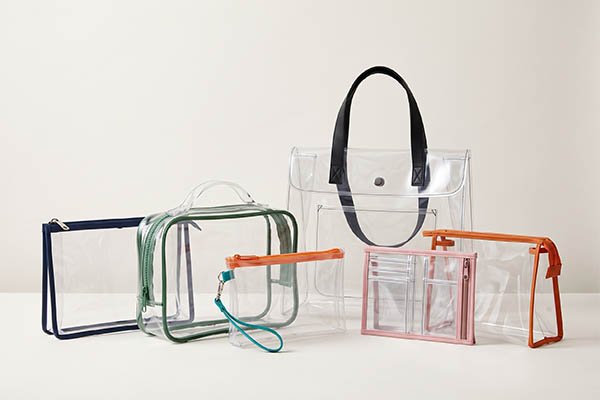
The same clear material can behave differently when it is made into different bag structures. A flat pouch, gusseted pouch, box-shaped bag, large reusable bag, and structured case do not place the same demands on the material.
A flat pouch has a relatively simple construction. The material mainly needs to form the front and back panels and work properly around the closure. A gusseted pouch has more panels and corners, so the finished structure can provide more usable space and a different level of support.
A box-shaped clear bag can need more body because the design is expected to hold a defined shape. A large reusable bag creates another issue. Its larger surface area and wider opening can create more movement during use, especially when the bag contains heavier products.
| Bag structure | What to consider |
|---|---|
| Flat pouch | Flexibility, folding, closure area |
| Gusseted pouch | Side and bottom construction, product weight |
| Box-shaped bag | Shape retention and corner construction |
| Large reusable bag | Size, handles, seams, and load |
| Structured case | Rigidity, protection, and shape |
The same thickness can perform differently in different bag structures. This is why 0.5mm should not automatically be considered better than 0.3mm.
For buyers comparing different clear bag structures, the custom quart-size and clear pouch options provide examples of how flat, gusseted, and structured formats can be developed for different applications.
Why Should Buyers Consider the Finished Bag Instead of Thickness Alone?
Thickness is only one part of the specification. Buyers should also consider bag dimensions, structure, product weight, closure, seams, handles, and intended use.
Consider two bags made from 0.3mm clear material. One is a small cosmetic pouch measuring around 20 × 15cm. The other is a large clear shopping bag measuring around 40 × 45cm. They may use the same material thickness, but the second bag has a much larger surface area and may carry a heavier load.
The product inside also changes the situation. A soft T-shirt creates less concentrated stress than a rigid box with sharp corners. A lightweight toiletry kit is different from a set of metal accessories.
The better question is not simply, “How thick should my clear bag be?” It is, “What thickness gives this finished bag the right balance of flexibility, structure, durability, weight, and cost?”
That question gives a supplier much more useful information when developing a custom clear pouch.
What Are the Common Thicknesses for Custom Clear Bags?
For custom clear bags, 0.3mm, 0.5mm, 0.8mm, and 1.0mm provide useful reference points for comparing flexibility and structure. These numbers are not universal rules. They are starting points for product development and sampling.
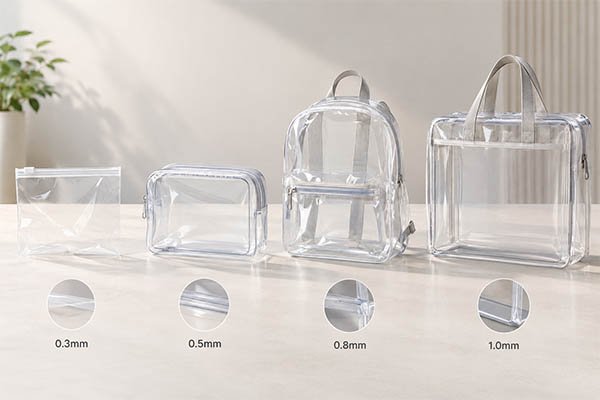
Think of these four thicknesses as a practical starting range rather than four fixed rules. The right option still depends on the finished bag.
What Is 0.3mm Clear Material Suitable For?
0.3mm clear material is a lighter and more flexible option. It can be easier to fold, pack, and handle, which makes it useful when the finished bag does not need a highly rigid structure.
A small cosmetic pouch is one possible application. A toiletry pouch or travel pouch can also benefit from a softer feel when the customer needs to put the bag into luggage or another larger bag.
This thickness can also work well when the clear bag is mainly used for lightweight products or packaging. The finished product can remain relatively light and easy to store.
Still, buyers should not assume that 0.3mm works for every small bag. The actual dimensions, zipper construction, seams, and product weight still matter.
For a small pouch with light contents, the flexibility of 0.3mm may be more useful than the extra structure of a thicker material.
If the same pouch becomes much larger or needs to carry heavier products, another thickness may need to be tested.
What Is 0.5mm Clear Material Suitable For?
0.5mm is often a useful balance point for custom clear bags because it provides more structure than 0.3mm while still allowing a reasonable amount of flexibility.
This thickness can be considered for organizer bags, larger cosmetic bags, travel organizers, reusable packaging, and other clear pouches that need to be used more than once.
For buyers developing organizer products with different internal layouts, the custom organizer bags wholesale page shows how dimensions, compartments, materials, closures, and other structural details can be developed around the intended application.
A buyer who feels that 0.3mm is too soft but does not want a very rigid bag can use 0.5mm as a practical sample option. It can give the bag a more substantial feel without moving directly into a heavy construction.
For many custom clear pouch designs, 0.5mm is a useful thickness to include in the sampling stage when the buyer wants a balance between flexibility and structure.
The final choice still needs testing. A 0.5mm clear bag with a large gusset and heavy contents may need a different construction from a small flat pouch using the same thickness.
When Would 0.8mm Be a Better Choice?
0.8mm is more suitable when structure becomes a stronger requirement. The material is thicker and usually less flexible, but it can give the finished product a firmer feel.
This thickness can be considered for display cases, structured clear bags, protective packaging, and products that need to maintain a defined shape.
A clear display case is a good example. If the case needs to stand on a shelf or protect a product presentation, a very soft material may not create the desired result. A thicker material can provide more body to the finished construction.
The reason for choosing 0.8mm should be a need for more structure or support, not simply the idea that thicker is always better.
A buyer should also consider the added weight and reduced flexibility. If the bag needs to be folded flat for shipping or stored in large quantities, 0.8mm may create a different packing situation from 0.3mm or 0.5mm.
When Is 1.0mm Clear Material Worth Considering?
1.0mm is a very thick option compared with the lighter materials discussed above. It provides a firm and structured feel, but it also adds weight and reduces flexibility.
This thickness can be considered for heavy-duty clear products, highly structured cases, and applications where maintaining shape is a major requirement.
A buyer should not choose 1.0mm simply because the bag needs to be durable. A well-designed 0.5mm or 0.8mm bag can be more suitable for many reusable applications.
The higher thickness can also affect production and packing. A stiff material may need more care around folding, seams, corners, and closure construction, depending on the material and bag design. It can also take up more space during transportation.
For most everyday cosmetic pouches, toiletry bags, and lightweight travel organizers, 1.0mm is usually more material than necessary.
It becomes more relevant when the finished product has a clear need for high structure.
How Do 0.3mm, 0.5mm, 0.8mm, and 1.0mm Compare?
The four thicknesses can be viewed as different positions on a flexibility-to-structure range.
| السماكة | المرونة | الهيكل | الوزن | General position |
|---|---|---|---|---|
| 0.3mm | عالية | Low–Medium | خفيف | Flexible |
| 0.5mm | متوسط | متوسط | معتدل | Balanced |
| 0.8mm | أقل | عالية | ثقيلة | Structured |
| 1.0mm | منخفضة | عالية جداً | Heavier | Heavy-Duty |
0.3mm is more flexible, 0.5mm offers a balanced option, 0.8mm gives more structure, and 1.0mm is for applications that need a much firmer construction.
These positions are useful for starting a discussion with a supplier. They should not replace a physical sample because the final performance also depends on the bag design.
How Do You Choose the Right Clear Bag Thickness for Different Applications?
Application gives the thickness number a practical meaning. The same clear material can make sense for one product and be unsuitable for another.

How Thick Should a Cosmetic or Toiletry Bag Be?
Cosmetic and toiletry bags often need a balance between flexibility and structure. The right choice depends on the bag size, how often it will be used, whether it needs to fold, and the weight of the contents.
For a small cosmetic pouch with lightweight products, 0.3mm can be considered when flexibility and easy storage are important. A customer can place the pouch into a suitcase or larger bag without dealing with a stiff case.
A 0.5mm clear pouch can make more sense when the buyer wants a stronger structure or a more substantial reusable product. This can be useful for branded cosmetic kits, hotel amenity bags, and travel organizers that customers are expected to keep.
For cosmetic and toiletry bags, 0.3mm–0.5mm is a useful range to test when the main goal is a balance between flexibility and everyday usability.
The zipper also matters. A pouch that opens and closes many times needs a suitable combination of material, zipper, and seam construction. Increasing thickness alone does not solve every durability problem.
What Thickness Works for Travel and Organizer Bags?
Travel and organizer bags often need more attention because their dimensions can be larger and their contents can vary.
A small organizer may work well with 0.3mm or 0.5mm material. A larger organizer with several compartments, a gusset, and a heavier product load may need a thicker material or stronger construction.
Frequent handling is another factor. A travel pouch can be opened, folded, packed, removed from luggage, and used again many times. That repeated handling makes the overall construction more important than the thickness number alone.
A 0.5mm clear pouch can be a useful starting point for many larger organizer designs, while 0.8mm can be tested when the design needs more shape retention.
The best approach is to make the same design in two thicknesses and compare the actual user experience.
When Should Larger Reusable Bags Use a Thicker Material?
As a clear bag becomes larger, the bag dimensions become more important. A larger bag has more material area and can experience more movement when it is carried.
Buyers should check the overall dimensions, product weight, handle attachment, bottom gusset, side gusset, and expected frequency of reuse.
A 0.5mm material may be suitable for one large reusable bag, while another design may need a thicker option because of its dimensions or load. A bag with long handles also needs careful attention around the handle attachment points.
For larger reusable bags, 0.5mm or thicker can be considered depending on the complete design rather than the bag size alone.
The supplier should check the complete construction before approving the material thickness.
For example, a wholesale custom clear PVC crossbody bag combines clear PVC with zippers, straps, hardware, and attachment points, showing why material thickness should be considered together with the finished construction.
When Is a Structured Clear Bag Better With 0.8mm or 1.0mm?
Some clear bags are expected to look like cases rather than soft pouches. Display cases, protective cases, and structured packaging fall into this group.
These products may need to stand, maintain a specific shape, or protect the appearance of the product inside. In these cases, 0.8mm or 1.0mm can be considered because the higher thickness can provide more body.
The thicker material should have a clear purpose. The purpose may be shape retention, product support, or a more structured presentation.
If a buyer wants a clear display case for a premium product, the shape of the case may be part of the product presentation. A soft 0.3mm material may not create the same appearance. A 0.8mm or 1.0mm sample can show whether the extra structure is useful.
How Does Product Weight Affect the Thickness You Need?
Product weight is useful, but it should not be the only deciding factor.
Light products can allow the buyer to prioritize flexibility. Heavier products can create a stronger need for support and durability. Yet a compact heavy product can behave differently from a large lightweight product because the load may be concentrated in a small area.
The buyer should check product weight together with bag size, shape, handles, seams, and closure.
| Product condition | Main factor to check |
|---|---|
| Light and soft | المرونة |
| Light but bulky | Bag size and structure |
| Heavy and compact | Support and stress points |
| Sharp or rigid | Puncture and seam risk |
| Frequently reused | Overall durability |
Product weight can guide the decision, but it should never be used as the only rule for choosing clear bag thickness.
This approach gives the buyer a more useful specification than simply saying, “The product weighs 1kg, so use 0.8mm.”
Why Isn’t a Thicker Clear Bag Always Better?
A thicker clear bag can provide more structure, but extra material also creates trade-offs. The goal is to match the material to the job.
What Are the Disadvantages of Using Material That Is Too Thick?
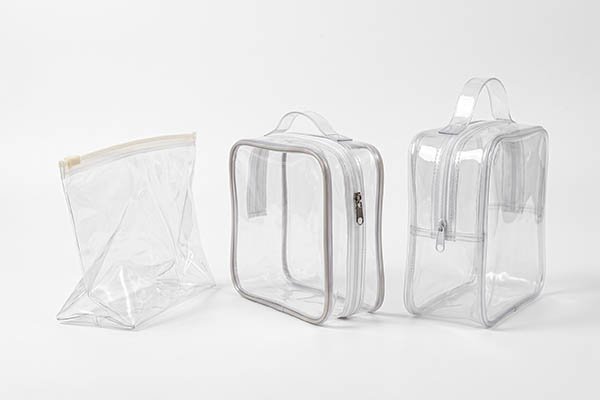
A thicker material usually adds weight and reduces flexibility. It can also make the bag harder to fold, pack, and store.
This can matter in large B2B orders. Imagine a buyer ordering 10,000 clear pouches for a travel product. If the buyer selects a much thicker material than necessary, the extra material weight can affect both unit cost and shipping volume.
The user experience can also change. A customer may prefer a soft pouch that can be folded into a suitcase. A very thick material can make that simple action less convenient.
There is also a production issue. Thicker materials can require different handling during cutting, sealing, sewing, or other construction processes, depending on the material and bag design.
More material only makes sense when it provides a useful improvement in the finished product.
If the product does not need a rigid structure, adding thickness may not create enough value to justify the extra material.
What Problems Can Occur When the Material Is Too Thin?
Material that is too thin may not provide enough support for the finished design. The bag may feel too soft, lose its shape more easily, or provide less support for heavier contents.
A large clear pouch is a useful example. If the pouch has a wide opening and a large bottom gusset, a very flexible material may not provide the level of structure that the buyer expects.
The same issue can appear with repeated use. A bag that is opened and closed every day needs more attention than a bag that protects a product only during shipping.
Still, buyers should avoid absolute rules. A 0.3mm bag is not automatically weak, and a 1.0mm bag is not automatically suitable. The result depends on the complete design.
If the material is too thin for the application, the finished bag may not provide enough durability or support. Sampling can show this much more clearly than a material specification sheet.
How Can You Find the Balance Between Flexibility and Durability?
A simple starting point is to decide what the bag needs to do most.
If the bag needs to fold easily, a lighter thickness can be considered. If the bag needs more structure, a thicker option may be useful. If the bag will be reused frequently, the buyer should test the complete construction. If the bag will carry heavier products, the buyer should check the product weight together with the stress points.
This creates a practical decision path:
Need more flexibility? → Consider a lighter thickness.
Need more structure? → Consider a thicker option.
Need frequent reuse? → Evaluate the full construction.
Need to carry heavier products? → Evaluate size, seams, handles, closure, and material together.
The right thickness is a balance between flexibility, structure, durability, weight, and cost. That balance is different for a small cosmetic pouch and a large reusable clear bag.
What Else Should You Consider Besides Custom Clear Bag Thickness?
Thickness does not work alone. Several other specifications can change how the finished bag performs.
How Does Bag Size Affect the Choice of Thickness?
Bag size can change the performance of the same material. A small pouch has a different load pattern from a large bag.
A 20 × 15cm cosmetic pouch may work well with 0.3mm material, while a 40 × 50cm reusable bag may need a different thickness or construction even if both bags carry lightweight products.
Buyers should therefore provide exact dimensions when requesting a quotation. “Large clear bag” is not enough information for a supplier to recommend a reliable material specification.
The larger the bag becomes, the more attention should go to the opening, seams, corners, gussets, and handle points.
How Does Bag Construction Affect Material Requirements?
Construction changes how forces move through the finished bag.
A flat construction is simple and can be flexible. A gusseted construction adds depth and changes how the product weight sits inside the bag. A box-shaped construction creates a more defined form and can need more structure.
Bottom and side gussets deserve special attention because they can affect both capacity and stability. The corner construction also matters when the bag carries a product with concentrated weight.
A supplier should review the drawing or sample together with the requested thickness. The material number becomes much more useful when the supplier knows how the bag will actually be built.
How Do Zippers and Closures Affect the Material Choice?
A zipper creates a stress area because the user repeatedly pulls the opening during normal use.
The zipper area, seams, corners, and attachment points should all be checked when selecting the material. A thicker bag body does not automatically solve a weak zipper attachment or poor seam design.
For a reusable travel organizer, the buyer should open and close the zipper during sample testing. The buyer should also check whether the material around the zipper feels stable when the bag is full.
The zipper area should be tested as part of the finished bag, not treated as a separate component.
Why Do Handles and Straps Matter?
Handles can create concentrated stress because the weight of the entire bag can transfer through a small attachment area.
This matters for clear tote-style bags, clear shopping bags, clear crossbody bags, and organizer bags with handles.
The buyer should look at the handle material, attachment method, reinforcement, and bag construction. If the product is heavy, these details may matter more than simply increasing the entire bag from 0.5mm to 0.8mm.
The strongest material is not useful if the handle connection is the weak point.
The goal is to strengthen the areas that actually receive the load.
How Does Frequency of Use Change the Specification?
An occasional packaging bag does not need the same specification as a reusable product.
A bag used once inside a shipping carton may have very different requirements from a travel organizer that a customer opens every morning.
You can divide the use into three simple groups:
| Use frequency | Main consideration |
|---|---|
| Occasional packaging | Cost and basic protection |
| Reusable product | Balance of flexibility and durability |
| Frequent daily use | Full construction and repeated handling |
The more often a bag is used, the more useful it becomes to test the actual finished product instead of selecting material from a thickness chart.
For general background on packaging efficiency, material use, and reuse, the U.S. EPA’s sustainable packaging guidance2 provides a neutral reference.
What Should Buyers Check Before Confirming the Material Thickness?
Before bulk production, buyers should check more than the material number.
A practical specification checklist includes:
- Bag dimensions
- Product weight
- Bag structure
- Intended use
- Frequency of use
- Closure type
- Handle or strap design
- Seam construction
- Folding requirement
- Target cost
- Packing method
- Shipping requirements
This checklist gives the supplier enough information to suggest a starting thickness and explain why that option fits the design.
How Can You Confirm the Right Thickness Before Bulk Production?
The safest way to confirm a custom clear bag thickness is to test the finished sample with the actual product.

What Should You Test on a Clear Bag Sample?
Do not judge the sample only by appearance. Put the real product inside and use the bag in the same way the final customer will use it.
Check the overall appearance first. Then check flexibility, shape retention, zipper performance, seam strength, product fit, actual weight, folding, packing, and handling.
If the bag is a travel organizer, put it into a suitcase. If it is a cosmetic pouch, load the normal cosmetic products. If it is a reusable retail bag, carry the expected product weight by the actual handles.
This type of test can reveal problems that a specification sheet cannot show. The bag may look perfect when empty but feel too soft when loaded. Another sample may look very firm but become inconvenient to fold.
The physical sample gives the buyer a direct way to compare these differences before committing to thousands of pieces.
Should You Compare Two Thicknesses During Sampling?
Yes. Comparing two thicknesses is one of the most practical ways to make the decision when the buyer is unsure.
Suppose a customer is deciding between 0.3mm and 0.5mm for a custom clear travel pouch. Ask the supplier to make both samples with the same dimensions, structure, zipper, and construction.
Then put the same products inside both samples.
Compare how they feel, how they hold their shape, how easily they fold, how the zipper works, and how they look when filled. The buyer can then compare the extra material cost with the actual improvement in use.
The same method can be used for 0.5mm versus 0.8mm when a structured design is under development.
My experience is that choosing the right thickness is not simply about choosing a thicker material. I always recommend looking at the bag size, structure, product weight, and intended use together. Before large-scale production, a physical sample test is usually the best way to confirm the final thickness.
الخاتمة
The best custom clear bag thickness is the one that gives the finished product the right balance of flexibility, structure, durability, weight, and cost after real sample testing.
Frequently Asked Questions
Q: Does clear material thickness affect transparency?
A: Yes. Material thickness can affect how the finished bag looks, especially when the material becomes thicker. Buyers should check both clarity and thickness when approving a sample.
Q: Can the same clear material be used for the front and back of a bag?
A: Yes. However, some custom designs may use different materials or thicknesses for specific panels when the front, back, or gusset has different functional requirements.
Q: Can clear bag thickness be customized for a specific order?
A: Yes. Suppliers can usually discuss different thickness options based on the bag design, order quantity, production method, and material availability.
Q: Is clear bag thickness measured before or after production?
A: Thickness is normally specified for the raw material before the bag is made. The finished product should still be checked because production methods can affect the final construction.
Q: Does clear bag thickness affect printing quality?
A: It can. The printing method, material surface, ink, and bag construction all affect the final logo result. A printed sample is useful when appearance is a major requirement.
Q: Can different clear materials have the same thickness but different performance?
A: Yes. Thickness alone does not define material performance. Different materials can have different flexibility, strength, clarity, chemical resistance, and temperature resistance at a similar thickness.
Q: Does a thicker clear bag take longer to manufacture?
A: Not necessarily. Production time depends more on the material, bag construction, sealing method, printing, accessories, order quantity, and production process.
Q: Can clear bags be made with different thicknesses in the same product series?
A: Yes. A brand can use different thickness specifications for different bag sizes or product categories while keeping the same visual design and branding.
Q: Does material thickness affect the minimum order quantity?
A: Thickness itself does not always determine MOQ. MOQ is more often related to material sourcing, production setup, printing requirements, bag construction, and the supplier’s production process.
Q: Should buyers specify thickness in the purchase order?
A: Yes. The approved thickness should be clearly listed in the product specification together with material type, dimensions, construction, closure, printing, and other agreed details.
-
ASTM International provides a standard guide for determining the thickness of plastic film test specimens and explains considerations for precise thickness measurement. ↩
-
The U.S. Environmental Protection Agency provides general guidance on sustainable packaging, including material efficiency, packaging reduction, and reuse. ↩

 English
  Deutsch
  Español
  Português
  Русский
  العربية
  Français
  Italiano
  日本語
日本語  한국어
한국어  Dansk
Dansk