Skip to content

You want to build your brand with custom bags, but you feel lost about where to start. Many buyers have great ideas but worry if they can actually be made.
Before ordering, you need to understand the basics like material selection, printing methods, and providing the right details to your supplier. We answer the top six questions to help you plan your project, avoid mistakes, and get packaging that fits your budget and brand vision.

Ordering custom packaging seems hard when you do not know the process. Let us look at the most important things to ask so you can buy with confidence.
How Do You Avoid Common Mistakes When Customizing Bags?
New buyers often focus only on how the bag looks. If you ignore practical details, you might end up with a product that does not work for your customers.
The most common mistake is choosing a design that does not fit the bag’s actual use. You must check the size and weight capacity before you order. Sharing your specific usage plans with your supplier helps them give you the best advice.

When you start your first project, it is easy to get excited about the logo placement or the color of the fabric. But a beautiful bag is useless if it is too small for your product or tears under weight. I often see clients who want a bag they saw on Pinterest but do not know the measurements. They guess the size, and this leads to disappointment when the final sample arrives. They might order a thin cotton bag for a heavy book, and the handles rip immediately. Without knowing the "job" the bag has to do, we cannot warn you about these structural risks.
To fix this, you need to tell us exactly how the bag will be used before we start. Will it carry heavy groceries, a shoebox, or a light t-shirt? Send us a reference picture of what you like, but also describe the items that go inside. We can then recommend the right thickness and size. If you tell us "this is for a wine bottle," we know to reinforce the bottom. If you say "this is for a trade show," we know to make the handles longer for shoulder carrying. Clear communication about the purpose allows us to suggest changes to the handle length or reinforcement points that you might not think of, ensuring the bag is both pretty and practical.
Why Is It Hard to Match Your Reference Picture Exactly?
You might want your bags to look exactly like a photo you found online. It is frustrating when the final product looks slightly different from your screen or sample.
Exact matching is difficult due to material differences and manufacturing limits. Colors look different on fabric than on screens, and specific hardware may have high minimum order requirements. Using standard materials and Pantone codes helps get the closest possible result.

There are distinct hurdles in manufacturing that make a "100% match" difficult. First, color is tricky. A color on a computer screen looks different when printed on fabric because of how the material absorbs ink. Even with a Pantone number, slight variations happen between batches. Second, accessories like zippers or metal buckles are often bought from other specialized factories. These parts have high minimum order quantities. If you have a small order, we might not be able to customize a specific zipper pull without charging you a huge cost. Third, specific sewing methods in a photo might require special machines, which raises the price significantly for small runs.
We can solve these issues with flexibility and standard tools. To fix the color issue, provide a Pantone (TPX/TCX) color code, or even better, let us send you our physical stock fabric color cards. You can pick the color you see in real life. For hardware, be open to using "stock" accessories. We have many zippers and buttons in the warehouse that look very similar to your reference but cost much less. For sewing, allow us to use standard stitching methods that provide the same strength but cost less. This approach keeps the price down and speeds up production while still ensuring the bag looks great.
| Issue | Why it happens | The Solution |
|---|---|---|
| Color Difference | Fabrics absorb ink differently than paper or screens. | Use Pantone codes or choose from stock fabric cards. |
| Hardware Mismatch | Custom zippers/buckles have high Minimum Order Quantities (MOQ). | Use available stock accessories that look similar. |
| Sewing Style | specific stitching may require expensive machines. | Use standard, cost-effective stitching methods. |
What Should You Confirm With Your Custom Bag Supplier First?
Starting a conversation with a factory can feel overwhelming if you are unprepared. You need to provide the right details to get an accurate price quote quickly.
You must confirm the shape, size, material, thickness, and intended use of the bag immediately. Also, state your required quantity and any special add-ons like zippers or pockets. This information allows the supplier to spot design flaws and give you a correct price.

Many buyers send a logo and ask, "How much?" It is impossible to answer this accurately without more facts. This leads to a long game of "email ping-pong" where we have to ask for details one by one. It wastes your time. Also, without knowing the quantity, we might quote you a price for digital printing when silk screen would be cheaper for you. If you leave out details like "I need a zipper," the final price will be a surprise later, which hurts your budget planning. Ambiguity is the enemy of a smooth production process.
To save time, you should prepare a simple checklist before you contact us. Start with the basics: what is the shape and the exact size (height, width, and gusset)? Next, tell us the material and thickness you want. If you do not know the technical terms, tell us the usage, like "packaging for a shoe box" or "giveaway for a summer event." Be clear about extras like pockets, zippers, or specific handle lengths. Finally, the quantity is crucial because it changes the production method and the price per unit. When you give us this full picture, we can calculate the cost right away. It also helps us act as your partner; we can warn you if the design is not feasible before you pay a cent.
How Do You Pick the Right Material for Custom Tote Bags?
Choosing the fabric is one of the biggest decisions you will make for your bags. The right choice depends on your budget, your brand image, and the bag’s purpose.
Cotton and canvas are popular for durability, while Tyvek offers a modern, waterproof look. If you need a budget-friendly option for large events, non-woven fabric is best. For eco-conscious brands, RPET made from recycled plastic is a strong choice.
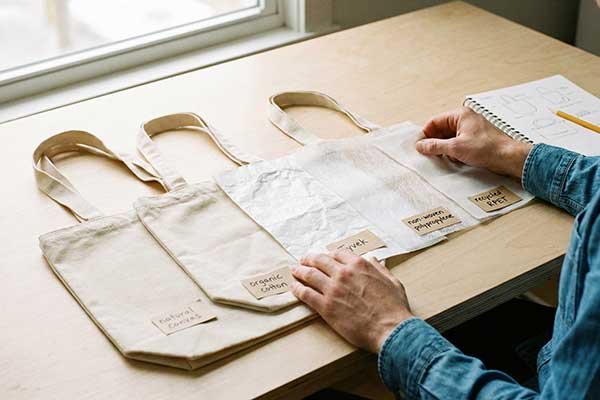
Buyers often choose a material based on a photo without knowing how it feels or behaves. You might pick 100% cotton because it sounds nice, but then realize it wrinkles too easily for your premium gift packaging. Or, you might choose a heavy canvas for a trade show giveaway, only to find out it eats up your entire marketing budget. Another issue is the "eco-trap"—wanting a sustainable bag but choosing a material that is hard to recycle in your region. Making the wrong choice leads to a bag that feels cheap, costs too much, or doesn’t match your brand values.
To choose correctly, match the material to the event and the budget. If you want a natural, eco-friendly feel for a boutique, go with Cotton (light) or Canvas (durable). اللوحة القماشية is the standard for daily-use tote bags. If you want something unique and high-tech, choose Tyvek; it is waterproof and has a cool paper-like texture. For a softer but strong bag, Nylon is excellent. If sustainability is your main goal, ask for RPET, which is made from recycled plastic bottles. For low budgets and large quantities, like a supermarket giveaway, Non-woven fabric is the king. We can help you navigate these choices if you tell us your priority: Price, Durability, or Eco-story.
| المواد | Key Feature | Best Use Case |
|---|---|---|
| القطن | Soft, natural, eco-friendly. | Boutique gifts, light shopping. |
| اللوحة القماشية | Thick, durable, premium feel. | Daily use totes, heavy items. |
| تايفك | Waterproof, paper-like, trendy. | Tech brands, unique packaging. |
| نايلون | Smooth, strong, flexible. | Foldable bags, travel pouches. |
| RPET | Recycled, sustainable story. | Eco-conscious brand packaging. |
| Non-woven | Cheap, lightweight. | Large events, supermarkets. |
What Printing Method Works Best for Your Logo?
A great logo needs the right طريقة الطباعة to look sharp and last long. The best technique depends on your design’s complexity and the fabric you chose.
Screen printing is best for simple, solid logos and is very durable. For colorful or complex images, heat transfer or digital printing gives better results. If you want a high-end look, consider UV printing for metallic effects or embroidery for texture.

A common mistake is forcing a complex design into the wrong printing method. For example, if you have a colorful photo with gradients and you ask for Silk Screen printing, the result will look grainy or lose detail. On the flip side, if you have a simple one-color logo but ask for Digital Printing, you are paying a much higher price for no reason. Some buyers also forget that the texture of the bag affects the print; a rough canvas cannot hold tiny details as well as a smooth nylon. This can result in a logo that looks messy or peels off after a few washes.
We look at your artwork and quantity to decide the best method. If you order a large batch with a simple, solid-color logo, Screen Printing is the most cost-effective and durable choice. It is the industry standard. If your logo has many colors, gradients, or is a photograph, we will switch to Heat Transfer or Digital Printing to keep all the details sharp. For a very premium feel, UV Printing can create shiny, metallic effects, while Embroidery adds texture and class, making it perfect for gifts. Send us your file first. We will analyze the colors and lines, then guide you to the method that makes your brand look its best while keeping costs reasonable.
| الطريقة | الأفضل لـ | Cost Level |
|---|---|---|
| طباعة الشاشة | Simple logos, solid colors. | Low (for bulk) |
| نقل الحرارة | Photos, many colors, gradients. | متوسط |
| الطباعة الرقمية | Small batches, complex art. | Medium/High |
| التطريز | Premium feel, text logos. | عالية |
الخاتمة
Customizing bags is easier when you communicate clearly. Prepare your reference photos and details early to reduce risks. A good supplier will guide you from the idea to the final product.
Frequently Asked Questions
Q1: What file formats should I provide for my logo design?
A: To ensure the sharpest print quality, especially for screen printing, always provide vector files. The best formats are AI (Adobe Illustrator), PDF, or EPS. These allow us to resize your logo without losing clarity. If you only have a JPG or PNG, it needs to be very high resolution (at least 300 dpi), but vector is always preferred.
Q2: If I pay for a pre-production sample, is the cost refundable?
A: Yes, in most cases. We charge a sampling fee to cover the machine setup and labor for a single unit. However, if you proceed to place a bulk order that meets our Minimum Order Quantity (MOQ), we typically deduct the sample fee from your final invoice.
Q3: Can I split my order into different bag colors (e.g., 500 blue and 500 red)?
A: It depends on the printing method. If the logo and ink color remain the same, we can often split the fabric colors. However, if changing the bag color requires us to clean the screens and change the ink color (e.g., white ink on a blue bag vs. black ink on a red bag), additional setup fees may apply.
Q4: Do custom cotton or canvas bags shrink after washing?
A: Yes, natural fibers like cotton and canvas are not pre-shrunk. If washed in a machine with hot water, they can shrink by 5-10% and the fabric may wrinkle. We generally recommend "spot cleaning" with a damp cloth or hand washing in cold water and air drying to maintain the bag’s shape and print quality.
Q5: How are the bags packed for shipment? Do they come in individual plastic bags?
A: By default, to reduce waste and cost, we pack bags in bulk inside a waterproof master carton (e.g., 50 bags per layer). If you need each bag individually packed in a polybag (OPP bag) for retail purposes, this is an additional service that must be requested and will increase the unit cost slightly.
Q6: What certificates should I ask for if I want to prove the bags are sustainable?
A: If you are ordering recycled materials like RPET or organic cotton, you can ask for GRS (Global Recycled Standard) or GOTS (Global Organic Textile Standard) certificates. These documents prove the origin of the material. For general safety, you can also ask for OEKO-TEX certification to ensure no harmful chemicals were used.
Q7: Is it possible to rush an order if I have a tight deadline?
A: Rush orders are sometimes possible but depend on our current production schedule. Be aware that rushing an order often incurs two extra costs: a "rush fee" for overtime labor in the factory, and significantly higher shipping costs, as we may need to use Air Freight instead of Sea Freight to get it to you on time.
Q8: What is the industry standard for "over-run" or "under-run" quantities?
A: In custom manufacturing, it is common to have a variance of +/- 5% in the final quantity due to quality control checks. For example, if you order 1,000 bags, you might receive 980 or 1,050. We usually charge for the exact amount shipped. If you need an exact number (no less than 1,000), please state this upfront so we can produce extras to cover potential defects.
Q9: What are the standard payment terms for custom orders?
A: For most custom projects, the standard term is a 30% to 50% deposit before production begins (to cover material costs) and the remaining balance paid before shipment or upon release of the Bill of Lading.
Q10: Can you print on the gusset (side) or the bottom of the bag?
A: Yes, but this usually requires "piece-to-piece" printing. This means we print the fabric قبل sewing the bag together. This allows for edge-to-edge design but is more expensive than printing on a pre-made bag, which is restricted to the center area of the front and back panels.

 العربية
  English
  Deutsch
  Español
  Português
  Русский
  Français
  Italiano
  日本語
日本語  한국어
한국어  Dansk
Dansk