Aller directement au contenu

You request a custom bag quote from three manufacturers and receive three different prices. One supplier quotes $1.10, another $1.30, and another $1.50 per bag.
The fairest way to compare custom bag quotes is to compare the same specifications, quantity, customization, included costs, production terms, and shipping basis. Instead of looking only at the custom bag unit price, compare the estimated total project cost and confirm what each manufacturer has included or excluded.
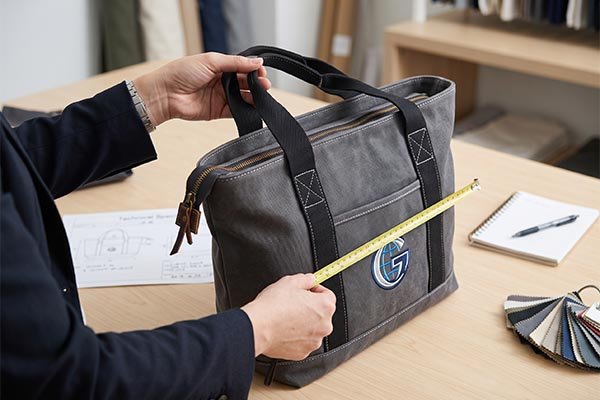
Why Can Different Manufacturers Quote Different Prices for the Same Bag?
Different custom bag manufacturers can give noticeably different prices even when the product appears similar. The difference may come from the material, fabric weight, construction, printing method, accessories, quantity, packaging, or shipping terms.
A different custom bag quotation does not automatically mean that one manufacturer is expensive or another is cheap. The first step is to find out what each supplier is actually quoting.
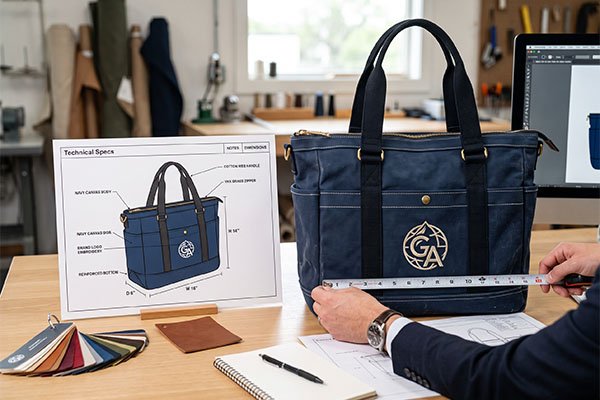
How Do Material and Construction Affect Custom Bag Pricing?
The material name alone is usually not enough to compare two custom bag quotes.
For example, two manufacturers may both quote a sac en toile, but one may use 8 oz canvas while the other uses 12 oz canvas. The composition, fabric weight, coating, finishing, and even the fabric source can also be different. Understanding fabric GSM and how it measures material weight1 can help buyers specify and compare fabric more accurately.
The same issue applies to other materials. A recycled polyester bag and a standard polyester bag may look similar, but their material costs can be different. For clear bags, a 0.3 mm PVC bag and a 0.5 mm PVC bag are also not equivalent products.
Construction is another important factor.
A simple flat bag usually requires less material and sewing than a bag with a bottom gusset, side gusset, multiple pockets, reinforced seams, lining, or padded sections. Zippers, buckles, D-rings, metal logos, snap buttons, and adjustable straps can also increase the manufacturing cost.
When comparing quotes, check details such as:
- Material composition
- Fabric weight or GSM
- Material thickness
- Lining or coating
- Bag dimensions
- Bottom or side gusset
- Number of pockets
- Coutures renforcées
- Closure type
- Hardware and accessories
Why Do Quantity and Customization Change the Quote?
The quantity shown on the quotation should always be compared with your actual purchasing requirement.
A manufacturer may offer a lower unit price at 5,000 pieces than at 500 pieces because material purchasing, setup, production, and labor costs can be spread across a larger order.
Customization can also change the price significantly.
Printing method, number of logo colors, embroidery, woven labels, custom-dyed fabric, custom hardware, special straps, and other details may all affect the quotation.
You should also pay attention to color breakdowns.
For example, an order of 1,000 bags may consist of:
| Couleur | Quantity |
|---|---|
| Noir | 500 pcs |
| Beige | 300 pcs |
| Green | 200 pcs |
| Total | 1,000 pcs |
Although the total quantity is 1,000 pieces, the factory may need to manage three separate material or production requirements. This can affect the actual quotation.
How Do Packaging and Shipping Terms Affect the Quotation?
Packaging and shipping are two areas that can make apparently similar quotations difficult to compare.
One supplier may include individual polybags and export cartons in the quotation, while another may quote only the finished bags and charge packaging separately.
Shipping terms can create an even larger difference.
For example, a $1.20 EXW quotation and a $1.50 DDP quotation are not describing the same cost structure. The EXW price leaves more transportation and import-related responsibilities to the buyer, while DDP covers a different range of delivery responsibilities.
Before comparing prices, always check whether the quotations are based on EXW, FOB, CIF, DDP, or another agreed shipping term. The International Chamber of Commerce’s Incoterms® rules2 provide the standard framework for understanding the respective responsibilities, costs, and risks of buyers and sellers.
Are You Actually Comparing the Same Custom Bag Specifications?
Before comparing custom bag pricing, make sure every manufacturer is quoting the same product. This sounds obvious, but specification differences are one of the most common reasons that buyers receive different prices.
If the specifications are different, the prices are not directly comparable. Align the product details first, then compare the quotation.
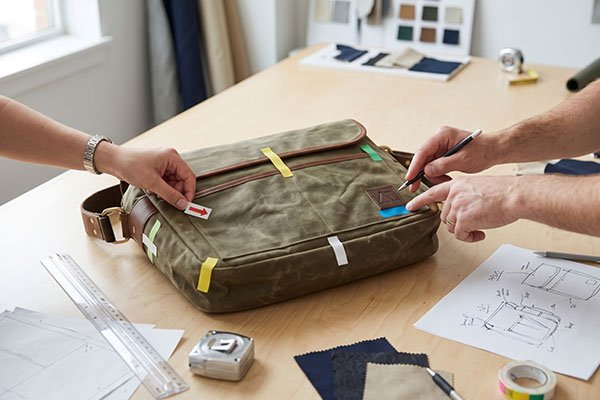
How Can You Compare Material and Construction Details?
Start with the basic physical specifications of the bag.
Instead of writing only “cotton bag” or “canvas tote,” record the exact information provided by each manufacturer.
| Specification | Supplier A | Supplier B | Supplier C |
|---|---|---|---|
| Matériau | Coton | Coton | Toile |
| Poids du tissu | 10 oz | 12 oz | 12 oz |
| Taille | 35 × 40 cm | 35 × 40 cm | 35 × 40 cm |
| Gusset | 8 cm | 8 cm | 10 cm |
| Lining | Non | Non | Oui |
| 1 | 1 | 2 | |
| Reinforcement | Standard | Double stitching | Double stitching |
This makes the differences much easier to identify.
Size should also be checked carefully. A quotation may list 30 × 40 cm, but one manufacturer may be referring to the flat dimensions while another includes the gusset or uses a different measurement method.
For bags with more complicated construction, check the bottom and side gussets, pocket dimensions, compartments, lining, reinforcement, closures, and stitching requirements.
What Customization Details Should You Match?
Customization needs to be compared in the same way as the basic bag specifications.
For example, two suppliers may both write “custom logo included,” but one may be quoting a one-color screen print while the other is quoting embroidery.
The following details should be confirmed:
- Logo size
- Logo position
- Printing method
- Number of printing colors
- Embroidery requirements
- Woven label
- Hangtag
- Zipper pull
- Hardware
- Strap design
- Custom accessories
Do not record customization simply as “Logo: Yes.” Record the actual decoration method, size, color, and placement.
How Should You Compare Quantity and Packaging?
Quantity should include not only the total number of bags but also the breakdown by color, size, design, or material.
Packaging should also be listed separately because it may have a meaningful effect on the final order cost.
For example:
| Item | Supplier A | Supplier B | Supplier C |
|---|---|---|---|
| Taille | ✓ | ✓ | ✓ |
| Matériau | ✓ | ✓ | ? |
| GSM | ✓ | ? | ✓ |
| Impression | ✓ | ✓ | ? |
| Hardware | ✓ | ? | ✓ |
| Individual Packaging | Included | Extra | Included |
| Quantity | 1,000 | 1,000 | 1,000 |
Do not compare the unit price until the specification columns are aligned.
What Is Included in Each Manufacturer’s Custom Bag Quote?
Even when two manufacturers are quoting the same basic bag, the contents of the quotation may be different. One supplier may include printing, packaging, and certain accessories, while another may list them as additional costs.
A lower unit price does not necessarily mean a lower final cost. You need to understand exactly what is included in the custom bag quote before comparing the numbers.
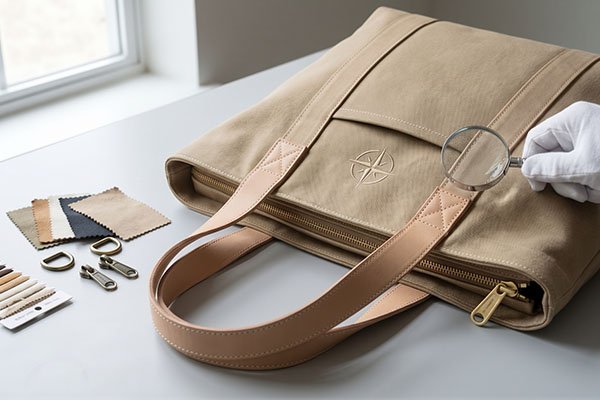
Is Printing Included in the Custom Bag Quote?
Printing is one of the first items you should check.
A supplier may quote a unit price that includes one-color screen printing, while another may quote the blank bag and calculate printing separately.
Even when printing is included, the quotation may be based on a specific logo size, location, and number of colors.
For example:
- Supplier A: $1.20 including one-color logo
- Supplier B: $1.05 excluding printing
Looking only at the unit price would make Supplier B appear cheaper, but the two quotations are not based on the same conditions.
Are Accessories and Packaging Included?
Accessories can sometimes be overlooked when comparing custom bag pricing.
Depending on the bag design, these may include:
- Fermetures à glissière
- Buckles
- D-rings
- Metal logos
- Snap buttons
- Adjustable straps
- Woven labels
- Hangtags
- Special zipper pulls
Packaging should be checked separately as well.
Individual polybags, tissue paper, custom boxes, barcode stickers, product labels, and special carton requirements may or may not be included.
A simple way to compare these items is to ask the manufacturer to mark each one as:
Included / Extra Cost / Not Included
This makes the quotation much easier to understand.
Are Sample and Other Costs Quoted Separately?
Sample costs are often handled separately from the bulk unit price.
Depending on the project, you may need to consider:
- Sample development fee
- Sample revision fee
- Sample shipping
- Logo setup
- Mold or tooling
- Custom hardware
- Testing
- Inspection
- Special packaging
Additional costs are not necessarily hidden costs. They may simply be outside the quoted unit price.
For this reason, it is better to ask the manufacturer for a clear quotation breakdown rather than assuming that every project cost is already included in the unit price.
Why Does the Unit Price Alone Not Tell You the Full Cost?
Consider this simplified comparison:
| Cost / Term | Supplier A | Supplier B |
|---|---|---|
| Product Cost | $1,200 | $1,100 |
| Packaging | Included | $100 |
| Sample | $50 | $80 |
| Expédition | $400 | $700 |
| Other Charges | $0 | $0 |
| Estimated Total | $1,650 | $1,980 |
Supplier B has the lower product unit price in this example, but its estimated project cost is different because other charges are handled differently.
The important question is not simply “Which manufacturer has the lowest unit price?” but “What exactly am I paying for under each quotation?”
How Should You Compare MOQ, Lead Time, and Shipping Terms?
Price is only one part of a custom bag order. MOQ, production lead time, sample development, and shipping terms can also affect whether a quotation fits your actual purchasing plan.
A quotation should be compared against your real order quantity, required delivery date, destination, and shipping method—not just against another supplier’s unit price.
Why Should MOQ Be Part of Your Quote Comparison?
MOQ is particularly important for small brands, startups, retailers, and buyers testing a new product.
For example, your actual requirement may be 500 bags.
| Supplier | MOQ | Required Quantity | Can Order 500 pcs? |
|---|---|---|---|
| Supplier A | 500 pcs | 500 pcs | Oui |
| Supplier B | 1,000 pcs | 500 pcs | Non |
| Supplier C | 2,000 pcs | 500 pcs | Non |
A supplier may offer a very attractive unit price at 2,000 pieces, but that price is not necessarily useful if your current purchasing requirement is only 500 pieces.
MOQ should therefore be evaluated together with the quantity you actually need.
What Lead Time Should You Confirm?
Lead time should be broken into several stages rather than treated as one number.
For a custom bag project, you may need to consider:
Sample development → Sample revision → Final approval → Material preparation → Bulk production → QC → Packing → Shipping
A manufacturer saying “30 days production time” may be referring only to bulk production.
It may not include sample development or international transportation.
When requesting a quotation, ask the manufacturer to clarify whether the stated lead time begins after order confirmation, deposit payment, artwork approval, or sample approval. A custom bag RFQ checklist can help you organize these requirements before requesting quotes.
How Do EXW, FOB, CIF, and DDP Change the Quote?
Shipping terms can significantly affect the final cost.
- EXW: The buyer generally takes responsibility for arranging transportation from the manufacturer’s location.
- FOB: The supplier handles the agreed export-side responsibilities under the applicable FOB Incoterm, with the buyer taking over according to the agreed port and terms.
- CIF: The quotation includes cost, insurance, and freight to the named destination port under the applicable CIF terms.
- DDP: The seller arranges delivery to the named destination and assumes the responsibilities specified under DDP, including duties and taxes where applicable.
The exact responsibilities should always be confirmed according to the agreed Incoterm and destination.
A $1.20 FOB quotation and a $1.50 DDP quotation should not be treated as directly comparable product prices.
How Can You Calculate the Total Cost of a Custom Bag Order?
Once the specifications and quotation conditions are aligned, you can move from unit-price comparison to total project-cost comparison.
This gives you a much clearer picture of what each manufacturer is actually charging for the complete order.
The most useful comparison is usually the estimated total cost of receiving the finished custom bags—not simply the factory’s quoted price per piece.
What Should Be Included in the Total Custom Bag Cost?
A simple comparison formula can be:
Total Project Cost = Product Cost + Sample Cost + Packaging + Shipping + Other Required Charges
Product cost is normally:
Unit Price × Actual Order Quantity
Depending on the project, you may also need to include:
- Sample development
- Sample shipping
- Individual packaging
- Custom packaging
- Product labels
- Cartons
- Shipping or freight
- Tooling or mold fees
- Testing
- Inspection
- Custom hardware
- Special material charges
The exact items will depend on the product and commercial terms.
How Can You Use a Custom Bag Quote Comparison Sheet?
A simple comparison sheet can help you organize several quotations without focusing too heavily on the headline unit price.
| Cost / Term | Supplier A | Supplier B |
|---|---|---|
| Product Cost | $1,200 | $1,100 |
| Packaging | Included | $100 |
| Sample | $50 | $80 |
| Expédition | $400 | $700 |
| Other Charges | $0 | $0 |
| Estimated Total | $1,650 | $1,980 |
This example is only for demonstrating the comparison method. It does not represent a standard custom bag price.
You can expand the sheet with additional columns for:
- Matériau
- GSM
- Taille
- Impression
- Accessoires
- MOQ
- Lead time
- Incoterm
- Packaging
- Payment terms
- Sample cost
- Shipping cost
Once all of these details are visible in one place, it becomes much easier to understand why two manufacturers may quote different prices.
What Questions Should You Ask Before Comparing the Final Numbers?
Before making your final comparison, confirm these points with every manufacturer:
- Are the product specifications identical?
- Is the material and fabric weight the same?
- Is the bag construction the same?
- Is the printing method and logo specification the same?
- Are the accessories included?
- Is packaging included?
- Are the MOQ and actual order quantity the same?
- Is the production lead time comparable?
- Are the shipping terms the same?
- Are sample, setup, tooling, or other additional costs included?
Once these questions are answered, the price comparison becomes much more meaningful because you are comparing similar products under similar commercial conditions.
Conclusion
To compare custom bag quotes fairly, first align the product specifications and quotation terms, then compare the total project cost rather than the unit price alone.
FAQ
Q: How long is a custom bag quotation usually valid?
A : A quotation may only be valid for a limited period because material, labor, and logistics costs can change. Always confirm the quotation validity before placing an order.
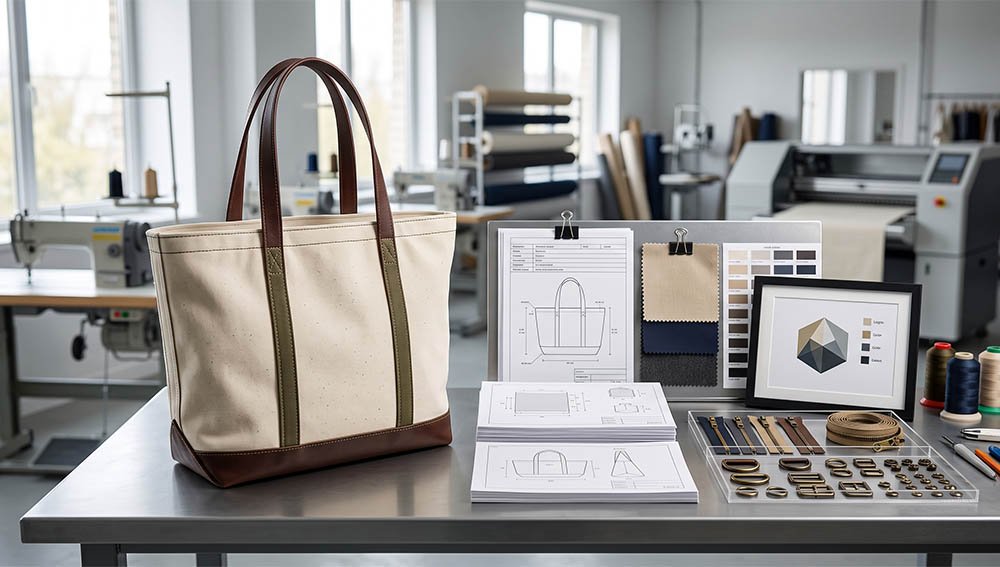
Q: Can I ask several manufacturers to quote from the same tech pack?
A : Yes. Using the same tech pack, artwork, drawings, and specifications helps ensure that each manufacturer understands the product in the same way.
Q: Should I send a physical sample when requesting a custom bag quote?
A : If you need to reproduce an existing bag, sending a physical sample can help the manufacturer evaluate its construction, dimensions, materials, and workmanship more accurately.
Q: What information should I prepare before requesting a custom bag quotation?
A : Prepare the bag dimensions, product photos or drawings, intended use, logo artwork, preferred material, estimated order quantity, and destination. The more complete the information, the easier it is for manufacturers to quote accurately.
Q: Can a manufacturer change the quotation after I approve the sample?
A : The price may need to be updated if the approved sample introduces changes to the original specifications. Confirm that the final production quotation matches the approved sample before production starts.
Q: Why might the same manufacturer give different prices at different times?
A : A quotation can change when material costs, production conditions, exchange rates, or shipping-related costs change. The date of the quotation should therefore be recorded when comparing offers.
Q: Is it possible to negotiate a custom bag quotation?
A : Negotiation is possible, but it is usually more productive to discuss specific factors such as order volume, design simplification, material alternatives, or production efficiency rather than simply asking for a lower price.
Q: Should I request a sample before accepting a custom bag quotation?
A : For products with detailed construction or branding requirements, a sample can help you verify the design and workmanship before committing to production.
Q: Can the same bag design have different production costs at different factories?
A : Yes. Manufacturers may have different production equipment, supplier networks, labor structures, and production processes, which can lead to different manufacturing costs for a similar product.
Q: What should I do if a manufacturer’s quotation is much lower than the others?
A : Ask the manufacturer to reconfirm the specifications and production requirements rather than assuming the lower quotation is incorrect. A significant price difference may come from differences in how the product has been interpreted or manufactured.
-
TextileTuts explains fabric GSM (grams per square meter), a standard measurement of fabric weight that helps buyers understand and compare material specifications. ↩
-
The International Chamber of Commerce explains Incoterms® rules and how they define the responsibilities, costs, and risks of buyers and sellers in commercial transactions. ↩

 English
  Deutsch
  Español
  Português
  Русский
  العربية
  Français
  Italiano
  日本語
日本語  한국어
한국어  Dansk
Dansk