Skip to content

Drawstring bags frequently fail due to material stress at the closure points. This structural weakness leads to tearing, peeling, and increased customer complaints for brands. Selecting the correct leather grade is essential for product longevity.
Microfiber leather provides the most balanced performance for custom drawstring bags, offering high durability and cost-efficiency. Genuine leather is suitable for premium, high-end collections, while PU leather serves as a budget-friendly option for short-term promotional items. The choice depends on the intended product lifespan.
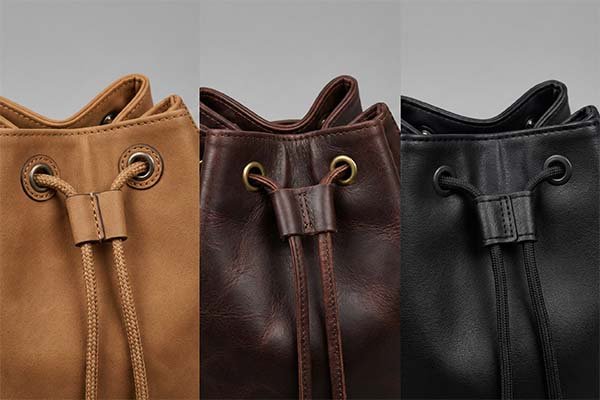
The structural simplicity of a drawstring bag hides a complex material requirement. The constant friction and tension at the pouch opening create a unique challenge for manufacturers and buyers.
Why Does Leather Choice Matter for Drawstring Bags?
A drawstring bag relies entirely on the durability of the material around the cinching mechanism. If the leather lacks sufficient tensile strength, the product will degrade rapidly. This leads to brand damage and high return rates.
The design of a drawstring pouch concentrates physical stress on specific points. Unlike a tote bag where handles bear the weight, a drawstring bag bears weight and friction at the punched holes. Weak materials cannot withstand this repeated force.
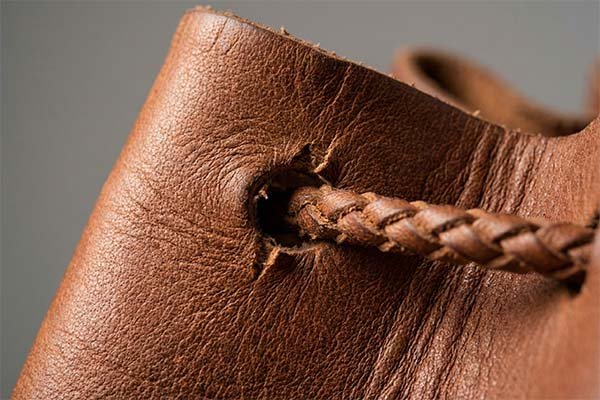
The manufacturing process for drawstring bags involves punching holes and threading cords. This structure creates immediate vulnerability. When a user closes the bag, the material folds and bunches together. This folding action tests the flexibility of the leather. Simultaneously, the cord rubs against the raw edges of the holes. If the material is brittle or consists of weak layers, cracks appear quickly.
For B2B buyers, material failure translates directly to financial loss. A batch of bags that peels after one month of use damages the company’s reputation. Quality control becomes difficult if the base material is inconsistent. The leather must handle the mechanical action of opening and closing hundreds of times. A poor choice, such as low-grade synthetic leather, will delaminate under this stress. The surface coating separates from the base layer. Therefore, the choice of leather determines not just the look, but the structural integrity of the final product.
What Do Drawstring Bags and Pouches Require from Leather?
Drawstring bags demand specific physical properties to function correctly. The material must be soft enough to cinch closed but strong enough to resist tearing. Standard stiff leathers often fail in this specific application.
The core requirements for this product category are flexibility, tear resistance, edge stability, and surface durability. These four factors determine whether a bag can be mass-produced successfully and withstand daily usage.
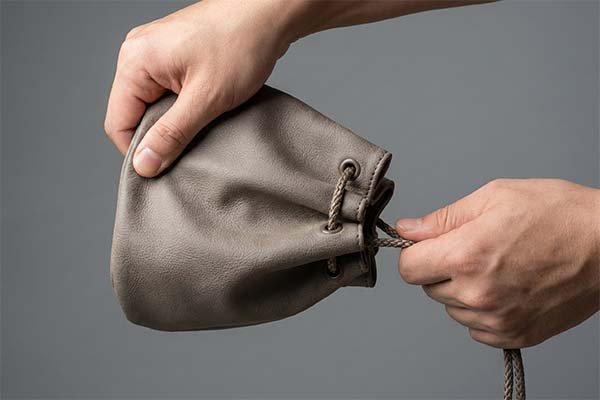
To evaluate whether a material is suitable for drawstring pouches, buyers should analyze specific performance metrics. The material must fold tightly without cracking. It must also hold a clean edge after die-cutting.
Flexibilité is the first requirement. Rigid materials create bulky, unattractive folds when the bag is closed. This prevents the bag from sealing properly. The leather must be pliable enough to drape naturally.
Résistance à la déchirure is critical for the hole placements. The punched holes sever the fiber structure of the material. Without strong internal bonding, the holes will stretch and rip under the tension of the cord.
Edge Stability ensures the longevity of the product. In many designs, the edges of the holes remain raw (unpainted). If the material layers are not bonded well, the constant friction of the string will cause the layers to separate.
Surface Durability protects the bag during transport and use. Drawstring pouches often act as secondary packaging inside larger bags. They face constant rubbing against other objects. The surface must resist scuffing to maintain the logo and brand appearance.
| Performance Metric | Function in Drawstring Bags | Consequence of Failure |
|---|---|---|
| Flexibilité | Allows smooth cinching and folding. | Bag remains partially open; ugly creases form. |
| Résistance à la déchirure | Maintains the shape of cord holes. | Holes rip open; cord pulls through material. |
| Edge Stability | Prevents layer separation at cuts. | Coating peels off; bag looks cheap and worn. |
| Surface Durability | Resists abrasion from daily friction. | Scratches appear; logos fade or flake off. |
How Does PU Leather Perform for Drawstring Bags?
PU (Polyurethane) leather is the standard choice for cost-sensitive projects. It offers a wide range of colors and uniform textures. However, its structural limitations make it less suitable for long-term applications.
While PU leather provides significant cost advantages for large-volume orders, it often lacks the density required for durable drawstring holes. It is best used for promotional items rather than permanent retail products.
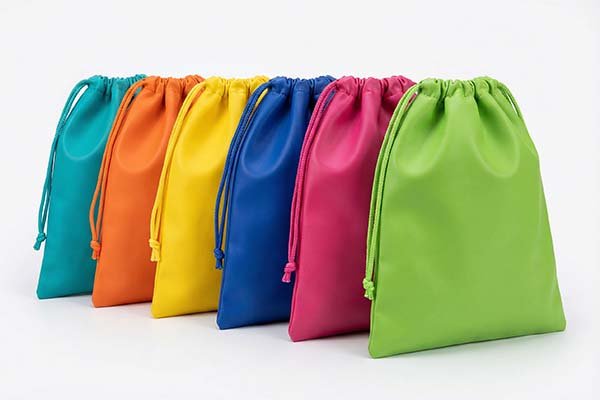
PU leather1 is a synthetic material made by coating a base fabric with polyurethane. Its primary advantage is economic. For large-scale promotional events, gift with purchase (GWP) campaigns, or simple dust bags, PU helps control the total budget. The surface is highly uniform, which makes printing logos easy and consistent. It is also naturally water-resistant and easy to wipe clean.
However, from a technical perspective, PU has weaknesses in the drawstring structure. The material usually has a lower density than microfiber or genuine leather. Over time, the area around the drawstring holes tends to stretch out. The most common failure mode is hydrolysis or peeling. This happens when the top coating separates from the base fabric after repeated friction or exposure to humidity. Most PU bags have a functional lifespan of 3 to 5 years. For B2B buyers, this material carries a higher risk of quality issues if the supplier uses a low-grade base. It is a valid choice for disposable or short-term packaging, but it does not convey high value.
Why Is Microfiber Leather Better for Pouches?
Microfiber leather represents the optimal balance between performance and cost for most commercial projects. It mimics the microscopic structure of genuine leather, providing superior strength and stability.
This material offers high batch consistency and durability, making it the preferred choice for brand packaging and retail goods. It eliminates the common defects found in standard PU while remaining more affordable than genuine leather.
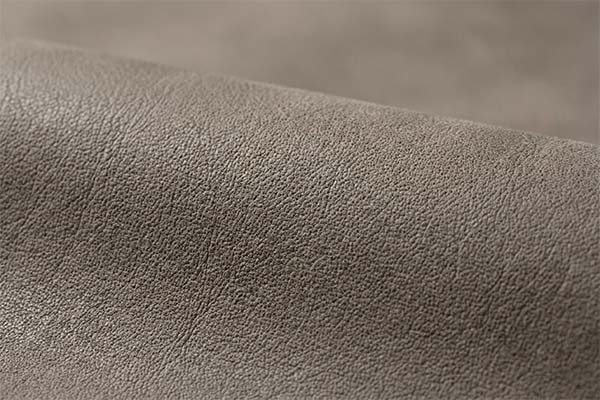
Microfiber leather is distinct from standard PU. It is constructed using a non-woven 3D structure of superfine fibers, bonded with high-grade polyurethane resins. This structure closely replicates the collagen fiber network found in natural leather. For drawstring bags, this difference is crucial. The high-density fiber base allows for clean die-cutting. When holes are punched for the drawstring, the edges remain sharp and do not fray. The material holds stitches tightly and resists tearing under tension.
For standardized production, microfiber offers significant advantages. Unlike genuine leather, which has natural imperfections and irregular shapes, microfiber comes in consistent rolls. This improves cutting efficiency and reduces material waste. The physical properties are uniform across the entire batch. It is highly resistant to abrasion, acid, and alkali. With a lifespan often exceeding 5 to 10 years, it supports a brand’s image of quality. It feels soft and substantial in the hand, similar to real leather. For brands looking to build long-term value without the volatility of the raw hide market, microfiber is the most logical technical solution.
What Leather Fits Different Drawstring Bag Uses?
Selecting the right material requires aligning the physical properties with the product’s market positioning. A mismatch between material and purpose leads to wasted budget or customer dissatisfaction.
Buyers should categorize their projects into promotional, retail, or luxury segments to determine the appropriate material. PU fits promotions, Microfiber fits retail, and Genuine Leather fits luxury.
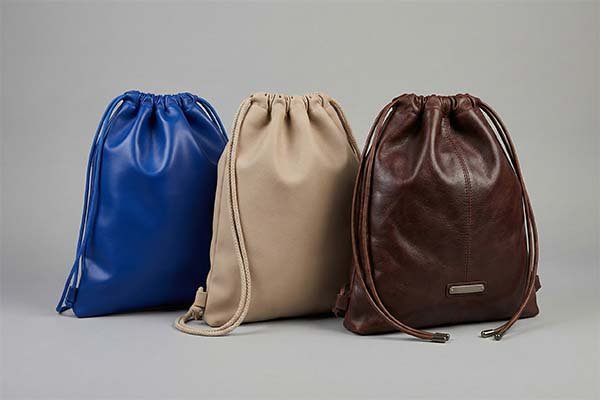
B2B procurement requires a "fit-for-purpose" approach. Over-specifying materials increases costs unnecessarily, while under-specifying damages brand equity. The market generally divides into three distinct categories.
Promotional and Gift Categories: For trade show giveaways, simple dust covers, or event favors, the priority is visual impact and low cost. Standard PU leather is the correct specification here. The product usage is expected to be light and temporary. The material cost must stay low to allow for high volume.
Retail and Daily Use Categories: For cosmetic pouches, tech accessory bags, or private label fashion items, durability is the priority. The consumer pays for the product and expects it to last. Microfiber leather is the correct specification. It withstands daily friction, travel, and repeated opening. It ensures the product remains functional for years, encouraging repeat purchases.
Luxury and Heirloom Categories: For jewelry packaging, high-end collector items, or limited editions, the priority is tactile experience and prestige. Genuine leather (such as goat suede or full-grain cowhide) is the necessary specification. While expensive and harder to maintain, it develops a patina and offers a unique scent and touch that synthetics cannot withstand. This justifies a premium price point.
Conclusion
Material stability is the decisive factor for drawstring bag quality. Microfiber offers the best durability for general retail, PU suits budget promotions, and Genuine Leather defines luxury. Correct selection reduces B2B risks.
Frequently Asked Questions
Q: What is the ideal thickness range for a leather drawstring bag to ensure proper closure?
A : For most drawstring pouches, a thickness between 0.8mm and 1.2mm is optimal. If the material exceeds 1.4mm, the pouch becomes too stiff to cinch tightly, leaving a gap at the top. If it is thinner than 0.6mm, the material lacks the structural integrity to hold the shape and may tear at the eyelets.
Q: Does the choice of drawstring cord material affect the lifespan of the leather holes?
A : Yes, the cord material creates friction against the leather holes. Rough materials like hemp or untreated jute can saw through soft leather edges quickly. We recommend using waxed cotton, satin, or nylon cords, as their smooth surfaces reduce friction and extend the lifespan of the bag’s opening mechanism.
Q: Is a lining necessary for microfiber or genuine leather pouches?
A : Microfiber leather typically has a clean, suede-like backing that does not shed, so a lining is optional and often omitted to save costs. However, genuine leather (especially split leather) often sheds particles from the flesh side, which can dirty the items inside. Therefore, genuine leather pouches usually require a velvet or cotton lining.
Q: How does the choice of leather affect the branding method (Logo)?
A : Genuine leather and microfiber are excellent for heat embossing (debossing), as they hold deep, crisp impressions under heat and pressure. Standard PU leather, however, often recovers its shape too quickly or melts under high heat, making it better suited for silk-screen printing or foil stamping rather than deep blind embossing.
Q: Are there significant differences in Minimum Order Quantities (MOQ) between these materials?
A : Yes. Stock PU and Microfiber often have lower MOQs (e.g., 500 units) because the material is readily available in standard colors. Custom dyeing genuine leather to a specific Pantone color usually requires a much higher MOQ (often 1,000+ units) because tanneries require a minimum drum load to dye the hides.
Q: How do these materials react to long-term storage or shipping in compressed boxes?
A : Genuine leather can develop permanent creases if crushed during shipping, which are difficult to remove without professional steaming. Microfiber has excellent memory and resilience, usually returning to its original shape after being unpacked. Low-quality PU poses a risk of "blocking" (sticking together) if packed tightly in hot environments without tissue paper interleaving.
Q: Is there an odor difference between these materials that buyers should be aware of?
A : Yes. Freshly manufactured PU leather can sometimes carry a strong chemical or plastic smell that requires airing out before packaging. Genuine leather has a distinct natural scent that many consumers perceive as high value. High-quality microfiber is generally odorless, making it the safest choice for packaging sensitive items like fragrance or jewelry where scent interference is a concern.
Q: Can we wash these drawstring bags if they get dirty?
A : Microfiber leather is generally water-resistant and can be wiped down with a damp cloth or even lightly hand-washed. Genuine leather should never be soaked, as it will stiffen and warp upon drying. PU leather can be wiped clean, but harsh detergents may dissolve the surface coating over time.
Q: How does the weight of the material impact international shipping costs?
A : Genuine leather is significantly heavier than synthetic options due to its density and natural oil content. For large bulk shipments (e.g., 10,000 units), choosing Microfiber or PU over Genuine Leather can result in substantial savings on air freight or courier costs due to the reduced gross weight.
Q: Are there specific "vegan" certifications available for the synthetic options?
A : Yes. While standard PU is synthetic, buyers targeting the eco-conscious market should look for Microfiber or PU that is GRS (Global Recycled Standard) certified or water-based (DMF-free). This ensures the material is not only animal-free but also manufactured without harmful solvents, which is a growing requirement for EU and US markets.
-
Explore this link to understand how PU leather can enhance your promotional strategies and budget management. ↩

 Français
  English
  Deutsch
  Español
  Português
  Русский
  العربية
  Italiano
  日本語
日本語  한국어
한국어  Dansk
Dansk