コンテンツへスキップ

You spend weeks choosing the right bag size and logo print. Then your final product looks flimsy or costs too much to ship. Wrong felt thickness ruins good designs.
The best felt thickness depends on your specific product needs. Use 1-2mm for simple promotional pouches, 2-3mm for everyday totes or cosmetic bags, and 3-5mm for items needing structural support like wine bags or electronics sleeves. Choosing the right material balances protection, appearance, and production costs.
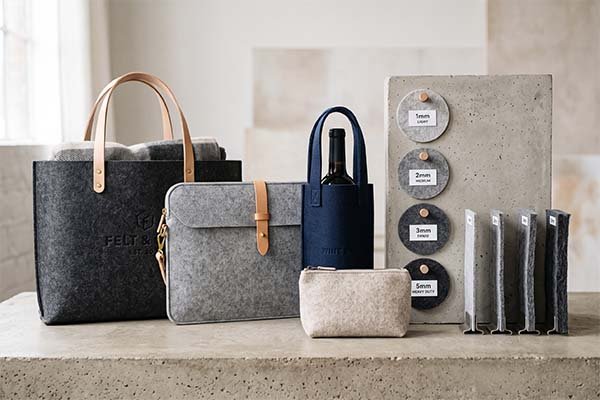
Many procurement managers ask me for the thickest felt available because they think it guarantees quality. I have to stop them right there. You only waste budget and complicate manufacturing if you choose a 5mm material for a simple grocery tote. Let’s look at exactly how thickness changes your final product.
Why Does Felt Thickness Matter for Custom Bags?
A bad material choice makes your packaging useless. Thin bags collapse under heavy items. Extra-thick bags waste money and drive up international shipping rates fast.
Felt thickness directly controls bag structure, product protection, and final unit cost. Thin felt offers easy folding and low shipping weight for basic packaging. Thick felt provides rigid shape retention and shock absorption, making it necessary for high-end luxury goods or fragile electronics.
Structural Shape and Support
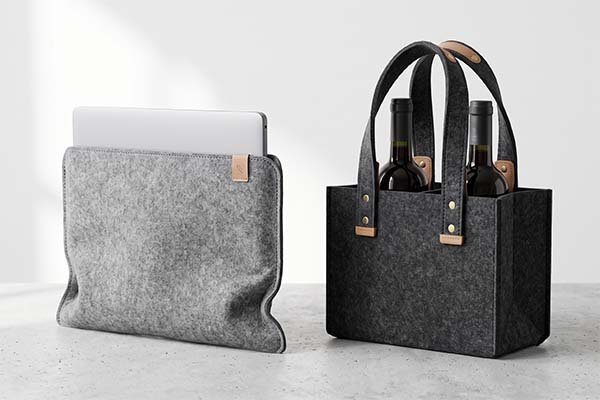
Different thicknesses create completely different bag profiles. If you order a 1mm custom felt bag, you get a soft, flexible product. This material folds flat. It costs very little to ship from China to the United States1. You use this for basic dust bags or small promotional items. But if you try to put a heavy glass jar in a 1mm bag, the structure fails completely.
Thick felt between 3mm and 5mm holds its shape. You get a rigid, premium appearance. A 4mm laptop sleeve sits upright on a retail shelf.
Impact on Unit Cost and Shipping
More material means higher expenses. You pay for raw material weight and international shipping volume2.
| アスペクト | Thin Felt (1-2mm) | Thick Felt (3-5mm) |
|---|---|---|
| 材料費 | 低い | 高い |
| Shipping Weight | ライト | 重い |
| Production Time | Fast | Slower |
| Best Application | Dust bags, cheap gifts | Laptop sleeves, wine totes |
A simple change from 2mm to 4mm can double your shipping cost per unit. You do not want to absorb that extra expense unless your product genuinely needs heavy-duty shock absorption. The goal is always to match the material exactly to the end use.
What Are the Common Felt Thickness Options for Different Applications?
Picking a random thickness delays your production schedule. Your supplier has to ask you multiple times for clarification. You risk receiving a sample that completely fails your durability tests.
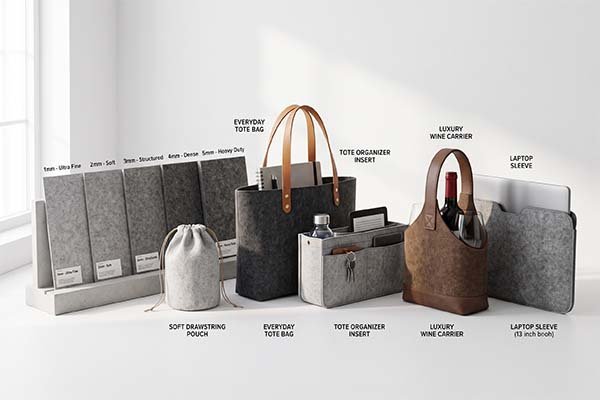
1-2mm felt works best for soft pouches and simple giveaways. 2-3mm is the industry standard for everyday totes and organizer inserts. 4-5mm felt provides maximum protection and structural rigidity for premium items like luxury packaging, heavy retail displays, and electronic accessories.
The 2mm Balance Option
For many mid-range projects, 2mm felt hits the sweet spot. You get a cleaner look than a 1mm dust bag. Sewing a 2mm material on a standard machine is fast and easy. You see this thickness everywhere in cosmetic bags and standard promotional event giveaways. It offers just enough body to look like a real bag without driving up your invoice.
Why 3mm is the B2B Standard
Most of our OEM custom felt bag projects start at 3mm. This thickness supports daily use. It stands up well. A 3mm トートバッグ keeps its shape even when empty.
Heavy-Duty Requirements
Once you reach 5mm, you enter a different manufacturing category.
| Thickness | Common Bag Types | Sewing Difficulty |
|---|---|---|
| 1mm | Small gift pouch | とても簡単 |
| 2mm | Flexible organizer | 簡単 |
| 3mm | Structured tote bag | 中程度 |
| 5mm | Premium electronics case | Hard |
Using 5mm felt adds machine strain. You need specialized strong needles and longer stitch lengths3. Seams become bulky. I usually recommend adding reinforced layers to the base or handles of a 3mm bag instead of jumping straight to a 5mm material for the whole product. You get the stability without the excessive bulk.
How Can You Choose the Right Felt Thickness Based on Your Product Needs?
Guessing what material your product needs causes endless sample revisions. You waste weeks sending packages back and forth. Your launch deadline approaches while you argue over a simple pouch.
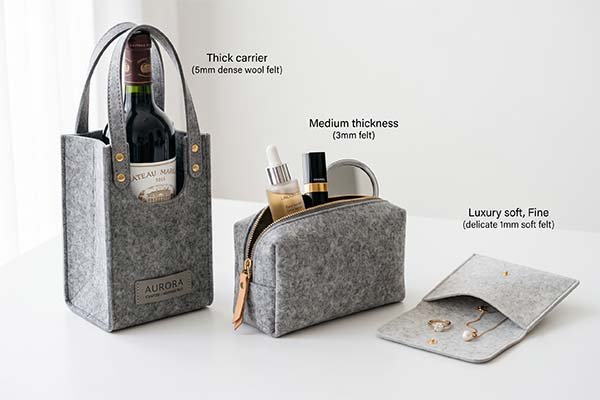
Match the material to the item inside. Wine bottles require 3-5mm felt to stand upright and prevent breakage. Cosmetic bags need lightweight 2-3mm felt for daily flexibility. Jewelry demands a premium soft-touch 3-5mm enclosure to elevate the perceived brand value for the end customer.
Packaging for Fragile and Heavy Items
Wine bags and electronic sleeves share a similar requirement. They carry heavy or fragile items. You cannot use 1mm felt for a heavy wine bottle. The bag will stretch, look cheap, and offer zero impact protection. We always start with a 3mm to 5mm range for these projects. A 4mm felt laptop sleeve absorbs shock during daily commutes. It protects the expensive device inside.
Lightweight Retail and Promotions
Cosmetic brands and promotional companies operate on different rules. A marketing manager ordering 10,000 bags for an event in Australia needs cost efficiency.
| Product Category | Recommended Thickness | Primary Goal |
|---|---|---|
| Wine Packaging | 3-5mm | Upright structure, impact safety |
| Electronics | 4-5mm | Shock absorption, durability |
| Cosmetics | 2-3mm | Flexibility, attractive look |
| Event Promotions | 2mm | Low cost, high volume visibility |
For promotional bags, 2mm felt gives you a great printing surface for logos. You keep your unit price low. You avoid heavy shipping fees. You still deliver a reusable bag that looks far better than a cheap plastic alternative. Always let your end-use dictate the thickness.
Why Is Thicker Felt Not Always Better for Custom Bag Quality?
You order a thick 4mm bag expecting a luxury feel. Instead, the final product feels rough, tears easily at the seams, and looks terrible. You forgot about density4.
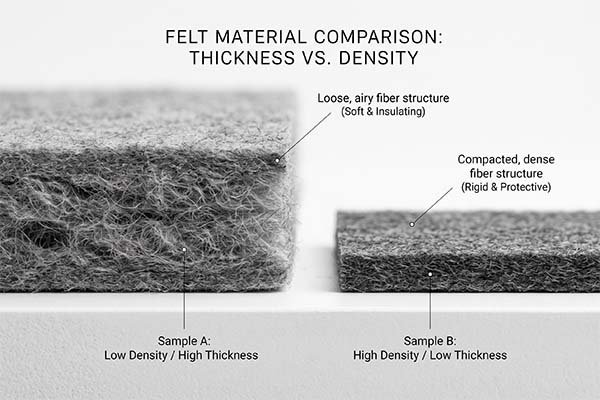
Felt thickness is just the height of the material. Felt density measures fiber compactness. A low-density 4mm felt feels weak and falls apart quickly. A high-density 3mm felt provides superior strength, a smoother hand feel, and better long-term durability for high-quality packaging.
The Density Difference
Many buyers make a massive mistake here. They tell their supplier to just use the 5mm felt. They think a high number equals high quality. This is false.
Thickness represents material height. Density represents fiber compactness. You can manufacture a 5mm felt bag that feels like a cheap kitchen sponge. The fibers sit loosely together. The moment your customer pulls the handle, the material stretches and warps.
Balancing Thickness and Compactness
A professional manufacturer looks at the entire material profile.
| Felt Profile | Characteristics | Resulting Quality |
|---|---|---|
| High Thickness + Low Density | Spongy, weak, pills easily | Very poor |
| Low Thickness + High Density | Stiff, thin, smooth | Good for flat items |
| Medium Thickness + High Density | Strong, durable, premium feel | Excellent for totes |
If you want a durable bag, you need dense fibers. A tightly packed 3mm felt outperforms a loose 5mm felt every time. It holds stitches better. It resists pilling5 on the surface. When a procurement manager from the United Kingdom asks me for a premium bag, I recommend a dense 3mm material rather than a low-density 5mm option. The result is a lighter, stronger, and more attractive product.
How Do Manufacturers Recommend the Best Felt Thickness for OEM Custom Bags?
You skip the consultation and force a specific specification on your factory. Production fails. You end up with 5,000 unsellable units sitting in a warehouse because the seams split open.
A professional manufacturer starts by analyzing your specific product weight, usage environment, and protection requirements. We test structures through prototype development and adjust the thickness before bulk production to ensure your custom bag balances cost, durability, and visual appeal perfectly.

The Consultation Process
We never just look at a spec sheet and start cutting fabric. If Samuel, a buyer from the United States, asks for a 5mm canvas and felt tote, we ask questions first. What exact item goes inside? How much does it weigh? Does the bag need to fold flat for retail display?
We take that data and match it to a material.
Prototyping and Adjustments
The real test happens in the sample room.
| Manufacturing Step | Action Taken | 目的 |
|---|---|---|
| Requirement Analysis | Check product weight and size | Prevent structural failure |
| 素材の選択 | Match density and thickness | Balance cost and function |
| Prototype Sewing | Test seam strength and needles | Ensure mass production viability |
| Bulk Confirmation | Finalize material spec | Lock in quality standards |
Sometimes, during prototyping, we discover that a 3mm body with a 5mm reinforced base works better than a uniform 4mm design. It reduces the strain on our sewing machines and gives the customer exactly the structure they need. We adjust the plan to save the buyer money while delivering a technically superior bag.
Frequently Asked Questions About Felt Bag Thickness?
Sorting through conflicting information online wastes hours of your workday. You need direct answers about material costs and structural durability before you sign a purchasing contract.
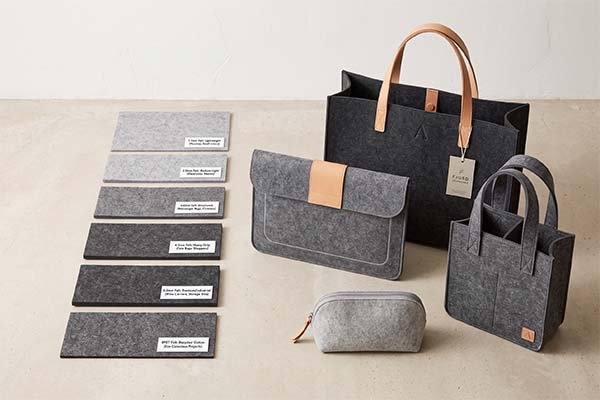
3mm is the most common thickness for custom bags because it balances cost and structure. Thicker materials cost more to produce and ship. Thickness improves protection, but fiber density actually determines long-term durability. Professional manufacturers always customize these specifications for your specific project.
Common Buyer Concerns
Buyers constantly worry about the relationship between material choices and final invoice prices. Yes, felt thickness directly changes your custom bag price. When you increase the thickness from 2mm to 4mm, you use twice the raw material. Your shipping weight increases. That drives up your logistics cost instantly.
Luxury and Durability Standards
Another common question revolves around high-end packaging.
| Question Topic | Standard Recommendation | Business Reason |
|---|---|---|
| Luxury Packaging | 3-5mm | High-end retail requires rigid, premium shapes. |
| 耐久性 | High density 3mm | Dense fibers prevent pilling and hold strong seams. |
| カスタマイズ | Full adjustment | Every brand has different budget constraints. |
You must remember that thicker does not automatically mean better. If you pack a small, lightweight cosmetic box in a massive 5mm felt bag, the packaging overpowers the product. It looks awkward. Work with your factory to find the exact millimeter measurement that fits your brand image. We adjust material parameters daily to hit specific price points for our B2B clients.
結論
Choosing the right felt thickness requires balancing protection, appearance, and unit cost. Match the material to your specific product to create durable, beautiful custom bags without wasting budget.
よくある質問
Q: Can I print my brand logo clearly on very thick felt bags?
A: Yes, but the printing method changes. Screen printing works well on 2-3mm material. For 4-5mm felt, laser engraving or leather patch embossing looks much cleaner and lasts longer.
Q: Will a 1mm felt pouch tear easily under heavy weight?
A: Yes. We design 1mm felt strictly for lightweight items like small accessories or dust covers. Heavy items will stretch the thin material and tear the seams.
Q: Is it harder to clean thicker felt bags?
A: Thicker felt absorbs more liquid if a spill happens, making deep cleaning difficult. You should always use a damp cloth for spot cleaning regardless of the material thickness.
Q: How does felt thickness affect the minimum order quantity (MOQ)?
A: Standard thicknesses like 2mm and 3mm usually have lower MOQs. Custom thicknesses like 5mm often require a higher MOQ because we have to order specialized raw material batches for production.
Q: Can I mix different felt thicknesses in one custom bag design?
A: Yes. A smart structural design uses 3mm felt for the main bag body and 5mm for the bottom base. This gives you extra load-bearing support without making the whole bag bulky.
Q: Will thick felt bags shrink if they get wet during ocean shipping?
A: Synthetic PET felt handles moisture well and rarely shrinks. However, we always use moisture-absorbing packets in our export cartons to prevent any warping during long ocean transits.
Q: Are 2mm felt bags suitable for grocery shopping totes?
A: 2mm works for light items, but 3mm is the industry standard for grocery totes. The 3mm material maintains an upright shape and handles heavy goods much better.
Q: Does the color of the felt affect its thickness or density?
A: No. The dyeing process does not alter the physical thickness or structural density of the felt fibers. A 3mm black bag has the exact same structural integrity as a 3mm grey bag.
Q: How do I know if my supplier actually used the thickness I requested?
A: Use a digital caliper to measure the center of the material panels. Do not measure the edges, because the pressure from our sewing machines compresses the borders slightly.
-
Freight transport is the physical process of transporting commodities and merchandise goods and cargo by land, air, and sea. ↩
-
Dimensional weight, also known as volumetric weight, is a pricing technique for commercial freight transport that uses an estimated weight calculated from the length, width, and height of a package. ↩
-
Stitch length in sewing refers to the distance between two consecutive needle penetrations, affecting the strength and appearance of the seam. ↩
-
In materials science, density refers to how tightly packed the fibers or mass are within a given volume, directly affecting the material’s overall strength. ↩
-
Pilling occurs when small, tight balls of loose fibers form on the surface of a textile, typically caused by friction and wear over time. ↩

 English
  Deutsch
  Español
  Português
  Русский
  العربية
  Français
  Italiano
  日本語
日本語  한국어
한국어  Dansk
Dansk