Skip to content

Trade shows are expensive, and a poor quality bag can hurt your brand image instantly. You need a solid plan to ensure your marketing budget actually brings results.
Planning a non-woven bag purchase requires treating it like a project: define your audience first, then lock in material specs, printing methods, and timelines. This approach prevents budget overruns and ensures your bags arrive on time and look professional on the show floor.
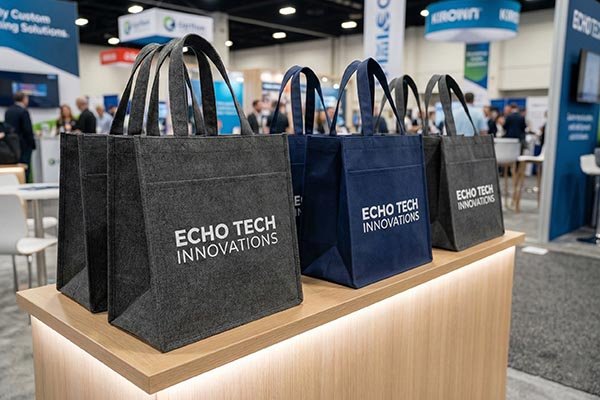
You want your brand to stand out in a crowded exhibition hall. Let’s look at the specific steps to make that happen.
What Requirements Should You Clarify Before Ordering?
Ordering bags without a clear goal leads to waste. You might end up with bags that are too small or too weak for your needs.
The first step is to confirm the event location, date, and the number of visitors you expect. You must also decide if these bags are for general visitors or VIPs, as this changes the budget and quality requirements.

To get the best results, you should treat this purchase like a mini-project. Do not just look at the price tag. Start by listing your goals. Are you distributing a heavy catalog? Or are you giving away a light flyer? This answer decides everything else.
First, look at your audience. If you are attending a general consumer expo, you might need a large quantity of standard bags. But if you are at a niche industry conference, you might need fewer, higher-quality bags for "Key Prospects." A "festival kit" needs a different vibe than a corporate document holder.
Next, think about the bag’s life span. Do you want a cheap, one-day disposable bag? Or do you want a sturdy shopper that people use for months? A durable bag costs more, but it acts as a walking advertisement for a long time.
Finally, clarify your design needs early. Do you have a vector file for your logo? Do you need to print on both sides? These details change the cost. You must set a clear budget range before you talk to suppliers. This helps them suggest the best materials that fit your money limits.
| Requirement | Key Consideration | Impact on Order |
|---|---|---|
| Event Type | Trade show vs. VIP Conference | Determines quality level |
| Contents | Heavy catalogs vs. Light flyers | Determines fabric strength |
| Audience | General public vs. Potential clients | Determines quantity split |
| Budget | Fixed vs. Flexible | Determines material options |
Why Do Material and Bag Structure Matter?
A bag that rips halfway through the show makes your brand look unreliable. Thin fabric can make even a good design look cheap.
You need to choose the right GSM (grams per square meter) and structure. Standard events usually need 80g fabric, but heavy loads require 100g or reinforced handles to ensure the bag holds its shape.
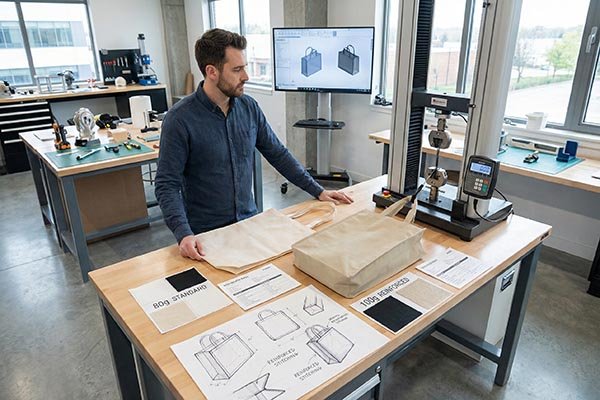
Non-woven polypropylene (PP) is the standard for trade shows because it is light and strong. But "non-woven" comes in many grades. You need to pick the right weight. 70g is very light and cheap. It is fine for a few flyers. 80g is the most common standard. It feels decent and holds typical swag. 100g feels premium and stiff. If you want your bag to look like a retail product, go for 100g or higher.
Size is the next big choice. A standard tote is about 14–16 inches wide. This fits A4 documents easily. But if you have bulky items, you need a gusset. A bottom gusset allows the bag to expand. Side gussets add even more room.
Structure also affects durability. If you expect people to carry heavy items, ask for "X-stitching1" on the handles. You can also extend the handles to the bottom of the bag for maximum strength. For a cleaner look, you can choose a "box bag" style. This sits flat on a table and looks very professional.
| Feature | Best Use Case | Cost Impact |
|---|---|---|
| 70g Fabric | Light flyers, budget giveaways | Low |
| 80g-100g Fabric | Catalogs, samples, daily use | Medium |
| Bottom Gusset | Bulky items, boxes | Low/Medium |
| X-Stitch Handle | Heavy loads, durability | Low |
How Do You Choose the Right Printing Method?
Your logo needs to be clear and sharp to attract attention. Choosing the wrong print method can result in peeling ink or blurry images.
Screen printing is best for simple logos with few colors and keeps costs low. For complex, colorful images, use heat transfer or lamination to get a photo-quality finish that really pops.

The printing method defines how your brand looks. You have three main choices.
First is Screen Printing. This is the most common method. It works best if your logo has solid colors and no shading. It is durable and cheap for bulk orders. But, you pay for each color. If your logo has 4 colors, you pay for 4 screens.
Second is Heat Transfer. This is for logos with gradients or many colors. If your design looks like a photo, use this. It costs more per bag, but it allows for complex art. It is flexible and looks great on non-woven fabric.
Third is Lamination (Gravure Printing). This is for the "Big Brand" look. The printer prints on a film, and then bonds the film to the bag. The result is waterproof and covers 100% of the bag surface. It is perfect for large exhibition gift bags.
You also have Digital or UV printing for small batches or VIP gifts. This is great for high detail but costs the most. You must balance your design wish list with your budget.
| Method | Best For | Cost | Durability |
|---|---|---|---|
| Screen Printing | Simple logos, text | Low | High |
| Heat Transfer | Photos, gradients | Medium/High | Medium |
| Lamination | Full coverage, premium look | Medium (High setup) | Very High |
| UV/Digital | Small runs, high detail | High | Medium |
What Quantity and Lead Time Should You Prepare?
If you order too few bags, you miss marketing opportunities. If you order too late, you pay huge fees for air freight.
Estimate your quantity based on past foot traffic and add a 15% buffer for safety. You must start planning 2-3 months early to allow for sampling, production (7-20 days), and slow but cheap ocean shipping.
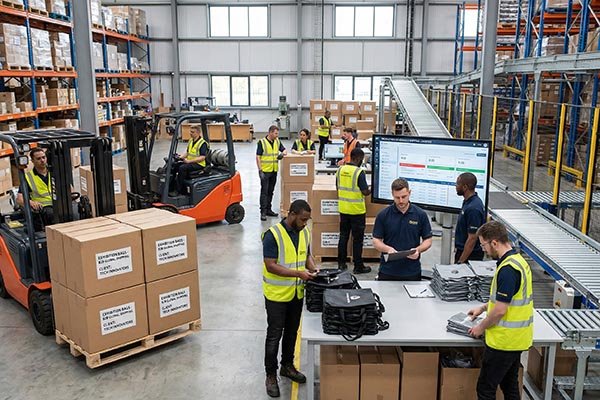
Quantity planning is a math game. Do not just guess. Look at the visitor numbers from last year. If 10,000 people attend, you might get 20% of them at your booth. That is 2,000 bags. Always add a buffer. I suggest adding 10% to 15%. This covers VIP sets, staff use, and unexpected rushes.
Minimum Order Quantity (MOQ) is a big factor. Standard size bags often have a low MOQ, sometimes just 500 pieces. But if you want a custom size or specific color fabric, the factory might require 1,000 or 5,000 pieces. Customization raises the bar.
Time is your most valuable asset. Production usually takes 7 to 20 days depending on the quantity. But shipping takes longer. Sea shipping is cheap but takes 30-40 days. Air shipping is fast but can cost more than the bags themselves.
You also need time for samples. Never skip the sample stage. It takes 3-5 days to make a sample and another week to ship it to you. So, for an international order, you really need to start 3 months before the show.
How Can You Select a Reliable Supplier?
A bad supplier can ruin your event preparation with delays or poor quality. You need a partner who understands strict exhibition deadlines.
Choose a supplier with trade show experience who responds quickly to emails and requests. They must offer pre-production samples and have a clear process for quality control and handling rush orders.

Finding the right supplier is about reducing risk. You want a factory that knows how critical the delivery date is. If the bags arrive one day after the show, they are useless.
First, test their communication. Do they reply within 24 hours? Do they understand English instructions clearly? If they are slow to quote, they will be slow to solve problems later.
Second, ask about their Quality Control (QC). Eric, our typical customer, cares about this a lot. A good supplier checks the raw material before cutting. They check the stitching during production. And they check the final printing before packing. Ask them if they send photos during production. This gives you peace of mind.
Third, check their flexibility. Can they handle a rush order if you need more bags suddenly? Do they offer "Door-to-Door" logistics? For a busy manager, a supplier who handles customs and delivery is worth a lot. Look for a one-stop solution that handles design, production, and shipping.
Conclusion
Planning your exhibition bags requires clear goals, right material choices, and a reliable timeline. Start early and choose a trusted partner to ensure your brand shines.
Frequently Asked Questions
Q: What exactly is the difference between "water-resistant" and "waterproof" for these bags?
A: Non-woven polypropylene is naturally water-resistant, meaning it repels light rain and splashes, keeping contents dry during a quick walk. However, it is not waterproof; if submerged or exposed to heavy downpours, water will eventually seep through the fabric weave.
Q: Can I split my order to ship some bags by air and the rest by sea?
A: Yes, this is a common strategy for urgent deadlines. We can ship a small "emergency batch" (e.g., 500 pieces) via air cargo to arrive in time for the event start, while the remaining bulk order travels by sea to save on logistics costs.
Q: Why do you require vector files (AI or EPS) instead of high-quality JPEGs?
A: Vector files rely on mathematical paths rather than pixels. This means we can scale your logo to any size without it becoming pixelated or blurry. JPEGs often lose quality when enlarged for screen printing screens, resulting in jagged edges on your final bag.
Q: How much weight can a standard 80gsm non-woven bag actually hold?
A: A standard 80gsm heat-sealed bag typically holds about 3-5kg securely. If you choose a stitched (sewn) bag with "X-stitch" reinforced handles, the capacity increases significantly to around 8-10kg, making it suitable for heavy catalogs and water bottles.
Q: Do I need to pay for printing plates or setup fees again for re-orders?
A: Generally, no. If you re-order the exact same design and size within a certain period (usually 6-12 months), we keep the printing screens or plates on file. You only pay for the production and material costs, making re-orders more cost-effective.
Q: Can I wash non-woven bags if they get dirty?
A: You can spot-clean them or hand wash them in cold water and hang them to dry. We do not recommend machine washing or tumble drying, as the heat and agitation can break down the fibers and ruin the bag’s structure and printing.
Q: What is the "Pantone Matching System" (PMS) and why do you ask for it?
A: Computer screens display colors differently. To ensure your brand’s specific shade of blue looks exactly like your corporate logo, we use PMS codes. This is a universal color language that ensures the ink we mix matches your brand guidelines perfectly.
Q: Does the fabric degrade if I store the bags for next year’s event?
A: Non-woven fabric is photodegradable. If stored in a cool, dark, and dry warehouse, they can last for years. However, if exposed to direct sunlight or high humidity for long periods, the material will begin to break down and become brittle.
Q: Can I mix different bag colors in a single order to reach the MOQ?
A: Often, yes. If your logo ink color stays the same (e.g., white ink on both Red and Blue bags), we can usually split the bag colors within one order. If the ink color needs to change, it may be treated as two separate production runs.
Q: What specific information do I need to give for delivery directly to an exhibition center?
A: Delivery to a show floor is tricky. Besides the address, we strictly need the Hall Number, Booth Number, the onsite contact person’s mobile number, and the specific "Move-In Date" window allowed by the venue logistics team.
-
Learning about X-stitching will guide you in selecting bags that can withstand heavy loads. ↩
 English
  Deutsch
  Español
  Português
  Русский
  العربية
  Français
  Italiano
  日本語
日本語  한국어
한국어  Dansk
Dansk